Get all your news in one place.
100's of premium titles.
One app.
Start reading
The Economic Times
The Economic Times

In 1930, US had a $57 million War Plan Red to invade Canada. Nine years before that Canada had Defence Scheme No. 1 fearing an invasion

Canada has reportedly considered the possibility that US President Donald Trump could use the American military to pursue his long-stated goal of making Canada part of the United States. According to The New York Times , Canadian Prime Minister Mark Carney told the newspaper that the possibility could not simply be ignored. Carney did not provide details of any military contingency planning. “I think you have a responsibility in these roles to look at extreme tail risk,” Carney, a former central banker for Canada and Britain, told the Times in an interview published late Wednesday.

Canada and the US remain close trade and military partners. But their relationship has been strained by Trump's trade policies and his repeated comments about wanting Canada to become the 51st US state. The idea of a US attack on Canada, however, is not entirely new. Nearly a century ago, both countries had developed military plans that envisioned a war between the two neighbours.

Canada's Defence Scheme No. 1

Canada created a plan for a pre-emptive attack on the United States in the hypothetical event of a war between the US and the British Empire. Known as Defence Scheme No. 1, the plan was created on April 12, 1921, by Lieutenant Colonel James “Buster” Sutherland Brown, Canada's Director of Military Operations and Intelligence.

Canada was concerned that it could once again become a battlefield after the First World War, particularly as the United States began to replace Britain as the world's dominant power.

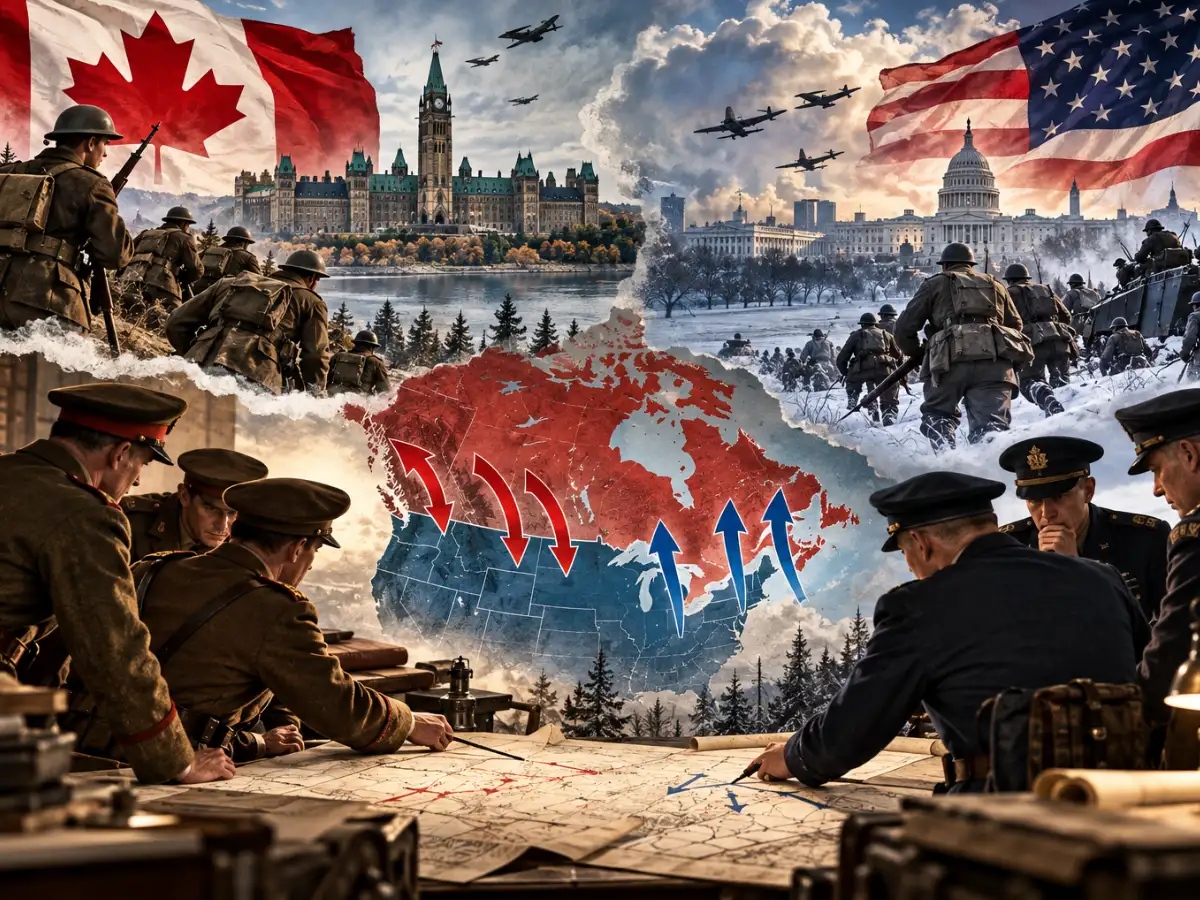
The plan envisaged Canada launching a surprise attack into the northern United States after receiving evidence that America was preparing to invade Canada. Canadian military planners assumed that US forces would initially target Montreal and Ottawa before moving against Hamilton, Toronto, the Prairie provinces, Vancouver and the rest of southwestern British Columbia. The Canadian response was therefore designed to strike quickly and create enough disruption for Britain to mobilise and come to Canada's assistance.

How Canada planned to attack the US

Under Defence Scheme No. 1, Canadian forces would be divided into several rapidly moving columns. Troops from western Canada were supposed to move against Seattle, Spokane and Portland. Forces stationed in the Prairie provinces would attack Fargo and Great Falls before advancing towards Minneapolis. Troops from Quebec would launch a surprise attack towards Albany, while Canadian forces from the Maritime provinces would move into Maine.

The strategy was not to occupy large portions of the United States permanently. Once American resistance became overwhelming, Canadian troops would retreat across the border while destroying bridges and railway lines to slow the American advance. Brown personally travelled deep into the United States, reportedly reaching roughly as far as Vermont, while gathering information for the plan.

According to Maclean's , Brown's strategy involved Canadian forces capturing important American cities, destroying critical infrastructure and withdrawing before a large US force could counterattack. The hope was that the destruction of bridges and railway tracks would delay an American offensive long enough for Britain and the wider British Empire to send reinforcements.

The plan was controversial within Canada's military leadership. Brown's successor reportedly disliked it so much that he ordered copies of the plan to be destroyed. Nevertheless, Defence Scheme No. 1 became Canada's most prominent publicly known plan for a potential invasion of the United States.

America's War Plan Red

Canada was not alone in preparing for a hypothetical war. In 1930, the United States developed War Plan Red, a military strategy for a possible conflict with Britain and its empire in which Canada would have been a major battlefield. Like Canadian planners a decade earlier, US strategists were concerned that growing economic and geopolitical competition between Britain and the United States could eventually lead to war.

Because Canada shared a long border with the United States and was part of the British Empire, American planners considered it a potential route through which Britain could attack the US.

War Plan Red therefore envisioned a rapid American offensive against Canadian territory. As per reports, the United States even spent $57 million on the plan to invade Canada.

How the US planned to attack Canada

The American plan envisaged several simultaneous advances. US forces based around Detroit would move against Toronto, while troops positioned around New York and Vermont would advance towards Quebec City and Montreal. American forces would also seek to secure strategically important areas and prevent Britain from using Canadian territory as a base for operations against the United States. The US plan also envisaged a naval blockade of Halifax, aimed at preventing British reinforcements from reaching Canada

The concern was significant because Britain could potentially draw troops from across its empire in the event of a major war.

The United States later updated War Plan Red. In 1935, the US Congress even approved $57 million funding for preparations connected to the plan, including military infrastructure and exercises. The US also conducted large-scale military exercises that simulated operations against Canada.

The two plans were remarkably similar in one respect: both assumed that a war between the United States and Britain could turn Canada into the main battlefield.

Plans that never became wars

Neither Defence Scheme No. 1 nor War Plan Red was ever put into action. They were contingency plans developed during periods when relations between the United States, Britain and Canada were shaped by very different geopolitical circumstances.

The US and Canada eventually became close military and economic partners, making the invasion scenarios obsolete. But almost a century later, the existence of those plans offers an unusual historical perspective on today's tensions.

Sign up to read this article
Read news from 100's of titles, curated specifically for you.
Already a member? Sign in here
Related Stories
Top stories on inkl right now
One subscription that gives you access to news from hundreds of sites
Already a member? Sign in here
Our Picks
Fourteen days free
Download the app
One app. One membership.
100+ trusted global sources.