
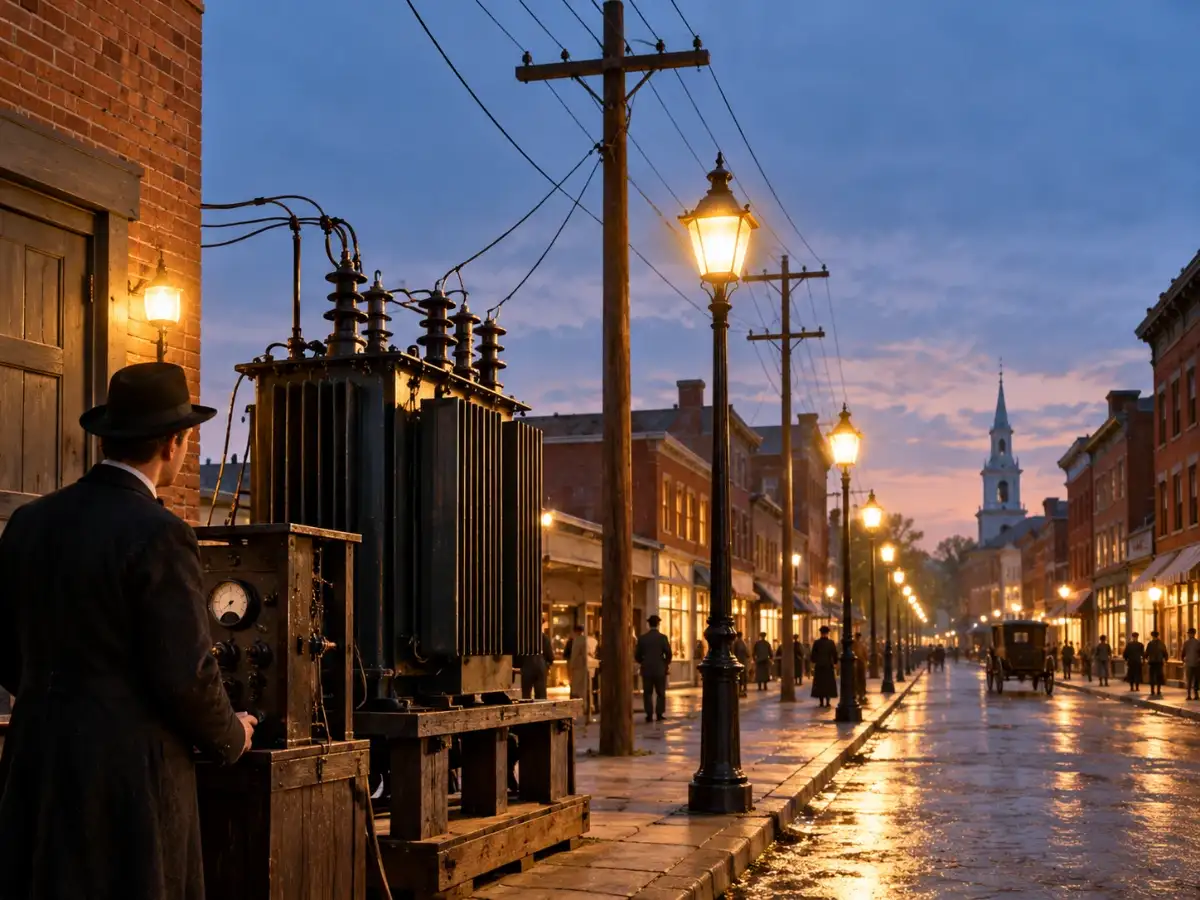
On 20 March 1886, offices and shops along Main Street in Great Barrington, Massachusetts, were lit by an electrical system that helped shape power distribution. Engineer William Stanley Jr. had developed a practical transformer system that allowed electricity to travel at a higher voltage and then be reduced to a level suitable for lighting buildings. The demonstration showed how alternating current (AC) could serve several businesses from a central generating station.
According to the National Inventors Hall of Fame, Stanley's achievement addressed one of the major obstacles facing the early electricity industry: how to distribute power efficiently without delivering dangerously high voltages directly to lamps and other equipment. His transformer design became a model for later systems and helped establish a principle that remains central to electricity networks today.













