
Get all your news in one place.
100's of premium titles.
One app.
Start reading
The Conversation
The Conversation
Tyce DeYoung, Professor of Physics and Astronomy, Michigan State University

I’m a physicist who worked on the Nobel-winning neutrino search – here’s how a cubic kilometer of Antarctic ice became a telescope for ghost particles from space

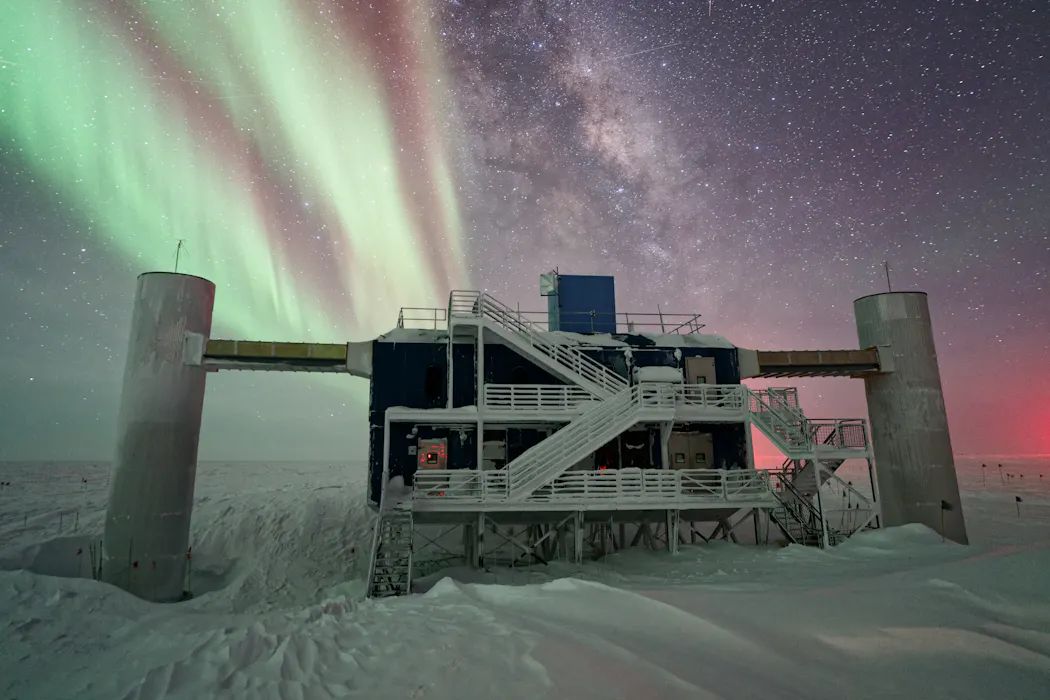
The IceCube observatory sits atop the South Pole's 1.8-miles-thick pure, clear ice sheet. Ilya Bodo, IceCube/NSF

Standing at the South Pole is the next-best thing to being on another planet. If you walk a few hundred yards away from the National Science Foundation’s research station, you see a featureless plain of snow and ice, most likely empty of living creatures larger than microbes for hundreds of miles.

With nothing but snow for sound waves to echo off, there’s an eerie silence. It’s easy to get lost in reverie, contemplating the stark landscape. But then I remember that I’m here for a reason: to work on what may be the world’s weirdest telescope, watching for some of nature’s most mysterious subatomic particles.

Sign up to read this article
Read news from 100's of titles, curated specifically for you.
Already a member? Sign in here
Related Stories
Top stories on inkl right now
One subscription that gives you access to news from hundreds of sites
Already a member? Sign in here
Our Picks
Fourteen days free
Download the app
One app. One membership.
100+ trusted global sources.







