Get all your news in one place.
100's of premium titles.
One app.
Start reading
Euronews
Euronews
Amber Louise Bryce

“I was beside myself when they stopped making iPods”: The people still collecting obsolete tech

Pasquale has a shelf in his house dedicated to old phones, framed by LED lighting that glows like a portal into the past.

His most prized possession is an HTC Dream (T-Mobile G1), a bulky 2008 model that features a slide-out physical keyboard and was the world’s very first Android smartphone.

“It’s a true relic of a tech world that has now disappeared,” the sociologist from Foggia, Italy, told Euronews Next.

Old mobile phones - often called dumb phones - have become increasingly popular in recent years as younger generations in particular seek to reduce their screen time and reliance on algorithmic dopamine.

Between 2021 and 2024, there was a 148% spike in dumb phone sales among 18-24-year-olds, according to a study in the journal Partners Universal Innovative Research Publication.

However, a desire to disconnect isn’t the only reason behind the growing interest in old technologies. Nostalgia - and an urge to experience something more tangible and communal - has fuelled a surge in collectors seeking out everything from retro gaming consoles to iPods and TV sets.

We interviewed four collectors of these now obsolete technologies to find out why, in a world of constant digital advancements, they keep looking backwards.

Peter Fuller: Super 8s, vinyl and iPods

Peter's treasured iPod and an old Sony Walkman - once pinnacles of music-listening tech. (Peter's treasured iPod and an old Sony Walkman - once pinnacles of music-listening tech.)

Peter, a UK-based journalist and leading expert on the actor Vincent Price, doesn’t consider himself a collector, but someone who enjoys using older technologies alongside newer ones.

He’s especially fond of analogue film players and formats, which capture the grainy textures and dreamy ambience of bygone eras.

“I have two Super 8 projectors and a Hanimex E400 dual 8 editor. Plus my dad’s old Super 8 camera from the 1970s, which I used prolifically during my university years to make my first short films,” he said.

Peter is also a self-confessed vinyl junkie - but mostly listens to music on his iPods.

“I was really beside myself when they stopped making iPods (around 2022), which effectively resulted in the demise of standalone music players,” he said.

“Instead, you have to stream everything, which costs money. Of course, that’s not what I want to do. I’ve got my music, I want to listen to it. So that’s why I still rely on the iPod, but also on vinyl.”

Streaming has become a source of frustration for many film and music lovers, who feel it homogenises content and removes the immersive experience of discovering and consuming art. In this sense, utilising analogue technologies is a way to reconnect with media more authentically and reclaim a sense of ownership over it too.

“A record player, an iPod, a Walkman, a mini disc, we will return to them again and again because they’re in our pocket. They are tactile. They’re something that you can actually press a button and listen to rather than be burdened with buffering, annoying ads (now with artificial intelligence voiceovers), subscription payments etc.”

Miles: Vintage gaming consoles and TVs

Miles' large collection of vintage games and consoles have inspired him to host pop-up events. (Miles' large collection of vintage games and consoles have inspired him to host pop-up events.)

Miles, who runs a pop-up event company in the UK called Bring Back Retro, started collecting old video games as a way to cope with grief.

“My Nana passed away, and before she did, she was really well looked after by Ipswich Hospital. I wanted to say thank you to them and the only way that I could think of doing that was to host a 24-hour gaming marathon,” Miles said. “From there, it just kind of escalated into a mass collection of consoles and a few TVs.”

Miles’ love for collecting retro technologies not only became a hobby, but also an occupation - spawning two businesses. One of them involves hosting retro video game events locally, which has allowed gaming to become a more sociable activity - and one that brings generations together.

“We did this one event in a library. There was this 80-year-old lady that had not really played video games before, but she was picking up Sonic 2 on the Mega Drive and just playing it and absolutely loving it. I think she spent the whole day there,” Miles said.

“Kids will also sometimes come up to me at events and go, ‘What is that? Why is that TV making that noise?’ It’s an old sound that adults can't hear but the kids find really annoying, and I find it hilarious,” he said.

For the most part, however, it’s millennials who grew up with these technologies who continue to be most drawn to them.

“I think anyone growing up in the 90s is still kind of gripped by it, wanting to relive that nostalgic time,” he said. “When I'm doing retro events and I have some old TVs set up or something, people will be like, oh I remember I had that TV in my bedroom!’ So it's bringing back those memories.”

Singh Lall: Old film formats and cassette players

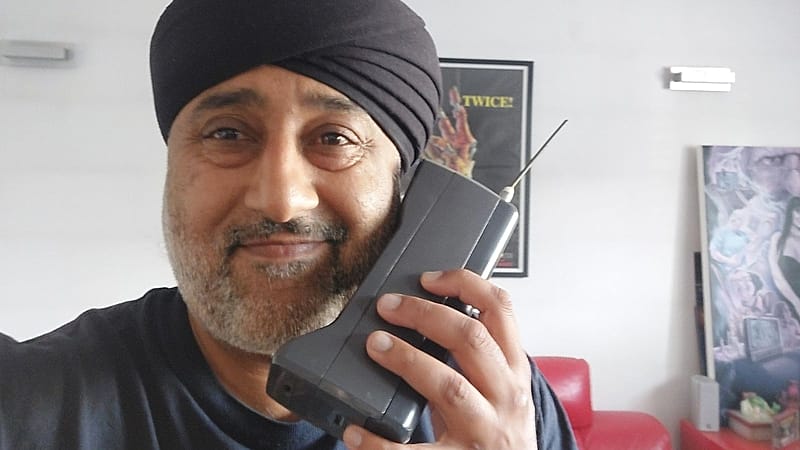
Some of Singh's retro tech collection, which he sometimes displays at film events. (Some of Singh's retro tech collection, which he sometimes displays at film events.)

Mobile phones, games consoles, cassette players - Singh collects it all. But the UK-based business teacher and film producer has a particular affinity for old film formats, including VHS, Laserdisc and Betamax.

His love for these comes from witnessing their evolutions over time, and the aesthetic lure of retro designs and their charmingly hazy visuals.

“The feeling of holding something tactile which is great to look at, illustrates the evolving technology that surrounds us. I use some of my collection at open days for my school to illustrate the point of obsolescence, and how it links with the dynamic markets of business,” he said.

“Placing a pencil next to a music cassette tape baffles teenagers and invokes a great sense of nostalgia amongst parents.”

Singh, like other collectors of old technology, is most drawn to its ties to a pre-digital world.

“We have a complex relationship with technology and we have everything at our fingertips digitally. The resurgence of older technology for me, represents a return to simpler times and less connectivity and reliance on the internet.”

Yet of all his many technological relics, his favourite item remains his first ever mobile phone - a chunky Motorola “brick” from the 80s: “It reminds me how far we have come.”

Pasquale: Retro mobile phones

Pasquale's prized shelf of vintage phones. (Pasquale's prized shelf of vintage phones.)

Pasquale, an active member of the vintage mobile phones subreddit (which has 24,000 members), loves 2000s-era smartphones - especially those that marked the precipice before the iPhone took over.

“For the past few years, I have been collecting smartphones, especially the early models released around 2008–2009. However, not all of them are “vintage” to me. They need to have specific features and unique characteristics. Not every phone holds the same value in my eyes,” he said.

As a trained sociologist, his interest in them isn’t purely nostalgic, but also cultural.

“I assign them a social value, as they once represented status. For example, HTC phones with physical keyboards were typically used by office workers, while Nokia devices were more popular among younger people. Moreover, many of those phones had mechanical structures, builds, and operating systems that no longer exist today. These aspects fascinate me, and I want to collect and preserve them.”

Last year, the Nokia Design Archive was launched by Aalto University in Finland with a similar goal of preserving these now obsolete objects. Representing a time when phones didn’t dominate our lives so much, they also give people like Pasquale an anchor to more optimistic times - when technologies seemed like the future, rather than our demise.

“They take me back to my childhood, to a time when I couldn’t afford those devices, as many of them were quite expensive and exclusive. Technology keeps moving forward and replaces everything - it never goes backwards.”

While this might be true, Pasquale’s collection, and those of the others interviewed for this article, suggest that we’re still not ready to let go of what led us here.

Sign up to read this article
Read news from 100's of titles, curated specifically for you.
Already a member? Sign in here
Related Stories
Top stories on inkl right now
One subscription that gives you access to news from hundreds of sites
Already a member? Sign in here
Our Picks
Fourteen days free
Download the app
One app. One membership.
100+ trusted global sources.