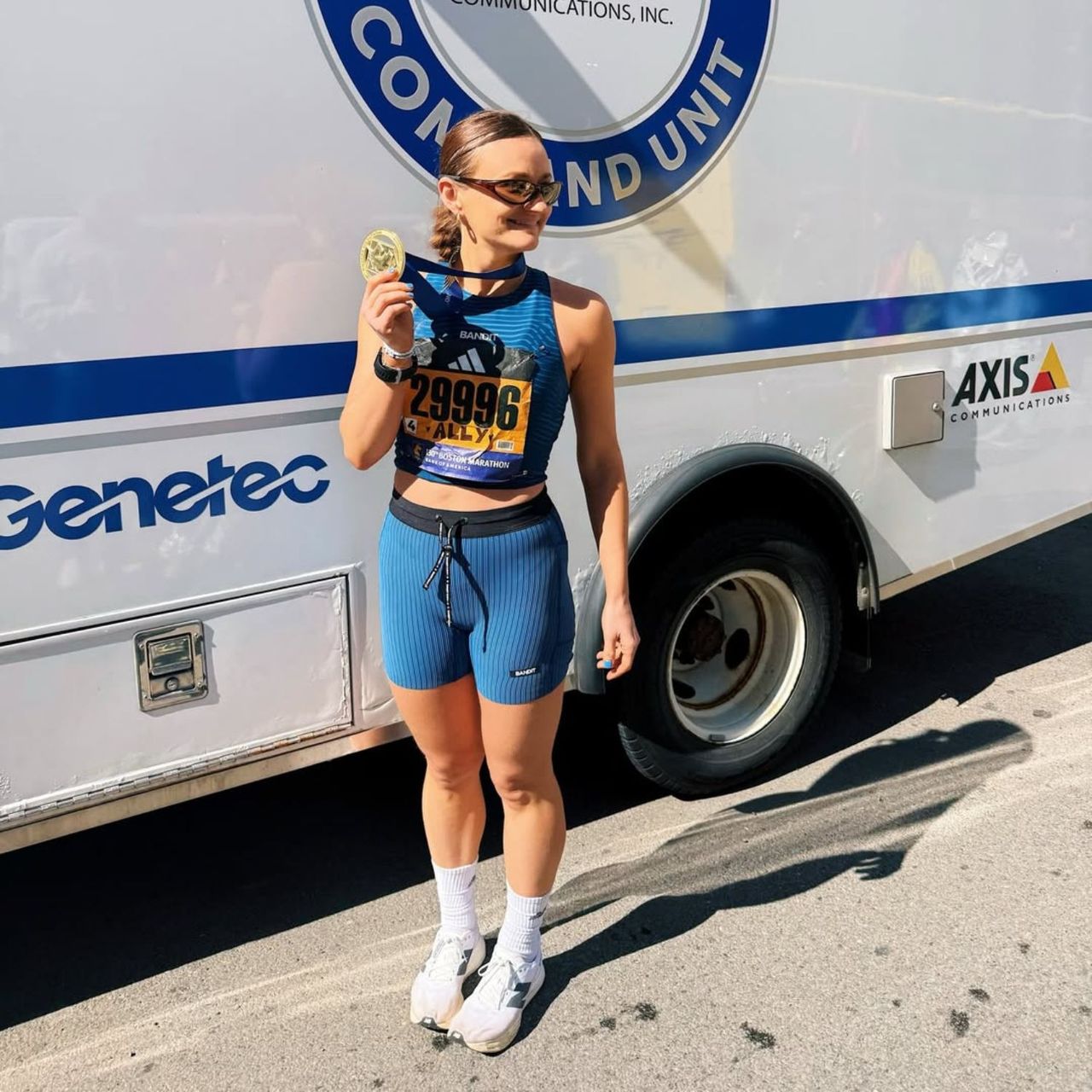
Last month, wearing head-to-toe blue, gels strapped to my waist and star clips in my hair, I ran the 130th Boston Marathon. It was the race of a lifetime; as an eleven-time marathoner, it was everything I could have dreamed of and more. Everything fell into place, and I came away with a shiny new five-minute personal best despite a significant elevation of nearly 1000 metres.
But let’s rewind a little, before I share more of my Boston story - because I’ve been a runner for most of my adult life. It helps me process, unwind, and never fails to boost my mood - it’s changed my life, shaped who I am, and made me lifelong best friends, along the way.
So you can imagine my devastation when, in December 2024, I broke my fifth metatarsal. The doctor’s instructions were clear - rest, ice, and elevation, and no running for a minimum of three months. I quietly started my rebuild - think hours (and hours, and hours) on the indoor bike, more calf raises than I care to count, and plenty of seated resistance band exercises, too. By April, I’d run my first half-marathon. And by December, I was on the start line of the Valencia Marathon, grateful beyond measure to be back doing what I love.
On paper, it’d been a perfect training block and I felt really confident. But the race was the only marathon I’ve run that I haven’t enjoyed. I got a pretty debilitating stitch from around mile six, which escalated into a full abdominal tear. Despite finishing with a PB, I left with more questions than I started with.
Had it been a strength issue? A fuelling error? Or was I simply not cut out for the distance after so much time off? That’s why, when Pamela Nisevich Bede, Global Nutritionist at Lingo by Abbott, reached out to offer her expertise ahead of my 14-week Boston Marathon training block, I leapt at the opportunity. I’d never had a nutritionist on hand to answer my fuelling questions before, and I’d be wearing an in-arm Lingo Glucose Biosensor to monitor how my body was actually processing the fuel I was consuming for my workouts.
To say this process was transformative probably undersells it. I’ve long been a fan of CGMs, wearing them for about twelve months back in 2023 as part of my PCOS journey, but I’d never quite understood how to eat for PCOS alongside fuelling for running (and the PBs I’d worked so hard for). The process with Lingo and Bede taught me exactly how to do it - and, if the five-minute personal best isn’t proof, I don’t know what is.
Let’s get into it.















