The following feature contains excerpts from Blow by Blow: The Jeff Beck Story by Brad Tolinski & Chris Gill, out now via Da Capo.
Iconic guitars aren’t necessarily dime-a-dozen (as proven by the results of Christie’s recent Jim Irsay Auction where several instruments sold for astonishing prices that beat previous records), but they are relatively plentiful as almost every player of note is associated with a particular famous guitar, or several.
However, instances where two or more legendary guitarists are associated with one single guitar are much rarer, with the 1959 Gibson Les Paul Standard that once belonged to Peter Green and Gary Moore (and is currently owned by Kirk Hammett) and the red “Lucy” Les Paul that passed from John Sebastian to Rick Derringer to Eric Clapton to George Harrison being notable examples.
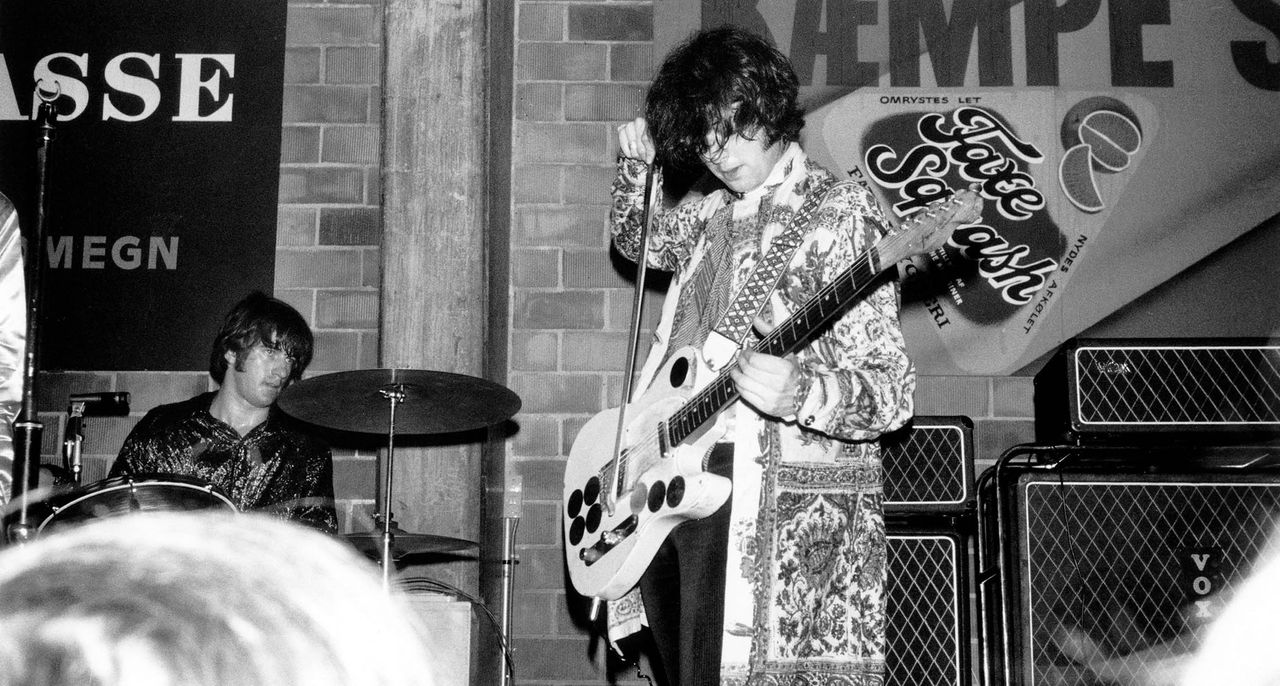
A certain 1959 Fender Telecaster also enjoys legendary “two-timer” status for the roles it played in the early careers of Jeff Beck and Jimmy Page – two titans of the highly influential ’60s British blues-rock triumvirate, which also included fellow Yardbirds alumnus Eric Clapton.
This was the guitar that Beck played as he rose through the ranks of London’s burgeoning blues-rock/R&B club scene during the early ’60s through his beginnings with the Yardbirds and that later became Page’s main instrument on Led Zeppelin’s 1969 debut album and was featured on select later recordings, including the solo for Stairway to Heaven.
How or when this particular 1959 Telecaster ended up in England is unknown, but its earliest known history can be traced to sometime in late 1960 or early 1961 when John Owen purchased it as a used instrument for £107.
This was a late-1959 example, featuring a slab rosewood neck, white eight-screw pickguard, light blonde finish that looked almost white and an ashtray bridge with six holes for top-loading the strings (a short-lived, poorly conceived feature), although the late-’59 model also had holes for anchoring strings through the body.
Owen was a good friend of Jeff Beck during their teenage years, and when Beck got an offer to join a band called the Deltones he accepted only under the condition that they also hire Owen on rhythm guitar.
It was a bold move, but Beck’s loyalty ran deep. Owen had been one of his biggest supporters, often lifting his spirits during moments of self‑doubt. And then there was a more self-serving reason: Beck coveted Owen’s ’59 Tele.
During his tenure with the Deltones, Beck experimented with several different instruments, including a Hofner Futurama III and a 1960 sunburst Fender Stratocaster, the latter purchased in 1961 with his mother’s reluctant help as a guarantor.
Although both were solid, professional-quality instruments, he gravitated toward Owen’s Tele, borrowing it so frequently that it became less of a loan and more of a permanent arrangement. Eventually, Beck convinced Owen to part with it for good, most likely shortly after Beck traded his Strat for a 1953 Ford Zephyr in late 1962 or early ’63.
The ’59 Telecaster remained Beck’s trusty companion as he joined various bands during the early ’60s, including the Nightshift and the Tridents.
“When I first heard Beck, I just thought, ‘What the fuck was that?’” Tridents lead guitarist Mike Jopp, who Beck replaced, later recalled.
“There was this guy with a Telecaster and a Binson Echorec, and the notes were flying everywhere. Nobody at that point was doing anything like it. He was incredibly flashy, pressing the strings behind the nut, detuning them, making sounds that were just otherworldly. He was on a whole different level.”
At some point, Beck swapped the Tele’s original white single-layer pickguard for a black pickguard. Beck idolized the early ’50s black-guard Esquires he first saw as an impressionable 13-year-old in the hands of the guitarists in Little Richard and Gene Vincent’s bands in the film The Girl Can’t Help It. This simple cosmetic modification brought the Tele closer to those guitars of his dreams.
The Telecaster remained in this state when Beck replaced Clapton as the lead guitarist for the Yardbirds in March 1965. The guitar appeared in Beck’s highly capable hands in his early television appearances with the Yardbirds on shows like Ready Steady Go! and Top of the Pops.
It also appeared in a promotional film shot on June 16, 1965, for American television where the band campily mimicked a performance of For Your Love while dressed in Renaissance Faire regalia. Beck played the Tele on his earliest recordings with the Yardbirds, including the seminal raga-rock hit Heart Full of Soul.
When the Yardbirds returned from Paris, where they opened shows for the Beatles on June 20, 1965, the Telecaster temporarily went missing. While on a previous tour with the Walker Brothers, Beck noticed a 1954 Fender Esquire that belonged to Walker Brothers guitarist John Maus.
The Esquire had a blond maple neck – a feature rarely seen on Fender guitars imported to Britain as most Fenders that made their way to U.K. shores were later models with rosewood fingerboards.
Needing a quick replacement for the lost Tele, Beck made a beeline to Maus and bought the Esquire for £75. When Beck later replaced the white pickguard for a black one, he finally had an Esquire that cosmetically matched the ones he lusted after in The Girl Can’t Help It.
When the ’59 Telecaster was eventually recovered, Beck lost interest in it in favor of his new axe. That interest waned even further when Beck bought a 1959 Gibson Les Paul Standard in early 1966 and the Les Paul became his main guitar.
I looked out the window and I saw this blue Stingray outside… and Jeff’s coming out and he’s holding this guitar
Jimmy Page
When the Yardbirds’ newly hired manager, Simon Napier-Bell, distributed funds from a large advance he negotiated for the band from EMI Records, Jeff bought a 1963 Corvette Stingray. The next day he drove it to his good friend Jimmy Page’s house along with the ’59 Telecaster.
“I was still living with my parents at the time in Epsom,” Page said. “And I heard this car come roaring up. I looked out the window and I saw this blue Stingray outside… and Jeff’s coming out and he’s holding this guitar. [I thought] ‘Oh, he’s come to have a play.’
“He knocked on the door and explained that [the Yardbirds] had just done a new deal and he bought the Stingray with it. Then he said, ‘Here, this is yours’ and gave me his 1959 Telecaster. He said, ‘This is yours for getting me in the Yardbirds.’ Well, obviously, I was really moved, you know, because there was a lot of love in that gesture of giving it to me.”
When Beck gave Page the Tele, Jeff had restored it to its original cosmetic appearance by replacing the black pickguard with either its original white pickguard or one he made himself. Later, when Page joined Beck in the Yardbirds – first on bass and soon as a second lead guitarist – he played the Tele with the band. Page perfected his signature use of the violin bow on this guitar while performing alongside Beck.
The ’59 Tele got the first of two significant cosmetic modifications Page performed to the guitar shortly after Beck left the Yardbirds in late 1966. First, Page acquired eight small circular mirrors and glued them to the guitar’s top on the upper bout and below the bridge as well as to the pickguard.
“After Jeff left, I started to think much more about my visual image with the band,” Page wrote in Jimmy Page: The Anthology (Genesis Publications, 2020).
“I wanted there to be more to the Telecaster than just the sound it made. I thought that maybe I could do something with light, maybe reflecting light from the guitar onto the audience to make a kind of kinetic sculpture. It started to become an art piece in its own right.”
I thought that maybe I could do something with light, maybe reflecting light from the guitar onto the audience to make a kind of kinetic sculpture
Eventually, Page decided to make a second, even more dramatic modification to the Tele’s appearance by stripping off its finish, installing a custom reflective pickguard that displayed changing colors under bright spotlights and painting a multi-colored dragon image on the body.
“I painted it in one go over the course of an evening, finishing it the next day,” Page recalled in The Anthology. “The pattern took on the imagery of a dragon. I was quite happy with the way it ended up. Now it was the ‘Dragoncaster.’ I played it on the last Yardbirds recordings at the Anderson Theater in New York and on Led Zeppelin. Once it was created and painted it became like the legendary Excalibur as it traveled from the Yardbirds to Led Zeppelin.”
The “Dragoncaster” became a familiar sight at Led Zeppelin’s early shows up until April 1969 when Page bought a Les Paul Standard from Joe Walsh while the band was on tour in the United States. The Les Paul promptly became Page’s main guitar, and he left the ’59 Telecaster behind at his home after Led Zeppelin returned to England in June 1969.
Led Zeppelin’s North American tour resumed during July and August 1969, and when Page came back home in September he was greeted with an unwelcome surprise from his house sitter.
“It’s a tragic story,” Page told Guitar World in 1998. “When I got back, a friend of mine had kindly painted over my paint job. He said, ‘I’ve got a present for you.’ He thought he had done me a real favor. As you can guess, I wasn’t real happy about that. His paint job totally screwed up the sound and the wiring, so only the neck pickup worked.”
In despair, Page stripped off the paint once again. He managed to repair the wiring and used the Tele for one last hurrah in 1970 when he recorded his solo for Stairway to Heaven. “I salvaged the neck and put it on my brown (string bender) Tele that I used in the Firm,” he told GW in 1998. “As for the body, it will never be seen again!”
That statement led many guitar fans to believe that the guitar had joined the list of legendary “lost Teles,” a rumor that still persists to this day. Fortunately, Page broke his controversial promise in 2019, not only by resurrecting the Tele but also by painstakingly reproducing his original dragon artwork from detailed photos and his own memory.
“It was the Met (the Metropolitan Museum of Art in New York City) wanting to include this guitar in the Play It Loud exhibition that gave me the motivation to get it repainted,” Page wrote in The Anthology. “I’d been meaning to do it at some point but had had so many projects to do and now was the time.”
Later that year, Fender released signature models based on the “mirrored” and “dragon” versions of this legendary 1959 Telecaster, each offered as both a production model and as a limited-edition Custom Shop release.
The Fender Jimmy Page Dragon and Mirror Telecasters were long-overdue tributes to a truly iconic guitar that played a massive role in the historic British blues-rock movement during the ’60s by inspiring the development of hard rock and heavy metal, which made the electric guitar the leading voice of rebellion and free expression ever since.
- This feature contains excerpts from Blow by Blow: The Jeff Beck Story by Brad Tolinski & Chris Gill, out now via Da Capo.
- This article first appeared in Guitar World . Subscribe and save .