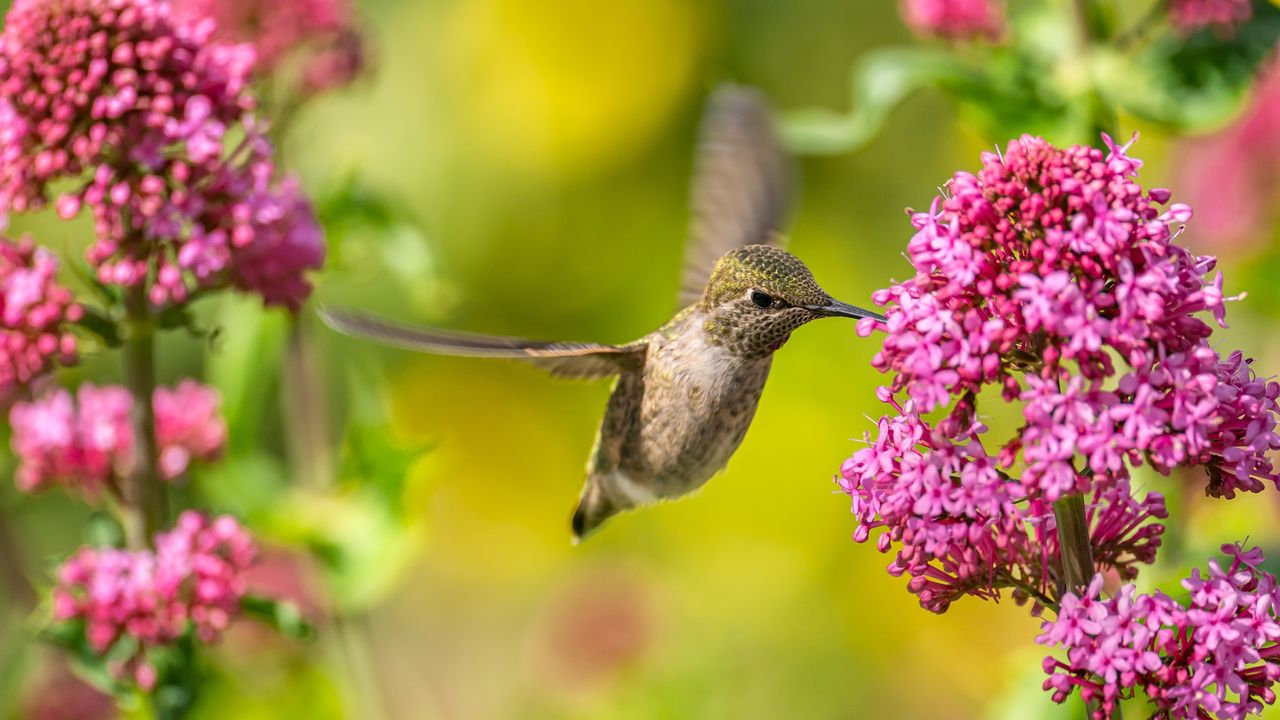
Hummingbirds are beautiful creatures; it's no wonder that nature lovers enjoy seeing them swoop into their yards to feed. These hovering birds are a spectacular sight to behold with their silky plumage and graceful acrobatics.
They don’t just visit your yard for your pleasure; hummingbirds are purposeful creatures in search of food. But rather than feasting on insects and seeds alone, they seek out high-energy nectar from tubular, brightly-colored flowers and feeders.

If you want to create a hummingbird highway in your yard, it helps to know how hummingbirds find feeders and the art of attraction.
A sharp eye

“Most hummingbird foraging is based on sight, as these sharp-eyed birds are looking for flowers that promise sugar-rich nectar, as well as tiny insects that provide protein and minerals,” explains Maria Kincaid, head ornithologist at FeatherSnap.
What’s more, hummingbirds can detect far more than the human eye. “They have four types of color-detecting cones, and in more dense concentrations than humans, which allow them to see colors on the UV spectrum, as well as better see warmer shades like red.”
Although hummingbirds also rely on their sense of smell, their eyesight is far superior, which is why it’s important to put your feeder in a place that can be easily spotted.
“There’s a delicate balance between placing it out in the open enough to be seen, but close enough to perches and other cover that the hummingbirds can rest or get away from danger if they feel threatened,” she says.
Color wise

Red, tubular flowers have adapted to be pollinated by hummingbirds and are therefore highly attractive to them; for this reason, hummingbird feeders are often red.
However, Kincaid explains that although red is a beacon for hummingbirds, it’s not the only color of flower or feeder they’ll feed from. “Anything that will produce nectar is a target. Colors in the red family, like orange, pink, and yellow, are the most attractive to hummingbirds, but they’ll visit purple, blue, and white blooms as well.”
And she also adds, that, despite color being a big attraction, studies have shown that nectar quality and composition in flowers is actually more important to hummingbirds than the color.
Interestingly, Bob Mulvihill, lead ornithologist at National Aviary, says that, unlike hummingbirds, bees are attracted to flowers that are white or blue.
Miraculous memories

Unlike some humans, who have to rely on Google Maps to get from A to B, hummingbirds have an excellent spatial memory, and they are clever with it.
“This allows them to remember what yards have the best flowers and hummingbird feeders, and what territories with abundant nectar and insect populations are best to return to year after year," says Maria Kincaid.
“It also allows them to remember which flowers they’ve fed from recently, keeping them from expending the energy to visit a flower that hasn’t replenished its nectar stores just yet,” she adds.
Hummingbirds are always hungry and easy to attract

If you want to attract more hummingbirds into your yard, there’s some good news. “Because of their small size and very high metabolic rate, it is fair to say that hummingbirds are always looking for food,” says Mulvihill. “And in that quest, they leave no stone unturned — no red thing goes uninvestigated!”
That’s why if you hang up a red hummingbird feeder and fill it with a nectar solution, they will eventually arrive.
Apart from adding a hummingbird feeder to your yard, there are other ways to attract hummingbirds, including planting bright red and orange flowers to your garden and selecting tubular flowers, like the cup and saucer vine.
By understanding what attracts hummingbirds to feeders, hopefully, it won't be too long before you're spotting more of these beautiful creatures in your yard.