Get all your news in one place.
100’s of premium titles.
One app.
Start reading
InsideEVs
InsideEVs
Technology

Hyundai's Atlas Robot From Boston Dynamics: What Is It, Exactly?

This year’s edition of CES in Las Vegas is all about robots and artificial intelligence. One of the biggest headlines came from Hyundai, which announced its plan to integrate 30,000 robots into its car production facilities by 2028—and some of those robots would be humanoids, too. 

With any luck for Hyundai, it's about to cash in some big returns on its 2021 acquisition of U.S.-based robotics giant Boston Dynamics. But what are these robots, exactly, and how do they work?

Hyundai-Boston Dynamics Robotics Display CES 2026

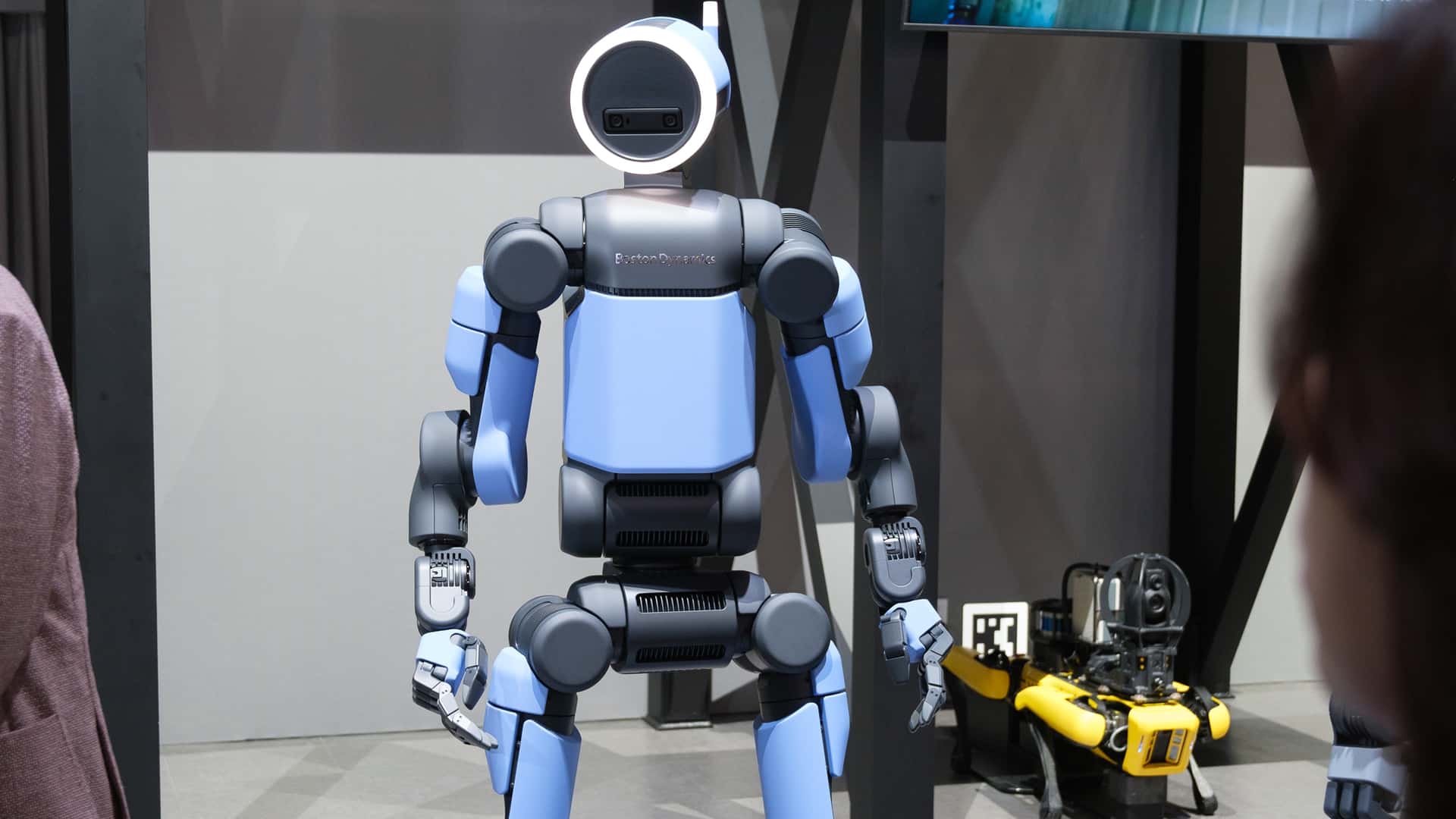
Hyundai's factories already use several Boston Dynamics robots, including the dog-like Spot for quality checks. But the major coup is Atlas—a bipedal robot designed to accomplish tasks in a humanlike way, but with a dexterity no human can match. 

Atlas stands 6.2 feet (1.9 meters) tall and weighs about 198 lbs (90 kg). If it extends its arms, it can reach up to a maximum height of 7.5 ft (2.3 m) and it can lift up to 110 lbs (50 kg), although its sustained lift capability is cited as 66 lbs (30 kg). It can operate in extreme temperatures too, ranging from -4° to 104°F (-20° to 40°C), although doing so will reduce its runtime considerably regardless of its specific battery chemistry.

Thus, it's roughly the same size as a tall adult, but it’s more powerful, can lift and carry heavier loads and has a range of motion in its joints that no human could possibly come close to replicating. In the official presentation videos, Boston Dynamics shows the Atlas bot carrying boxes and the entire side of a car’s shell and also more delicately handling a sun visor.

Atlas is not just designed for heavy lifting. Since it's an evolution of humanoid robot designs that Boston Dynamics has been working on for decades, it goes from the previous version’s hydraulics to electric actuators, which allow for both brute force and finesse. The latter was a problem with the older Atlas models.

Hyundai-Boston Dynamics Robotics Display CES 2026

"I believe actuators are the most critical hardware component that determines a lot of overall performance," said Jaehoon Chang, the Vice Chairman of the Hyundai Motor Group, during a media briefing attended by InsideEVs. But actuators account for "approximately 60% of the total material cost" of ant robot, Chang said. That's where Hyundai's massive manufacturing operations can help build them at scale quickly, executives said. The actuators will be built by in-house supplier Hyundai Mobis. 

Its three “human-scale” tactile fingers allow the bot to pick up small items and place them gently without damaging them. This was an important skill to master, as Atlas was designed to integrate into existing workflows and replace human labor on repetitive, labor-intensive tasks. Its makers say it can handle part sorting, machine operation and generally manipulating and moving stuff from one place to another.

Hyundai CES 2026 Press Conference

In Boston Dynamics’ own factory-style demo, Atlas autonomously moved engine covers from supplier containers to a mobile dolly. It took note of where everything was, planned its movements in real time and adjusted on the fly when something needed correcting by using its cameras and touch/sensing capability.

Stay informed with our newsletter every weekday
For more info, read our Privacy Policy & Terms of Use.

It also scans bar codes, which allows it to handle inventory duties. The bot can be teleoperated remotely through virtual reality if required (just like the prototype shown on the CES 2026 stage), but it is meant to operate autonomously.

Boston Dynamics claims it takes just one day to set up this version of Atlas, it “learns new tasks quickly, adapts to dynamic environments,” and requires minimal human supervision to carry out its set tasks.

Hyundai-Boston Dynamics Robotics Display CES 2026

It's also not unlike an electric vehicle in some ways. Atlas can swap out its battery—including on its own, autonomously. The robot carries two swappable battery packs of undisclosed capacity that it takes out one at a time, so it has power throughout the swap process.

Boston Dynamics says it has a runtime of around four hours, although that will likely drop significantly if its tasks involve a lot of lifting or transporting heavy loads. Its makers say Atlas “is designed for reliability and serviceability,” and it is highly rated for ingress protection, which means it’s completely safe from dust intrusion and fairly protected against water.

It’s designed to observe and work around humans with its 360-degree vision system. Boston Dynamics notes that even though Atlas will try to stay safely away from humans, if they do come close, it “is also designed with padding and minimal pinch points as added safety precautions around people.”

Hyundai has said that it will initially use Atlas for parts sequencing, which basically means they will be delivering parts at the exact place and time that they are needed on the assembly line. Their range of tasks will be expanded in the future.

Boston Dynamics said Atlas is already in production and will enter service at the Hyundai Motor Group Metaplant America, located near Savannah, Georgia, by 2028. The bots will be trained at the Robot Metaplant Application Center (RMAC).

Even if the return on investment promise of Atlas is unclear, it is said to be the first commercially viable humanoid robot, which is a significant milestone in the industry. It will inevitably lead to at least some job losses down the line, although Hyundai executives say that more and different jobs will be needed to service, train and supervise these robots.

But first, it needs to prove itself in an actual work environment before we can gauge how significant a disruption it could actually cause. 

Meanwhile, Hyundai showed off more robotic initiatives at CES, including a robotic arm that charges a self-driving Ioniq 5, and a motorized platform that automatically does all of the parking for you. Whatever happens next, it's clear that the Korean car company is aiming for a much more automated future.

Gallery: Hyundai-Boston Dynamics Robotics Display CES 2026

Got a tip for us? Email: tips@insideevs.com
Sign up to read this article
Read news from 100’s of titles, curated specifically for you.
Already a member? Sign in here
Related Stories
Top stories on inkl right now
One subscription that gives you access to news from hundreds of sites
Already a member? Sign in here
Our Picks
Fourteen days free
Download the app
One app. One membership.
100+ trusted global sources.