
Get all your news in one place.
100's of premium titles.
One app.
Start reading
Space
Space
Science
Keith Cooper

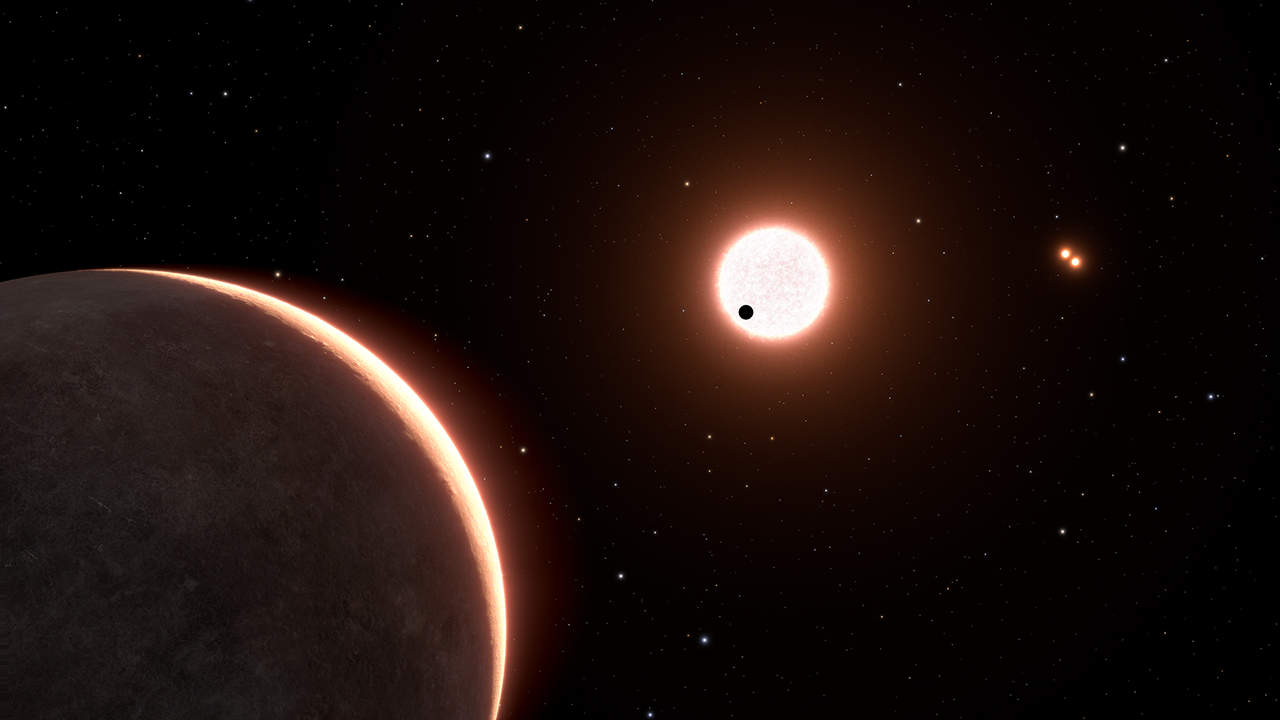
Hubble Telescope investigates nearby exoplanet, finds it's Earth-size

An artist's illustration of space in which a large orb is seen toward the bottom right. Farther out, there's a bright orb representing a star, and in front a small black dot representing a transiting planet. Two smaller bright dots are seen far away, representing other stars.

The Hubble Space Telescope has measured the diameter of the nearest transiting exoplanet to us, discovering that it is a rocky planet very similar in size to Earth. Unfortunately, however, the world's surface is far too hot to support liquid water or life as we know it.

The planet, known as LTT 1445Ac, was first discovered in 2022 by NASA’s Transiting Exoplanet Survey Satellite (TESS). LTT 1445Ac orbits a cool M-dwarf star that is just a quarter of the mass of our sun; the star itself is found in a triple system of M-dwarfs located 22.5 light years away in the direction of the constellation of Eridanus, the River. LTT 1445Ac is joined by two other planets in the triplet, LTT 1445Ab and LTT1445Ad, both of which orbit farther out.
Sign up to read this article
Read news from 100's of titles, curated specifically for you.
Already a member? Sign in here
Related Stories
Top stories on inkl right now
One subscription that gives you access to news from hundreds of sites
Already a member? Sign in here
Our Picks
Fourteen days free
Download the app
One app. One membership.
100+ trusted global sources.