
Get all your news in one place.
100's of premium titles.
One app.
Start reading
LiveScience
LiveScience
Ivan Farkas

Hubble telescope discovers 'Cloud-9,' a dark and rare 'failed galaxy' that's unlike anything seen before

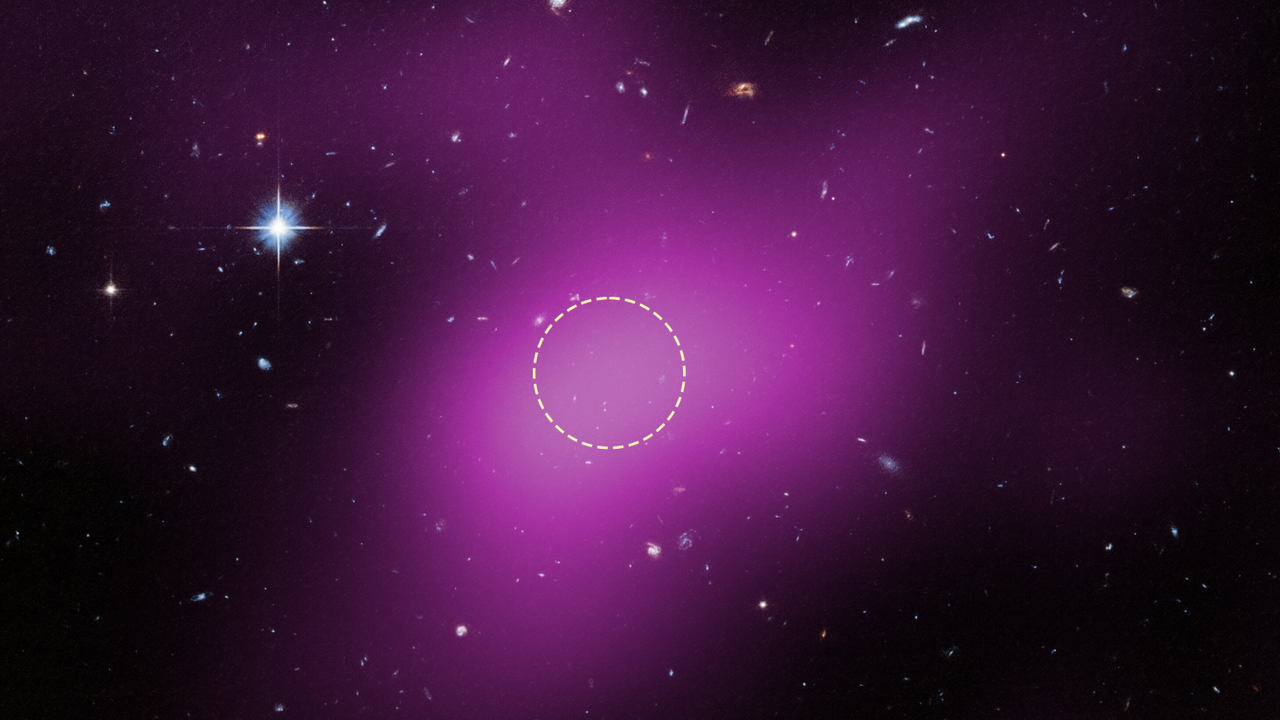
A region of space mostly filled with background galaxies, with one prominent star at upper left. A large blob of purple haze occupies much of the field. Within the purple region, an unremarkable area is outlined with a dashed white circle.

Astronomers using the Hubble Space Telescope have just spotted a new type of celestial object: Cloud-9, a starless, gas-rich cloud of dark matter that was slightly too light to become a full-fledged galaxy.

As detailed in a study published Nov. 10 in The Astrophysical Journal Letters and presented this week at the 247th meeting of the American Astronomical Society in Phoenix, this odd object is located more than 14 million light-years from Earth, near the spiral galaxy Messier 94 (M94). Cloud-9 is a cosmic relic, a primordial building block of galaxies that confirms the critical mass threshold needed for a body of gas and dark matter to collapse into a galaxy.

Sign up to read this article
Read news from 100's of titles, curated specifically for you.
Already a member? Sign in here
Related Stories
Top stories on inkl right now
One subscription that gives you access to news from hundreds of sites
Already a member? Sign in here
Our Picks
Fourteen days free
Download the app
One app. One membership.
100+ trusted global sources.