The global transition to portable computing has created a secondary crisis often overlooked by corporate ESG (Environmental, Social, and Governance) strategies: the illicit resurrection of lithium-ion waste. As we navigate the technological landscape of 2026, a "dead" laptop battery is no longer merely a chemical disposal concern. It is a high-value asset for a sophisticated black market that specializes in the deceptive refurbishment and resale of exhausted cells.
To the untrained eye, a battery is a simple plastic brick. To a "scrap pirate," it is a vessel of lithium-ion cells that can be harvested, electronically manipulated, and sold back to unsuspecting consumers. This article examines how to properly handle end-of-life (EOL) batteries to ensure they are permanently removed from the supply chain, protecting both the environment and global safety standards.
When a consumer drops a battery into a retail recycling bin, they assume a linear path to destruction. However, the global e-waste supply chain is notoriously "leaky." The CEO of StoreShoppe, has witnessed this firsthand. He notes that a staggering volume of electronic waste flows back into the market from overseas recycling hubs. "Innocent-looking scrap shipments are often diverted at the port," he explains. "Unscrupulous vendors intercept these units, selecting those with physical integrity to be 'reborn' through unauthorized repair."
This is not a localized issue. Dr. Vanessa Forti, a leading researcher on global e-waste statistics, has frequently pointed out that only a fraction of e-waste is documented as being collected and recycled through formal channels. The "undocumented" remainder provides the raw material for a multi-billion dollar refurbishment industry. When a battery is not physically or digitally decommissioned before disposal, it remains a "live" asset that can be exploited for profit.
The danger of these "zombie" batteries cannot be overstated. Lithium-ion chemistry is subject to "dendrite" growth—microscopic, needle-like structures that form on the anode over time. Even if a battery is electronically reset to show 100% health, these internal physical degradations remain, creating a significant risk of internal short-circuits and thermal runaway.
The Anatomy of Battery Fraud: Firmware Hacking and Aesthetic Deception
The most insidious aspect of the battery black market is the manipulation of the Battery Management System (BMS). Every modern laptop battery contains a sophisticated microcontroller that acts as a "black box," recording cycles, voltage fluctuations, and health metrics.
Kyle Wiens, the founder of iFixit and a vocal advocate for the Right to Repair, has often highlighted the "software locks" present in modern hardware. While these locks are intended to ensure safety, they have inadvertently created a market for hacking tools. Black-market workshops use proprietary software to access the battery's EEPROM (Electrically Erasable Programmable Read-Only Memory). They can force a "reset" on the cycle count, effectively lying to any laptop that the battery is connected to.
The Illusion of Originality
Once the internal "brain" is hacked, the physical "body" is given a makeover. Avery Sun, a supply chain analyst specializing in Asian electronics manufacturing, notes that the forgery of OEM (Original Equipment Manufacturer) labels has reached a state of near-perfection. "Scammers use high-resolution thermal printers and counterfeit UV-reactive inks to replicate the security stickers of brands like Dell, HP, and Apple," Sun explains.
When these batteries are re-sleeved in fresh PVC and placed in a forged box, they are indistinguishable from genuine stock to a standard consumer. The analytical reality is that the chemistry inside is exhausted, but the digital interface and the outer packaging scream "brand new." This is a fundamental breach of consumer trust and a direct violation of international trade safety standards.
Physical Decommissioning: Strategies for Permanent Neutralization
To protect the market, the user must ensure the battery is no longer "fit for purpose" before it enters the waste stream. This requires moving beyond passive recycling to active decommissioning.
Mechanical Defacement
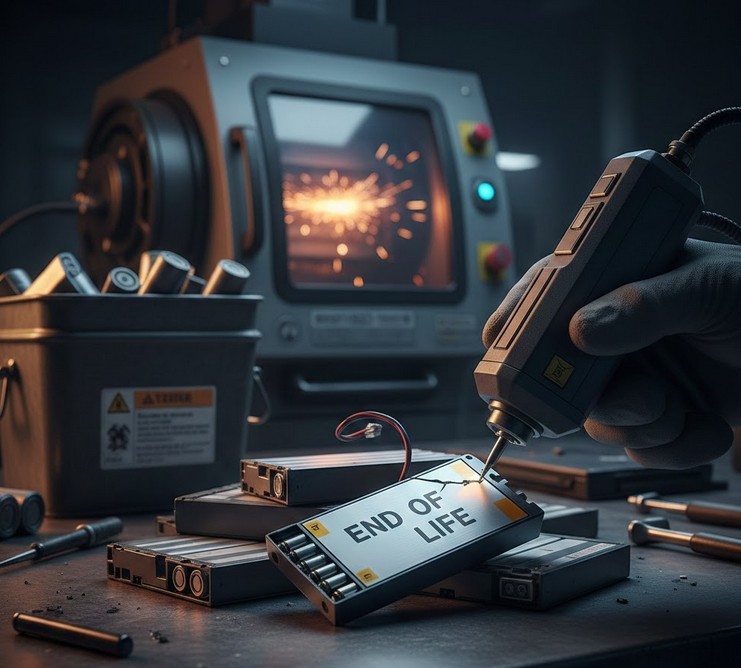
A key strategy recommended by industrial security experts is the permanent defacement of the battery's contact points. Corey Dehmlow, an expert in high-stakes electronics recycling, suggests that damaging the proprietary interface—the plastic fins or the gold-plated pins that connect the battery to the laptop—is one of the most effective ways to lower its resale value.
If a refurbisher has to replace the entire connector assembly, the labor cost often exceeds the potential profit from the sale. Furthermore, using a tungsten-carbide scribe to etch "SCRAP/EOL" directly into the plastic casing ensures that the unit can never be sold as "Grade A" or "New" stock. This "marking" protocol should be standard for any IT department handling more than ten units per year.
The "Bricking" Protocol
Digital neutralization is equally important. Some manufacturers have begun implementing "Self-Destruct" bits within the BMS. When an authorized technician flags a battery as defective, the system can send a command that permanently blows an internal fuse on the logic board. While this doesn't stop a dedicated hacker from replacing the board entirely, it adds another layer of cost and complexity to the refurbishment process.
Personal Insight: In my years of auditing hardware lifecycles, I have found that the most secure organizations treat batteries like hard drives. They don't just "recycle" them; they "sanitize" them. This includes a documented chain of custody and physical verification that the battery has been rendered inert.
Navigating the Recycling Labyrinth: Vetting Downstream Partners
Where your battery goes is the final frontier in preventing its return to the market. Not all recyclers are created equal. Many operate as mere "aggregators," who buy waste and sell it to the highest bidder, regardless of the bidder's intent.
Jim Puckett, Executive Director of the Basel Action Network (BAN), has been a pioneer in exposing the "global e-waste shell game." He emphasizes that the e-Stewards certification is the only standard that truly prohibits the export of hazardous electronic waste to developing countries for "informal" processing.
Identifying the "Scrap Pirate"
A legitimate recycler will operate with a high degree of transparency. They should be able to provide a Certificate of Destruction (CoD) that includes the serial numbers of the batteries processed. If a recycler cannot or will not provide this, they are likely a broker.
Brokers are the primary facilitators of market leakage. They look for "functional scrap" that can be sold to "repair centers" in regions with lax safety regulations. Dr. Sahadat Hossain, a researcher in sustainable waste management, argues that "the lack of a standardized global tracking system for lithium-ion units is the black market's greatest ally." Until such a system exists, the burden of vetting falls entirely on the consumer and the corporation.
The True Cost of "Free" Recycling
Many retail "drop-off" programs are convenient, but they often lack the security of a direct-to-smelter contract. For sensitive or high-volume disposals, it is always safer to pay for a certified industrial recycling service than to rely on a free consumer-facing bin. In the world of hazardous waste, you often get the level of security you pay for.
Conclusion: Building a Transparent Circular Economy
The fight against the re-utilization of spent laptop batteries is a battle for the integrity of the circular economy. As we look toward the 2027 regulatory environment, we see a push for "Battery Passports"—digital ledgers that track a battery from its birth in a cobalt mine to its final destruction in a smelting furnace.
However, until these high-tech solutions are universal, the responsibility rests with us. The StoreShoppe CEO's warning serves as a vital reminder: the electronics we discard do not simply vanish. They are either recovered as raw materials or resurrected as dangerous counterfeits.
By adopting a rigorous decommissioning process—comprising physical marking, BMS neutralization, and the use of e-Stewards certified recyclers—we can effectively starve the black market of its raw materials. We must shift our perspective from seeing a battery as "trash" to seeing it as a "hazardous asset" that requires a controlled end-of-life strategy.
In doing so, we don't just protect our laptops; we protect the global supply chain from a cycle of deception that compromises safety, ethics, and environmental progress.