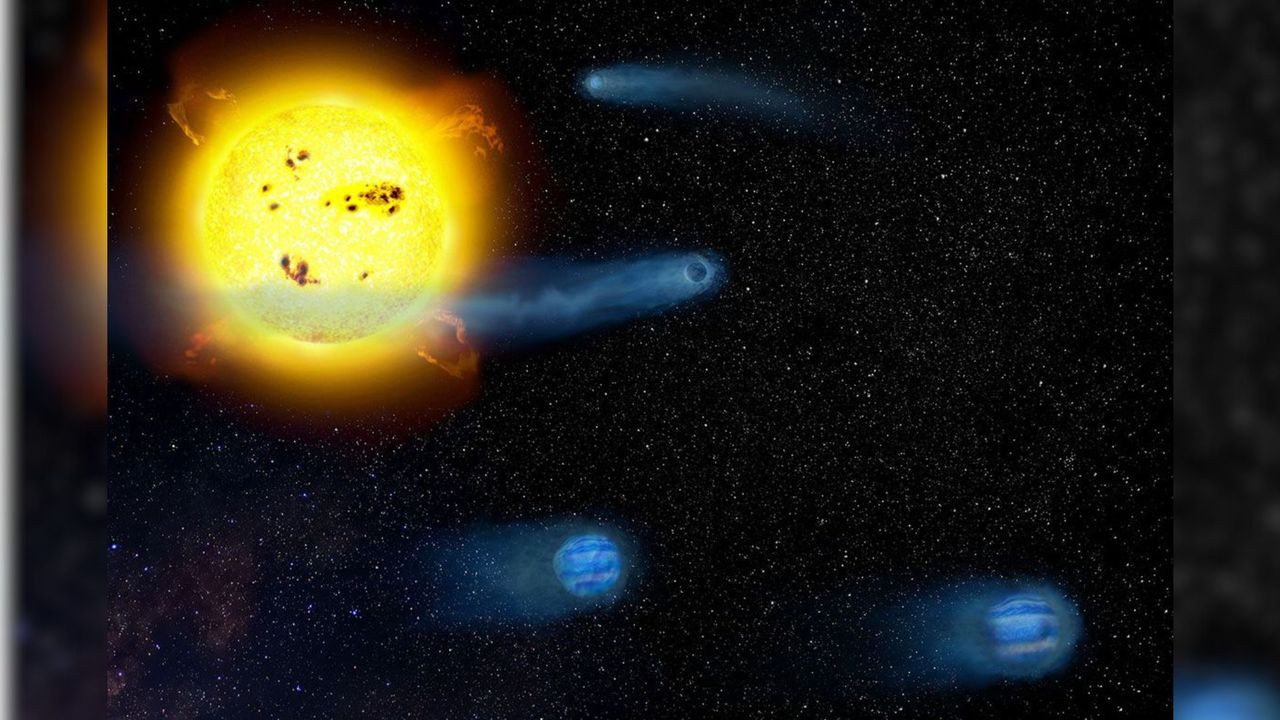
The secret behind the formation of super-Earth and sub-Neptune exoplanets has been revealed, thanks to a study of four young planets that are evaporating.
Some 350 light-years away, the V1298 Tau system features an infant sun-like star, just 23 million years old, orbited by four planets on compact orbits close to their star, and all of which are seen to transit. Discovered in 2019 by astronomers Erik Petigura of the University of California, Los Angeles and Trevor David of the Flatiron Institute in New York, using data from the Kepler space telescope's K2 mission, the four planets are huge, with radii between five and 10 times that of Earth.