
Get all your news in one place.
100's of premium titles.
One app.
Start reading
Livingetc
Livingetc
Amiya Baratan

How to Get Your Taste Back — In a World Flooded with AI-Generated Interiors, Here's What Really Matters When Designing a Space That Feels True to You

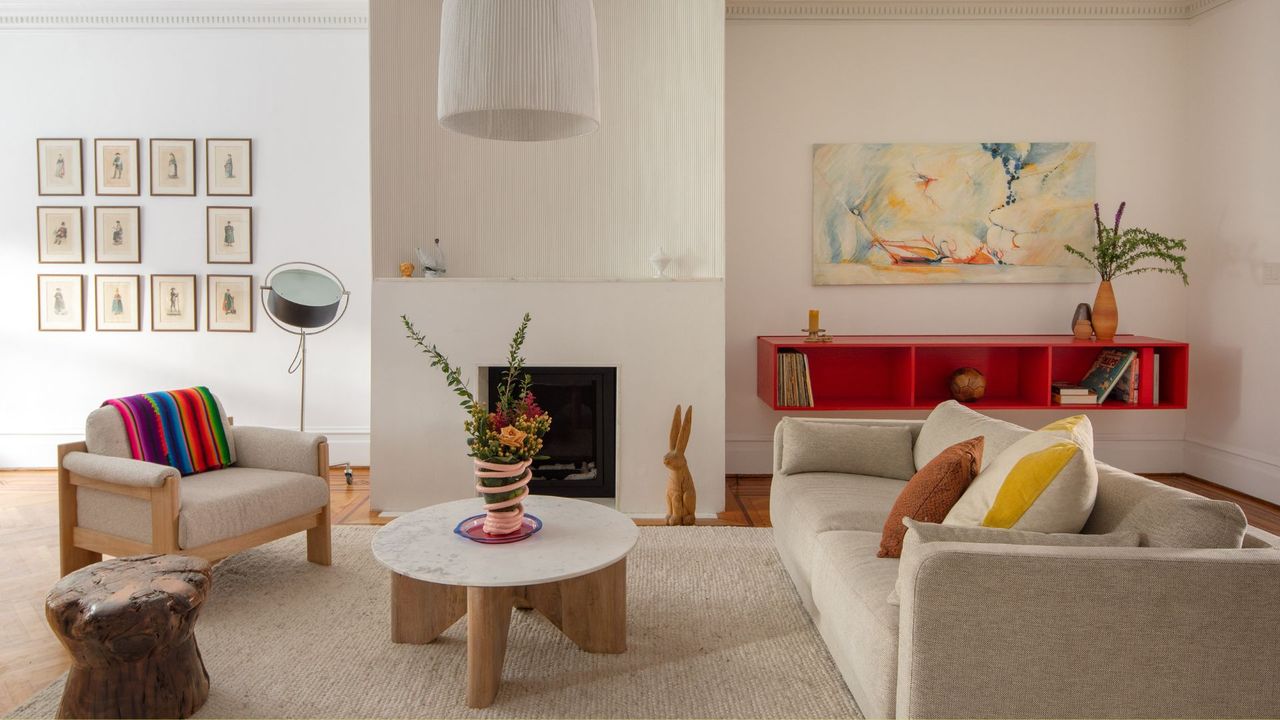
A white living room with a beige sofa, colorful pillows, a round coffee table, a beige armchair with a colorful striped throw, a side table, a wooden bunny, a floating orange sideboard and framed art.

I've been catfished by AI-generated design more times than I'd like to admit of late. Now you'll see me zooming for the shadows, calling out the overglossed finish, and looking for the subtle distortions that reveal the smoke and mirrors. And in a recent conversation (read: rant) about AI labels everywhere I look, I found myself spiralling into the thought: 'Is my taste my own?' Or is it the spoon-fed and forced down my feed content that has consumed me?

You can't escape the haze of polka dots (typically blue and brown), the admittedly pretty but almost mainstream green garden furniture, and the warmth of glossy butter yellow dripping into every surface. While I can admire the allure of each of these aesthetics and acknowledge my participation in more than one of these trends, it has led me to want to avoid copycat interiors.

Maybe it's friction-maxxing or some sort of quarter-life crisis setting in, but I'm on a serious mission to reclaim my taste. So, I reached out to tastemakers I genuinely admire to lend some advice on wiping the style slate clean and building it brick by brick. And here's why it's important to find your own eye.

Why Is Personal Taste the Need of the Hour?

Straying from your feed to seek out your real style might be tough at first. But when you find a real connection, the kind that you'll feel in your bones, it'll make the discomfort worth it. (Image credit: Jeremy Wilson. Design: Marianne Tiegen)

"Taste is meant to be your point of view," says designer Afaf Seyam, or Zeopatra, as you might know her from her Brain Candy series. "Good taste or bad taste is subjective, so really it's important to develop a skill in being able to 'read the room'."

She explains that personal taste is important as a filter for your own life. "It's necessary to determine what you truly like. AI can amplify anything, but the results can all still be garbage if it's not filtered by the right person," she says.

"AI doesn't have that magical intuition that people have to take something, change the context, and give it new meaning. Even before AI, 'handmade' always felt special. Human-made will become the new handmade. And in that same vein, being human-thought or human-curated will feel more artistic and impressive than ever before."

She goes on to say that framing your own taste, be it within interior design styles or otherwise, is important because otherwise you end up becoming a sheep following the scent of AI-optimized everything. "Life is a lot less interesting when things become repetitive. Being able to make your own decisions regardless of popularity, name brands, and price points, helps you create excitement in your life and build a slow, meaningful collection of things."

Mix your metals, layer bold patterns, and experiment with famously opposed colors to see what works for you. (Image credit: Six Dots Design)

Upon asking Joseph Ellwood, founder of the curiously cool Six Dots Design, about the importance of taste, he references the internet's latest source of intrigue — 'looksmaxxing influencer' Clavicular. "When asked why he was subjecting himself to extreme and sometimes dangerous practices to pursue his own beauty, Clavicular had no answer," he recounts.

"I think we have become so obsessed with progress, removal of problems, and personal development that we have completely lost sight of why we were pursuing a 'better' life in the first place."

And this ties into the way we shape our taste. When your home is covered from ceiling to floor in every interior design trend that was served up to you, you will eventually find yourself wondering whether you're even at home in your own house.

"Taste to me is a pure form of self-expression. If we don't exist to share our own perspectives or bring our unique viewpoint to the world, then why aren't we just drones?" he probes.

"To be human is to hate bouclé but love garden gnomes. Frida Kahlo felt that her house (Casa Azul) was not about decorating but about a declaration of principles. We can't AI our own principles or beliefs, they need to come from within, our interiors, our art, and our humanity are expressions of those principles in physical form."

And if that has convinced you to go off the beaten path and collect fragments of your own inspiration, even if it leads back to traditional styles, then here's how to get your taste back.

How to Get Your Taste Back

Step one is deciding to wipe the slate clean and create your palette of inspiration from scratch. (Image credit: Clinton Weaver. Design: Studio ZAWA. Styling: Claire Delmar)

"AI is extraordinary at remixing what already exists. It can draw from every reference at once and generate something that looks right. But looking right and having a point of view are two different things," says Anne Valois, creative director and founder of The Taste Files. "Taste is the conviction to commit to a choice even when current trends don't agree, and that's something an algorithm can't replicate."

So, from curating moodboards to connecting your home to your life and paying attention to the real world while questioning it all, here are some helpful ways to reclaim your taste.

1. Create Folders of Inspiration

"Start folders and categorize items based on why you like them," says Afaf. "It can be by category, color, material, whatever. Red things, glitter things, marble things... Your instincts about what excites reveal everything."

One of my favorite ways to bring this into my routine is to turn it into an offline ritual. My medium of choice is a junk journal, and anything goes. Cut-up cans that caught my eye, a handwritten bill from a lunch with friends, and even torn spreads from magazines that made me feel something. Escape the algorithm. Flick through design books, rather than scrolling.

2. Build Beyond Your Own Field

Artistic disciplines , like ikebana, can serve as inspiration for fashion, art, or even just interiors, depending on how you look at it. (Image credit: Octavia Flowers)

"If you're into interiors, don't just look at interiors," says Anne. "Watch how a film uses light, listen to how a playlist changes the energy of a room, pay attention to why a certain building makes you want to stay. The most interesting taste tends to come from connections between things that don't obviously belong together."

Afaf also recommends looking at everything, saying: "Fashion, films, nature, packaging, cultures, and religion. Just paying attention to how things are done and your feelings towards them is eye-opening. It's important to know what you like and what you don't like."

Take a look at how the set design foreshadows the meltdown to come in The Drama, or watch butter yellow get a grim facelift in Backrooms. It's important to look past the obvious to forge growth.

3. Connect to Your Past, Present, and Future Self

Note Joseph's, dare I say, ancient Mac propped upon a material manifestation of his own taste. (Image credit: Six Dots Design)

"I think, firstly, it's worth saying that to have taste is a privilege. To have a style or preference for your clothes or interior decor means that you have enough time, energy, and money to explore and invest in pieces that express that style," says Joseph.

"It's easy to design in the image of what other people are saying is cool or in style. My philosophy is to celebrate objects that you feel speak to your past, present, or future. I have a collection of old Apple computers and a small wooden log on a shelf in my house."

The computers of a bygone era speak to Joe's fascination with the design language of Apple in his early teens, and the wood was a gift from a past employer who taught him how to make furniture.

"These individual elements are like pixels on a screen that slowly build a picture of the life I live and the life I hope to live," he says. "In a corrupt, confusing, and rapidly changing world, I think it's more important than ever to hold on to our humanity in all its contradiction and imperfection. In this battle, I think that objects, interiors, and art are the first frontier."

4. Pay Attention to the Real World

What do you see? For me, it's the edge of the brat summer green marrying the almost childlike wonder of a waning afternoon. (Image credit: Nicholas Venezia. Design: One With_. Architecture: ON-Architects)

Anne's advice is just this — slow down. "Most people scroll past the things that could actually shape their perspective," she says. "When something stops you — a space, a detail, a feeling you can't quite name — sit with it long enough to understand why. That's where taste starts."

And if you're not completely anti-AI, Francis Aguillard, founder of One With_, explains that AI is a powerful tool. "How we wield it is where its power lies. To that end, we should use AI to test out creative ideas that first arise in our minds, triggered by the world," he notes.

"Let yourself dream away from the machinery: stare at clouds, talk with friends, swim in the ocean, and marvel at the way a caterpillar inches across a leaf in all its squishy glory. Practice becoming one with your surroundings. In these very human moments, you'll find your taste(s), literally and figuratively!"

A dreamy example of how living in the real world can impact the way you shape your home is komorebi. The dappled light in your favorite park could be a part of your design story if only you stop and take in the atmosphere around you.

5. Question Everything

Take your rug and hoist it on a wall, frame your flowers, and celebrate the smudge of a champagne cork housewarming ritual. You'll never know until you try. (Image credit: Annika Kafkaloudis. Design: Without Studio)

This is a change that has made me realize how many facets of my life have been moulded just because. Questioning the colors you like, the decor you have, and the art on your walls is important.

It might make you feel uncomfortable, but it will help you discern which spaces in your home are a result of going with the flow from the corners that you genuinely connect with.

I've dressed my life in minimalism for so long. However, in part to working for a contemporary magazine and also to pushing my boundaries, I've realized that I love layering a neutral foundation in maximalist pockets. And the road to that discovery involved picking my taste part and pulling at the strings to find where it began.

Think an unexpected pop of red, a piece of hairy furniture, or a jolie-laide magnet display on a fridge. There's a lifetime of nuanced takes on trends waiting to be stretched, inked, and peppered into your home.

Recent Homewares That Have Inspired Me

On my journey to test my taste, I found myself taken by this Tables Mates Resin Cutlery Placemat from the genius of Fish Design by Gaetano Pesce.

Taking Joseph's advice to connect with my past, this kintsugi-d plate reminds me of my grandmom's china collection melded into a single piece.

This murano glass is reminiscent of an old cup streaked with dried swirls of paint sitting on my nightstand. Except, I can drink out of this one.

Drawn-on decor has been on my brain, and this fabric coaster set from Solar Club x H&M is an understated way to tap into it.

I can't stop thinking about this soap bar from Mienne. This inky black color and the idea of soap don't mix in my mind, but this makes me question why not.

I still prefer a sense of order while I try my hand at silly-maxxing. And this candle holder catch-all from Design Letters caught my eye.

Now picture the candle holder with this Dryp Candle from Ferm Living and its blue wax peeling with every passing light.

I love the idea of hanging this on a bedroom door. Or even in a quiet zone like a reading nook or a wellness room.

I always wanted a beaded curtain growing up. And this colored bamboo version from Urban Outfitters feels like an ode to a childhood chapter that never was.

"AI can generate endlessly, but it can't tell you what's worth creating and worth keeping. The skill that matters now is something editorial. Knowing what to pay attention to, what to discard, and what actually deserves to exist," says Anne. "That kind of discernment requires a point of view, and a point of view requires lived experience. AI doesn't have either."

On that mic drop, if you want ideas formed by humans to lend to your process of finding what works for you, the Livingetc newsletter is the place to be. And while you go on this journey of self-discovery, might I introduce you to sillymaxxing? The name might be corny to some, but the concept is very real.

Fish Design by Gaetano Pesce Tables Mates Resin Cutlery Placemat Seletti Kintsugi N3 Porcelain & 24ct Gold Dinner Plate LAGUNA~B Fantasia Medium Murano Glass Solar Club x H&M 4-Pack Embroidery-Detail Coasters Mienne Bar Soap Design Letters Candle Holder Ray Ferm Living Dryp Candles - Set of 2 Anthropologie Do Not Disturb Door Plaque Urban Outfitters Iris Bamboo Curtain
Sign up to read this article
Read news from 100's of titles, curated specifically for you.
Already a member? Sign in here
Related Stories
Top stories on inkl right now
One subscription that gives you access to news from hundreds of sites
Already a member? Sign in here
Our Picks
Fourteen days free
Download the app
One app. One membership.
100+ trusted global sources.