A lot goes into choosing the right mattress for your individual needs. The right pressure relief, comfort and support are key, but with so many mattresses to choose between, can our sleep style be used as a guide?
Here, we focus on back sleeping specifically, speaking to the experts for the lowdown on choosing the right mattress for your sleeping position, including physiotherapists, sleep physiologists and mattress specialists.
“If you're physically feeling uncomfortable in your bed and you just can’t get comfortable, it’s probably an indication that you need to ask questions about your mattress and whether it's right for you”, says sleep physiologist at Land of Beds Dr Nerina Ramlakhan. “Another sign is pain in your body when you wake up.” In the case of back sleeping, she says you might feel pain in the lower back, shoulders or hips.
With this in mind, if the time has come to replace your mattress, keep reading for what you need to know as a back sleeper, according to experts.
Read more: How to choose a mattress for side sleepers, according to experts
Mattress firmness for back sleepers
“A medium mattress is usually the best for people who sleep on their back”, says physiotherapist Nell Mead. This is owing to the lumbar support required in this position. Mead explains: “Your lower back has a natural inward curve, and a good mattress should support that curve without either flattening it (too firm) or exaggerating it (too soft).”
Dr Ramlakhan elaborates. “If [the mattress] is too soft, the hips are going to sink and the lower back will start to arch and cause back pain, and lead to a chronic back problem. If it’s too firm, it puts more pressure on the spine and the shoulders.”
To determine if your mattress may be too firm for you, Tempur sleep expert, Emma Sharp, suggests if you can put “your hand between your lower back and the mattress quite freely, that’s probably too firm.”
Read more: 6 best memory foam pillows for extra neck support
However, how firm a mattress is will depend on the sleeper. With this in mind, Hannah Shore, head of sleep science at Mattress Online, says firmness “should match your unique body shape and size”. She advises: “Broadly speaking, the larger your stature the firmer the support you will need.”
Trying out a mattress before is also advisable. Dr Ramlakhan says: “Shop around and see what works for you. Especially when you have back issues, or if you know you have to sleep in a certain way on your back – as much as possible, try out mattresses, speak to staff and ask questions.”
Mattress type for back sleepers
“Back sleepers are the most versatile when it comes to mattress type, as most options work reasonably well” says Mead. “That said, mattresses with a responsive surface, like pocket springs or latex, tend to perform particularly well because they push back against your lumbar region rather than simply moulding around it”, she adds.
Sleepeezee regency kew
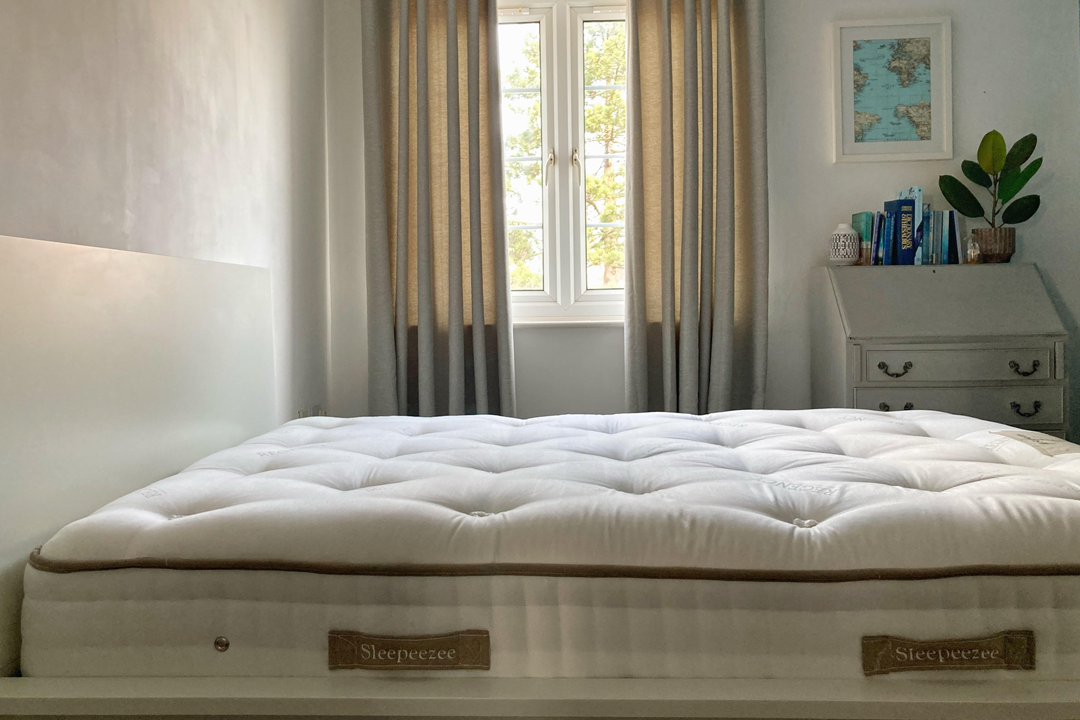
In our review of the Sleepeezee’s regency kew mattress, it was recommended for back sleepers by our tester, Sarah Jones, who said “it should help to keep your spine better aligned” and “this, in turn, should help to avoid aches and pains come morning.” It contains pocket-springs, which Sarah noted “helps to distribute weight evenly, in turn limiting the amount of motion transfer.”
Buy now £1599, Dreams.co.uk
Natural fibres can also be suitable. “All [natural fibres] will have a slightly different feel, but all tend to have lower pressure-relieving abilities compared to foams”, Shore says. When on your back, there are “less prominent boney parts like shoulders and hips digging into the mattress, so less pressure relief is often needed”. Cotton, hemp, wool and flax are some examples she offers.
Once you start sleeping on your new mattress, it’s worth giving it some time before you make your verdict. Sharp says that when you change it, “there may be a settling period or adjustment period”. This could be “up to a couple of weeks for some people, while other people don’t notice a difference”.
Finally, as ever, pillow choice is key. “If you sleep on your back, you need a pillow that fills the gap between the back of your head and neck and the mattress”, says Mead. It shouldn't be “so thick that your head is pushed forward, but so flat that the neck droops back.” She adds: “Make sure you don’t sleep with the pillow under your shoulders – try pulling it around them like a scarf.”
Meet the experts
- Nell Mead – Physiotherapist and author of How To Be Your Own Physio
- Hannah Shore – Head of sleep science at Mattress Online
- Dr Nerina Ramlakhan – Physiologist, sleep expert and author of Tired But Wired, Fast Asleep, Wide Awake and The Little Book of Sleep
- Emma Sharp – Tempur education and advocacy manager, and sleep expert
Read more: How to find the right pillow for back, side, or front sleepers