
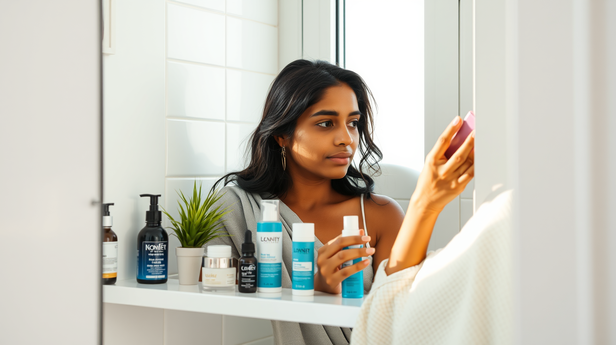
The Ten-Step Routine Was Never About Your Skin
The average Indian woman in her twenties owns more skincare products than she will finish in two years. That is not a coincidence. The ten-step routine, popularised by Korean beauty marketing and amplified by Indian influencers, was never a dermatological recommendation. It was a sales architecture. Each step creates a slot, and each slot demands a product. Toner, essence, serum, ampoule, moisturiser, SPF, eye cream, lip treatment: every layer is a new SKU, a new purchase cycle, a new dependency.

Dermatologists at AIIMS and private clinics across Mumbai and Delhi have said consistently that most healthy skin needs three things: a gentle cleanser, a moisturiser with SPF, and a targeted treatment for any specific concern. That is it. The rest is margin.
How Marketing Manufactures Skin Anxiety
The industry sells solutions to problems it first has to convince you that you have. "Uneven skin tone" became a crisis only after brightening serums needed a market. "Dull skin" is not a medical condition, it is a phrase invented to sell exfoliants. "Pores" have been a source of shame for Indian women since fairness cream advertising decided they were, which is to say, since fairness cream advertising needed something new to fix after the original promise wore thin.
The mechanism is consistent: name a normal skin characteristic, reframe it as a flaw, introduce a product that addresses it, and create a routine that makes the product feel indispensable. Ingredients cycle through this machine on a schedule. Niacinamide, retinol, peptides, bakuchiol, each arrives with a wave of content that makes last year's serum feel obsolete. Your skin did not change. The marketing calendar did.
What Ingredients Actually Do the Work
Minimalism in skincare is not a trend. It is what the evidence supports. A 2021 review published in the Journal of the American Academy of Dermatology found that layering multiple active ingredients increases the risk of irritation without proportionally increasing benefit. The skin barrier, the outermost layer that keeps moisture in and irritants out, does not get stronger with more products. It gets compromised.
Three ingredients have the most consistent clinical backing: retinoids for cell turnover and collagen, broad-spectrum SPF for photoprotection (the single most evidence-backed anti-ageing intervention available), and a ceramide-based moisturiser for barrier repair. Everything else is conditional on your specific concern. Vitamin C serums work, but they destabilise quickly and most formulations are ineffective by the time you reach the middle of the bottle. Hyaluronic acid draws moisture from the environment, useful in humid Indian coastal cities, actively drying in low-humidity conditions without a sealant on top.
Knowing this does not mean abandoning everything in your cabinet. It means stopping the automatic repurchase of things that are not doing a measurable job.
The Subscription Trap and the Haul Economy
Indian skincare consumption has been reshaped by two forces: D2C brands selling directly through Instagram, and the unboxing and haul culture that makes buying feel like a hobby rather than a need. Brands like Minimalist, Dot and Key, and Plum have built genuine audiences, and some of their formulations are well-made. The problem is the volume. A brand that sells eight different serums is not covering eight different needs, it is covering eight different anxieties, and hoping you have all of them.
Subscription boxes compound this. The model is designed to introduce products before you have finished the last one, creating a permanent backlog that feels like abundance but functions as overconsumption. The average Indian skincare subscriber receives more product per quarter than their skin can cycle through without overlap and interference between actives.
The resistance is simple and requires no special knowledge: finish what you have before buying the next thing. That single rule collapses most of the industry's leverage over your routine.
Building a Routine That Does Not Need to Grow
A functional minimalist skincare routine for Indian skin, which contends with high UV index, humidity variation across regions, and hard water in most metros, does not need to be expensive or elaborate. A low-pH cleanser that does not strip the skin. A moisturiser with ceramides or glycerin. Sunscreen with at least SPF 30 and PA+++ rating. One targeted active if there is a specific concern: a retinoid at night for texture, or an azelaic acid for pigmentation.
That is four products. The industry would like you to believe that four products is a starting point. Dermatologists would tell you it is a complete routine for most people most of the time.
The question to ask before every new purchase is not "will this help?" but "what is this replacing?" If the answer is nothing, if it is an addition to an already functioning routine, the product is serving the industry's needs, not yours. Skincare marketing is very good at making that distinction feel complicated. It is not.
When you strip the routine back to what your skin actually requires, something else happens: you start to notice what is working. With ten products cycling through your skin simultaneously, attribution is impossible. With four, the signal gets clear.