Get all your news in one place.
100's of premium titles.
One app.
Start reading
The Times of India
The Times of India
World
TOI World Desk

How Queen Elizabeth II’s coronation dress used flowers to tell a Commonwealth story

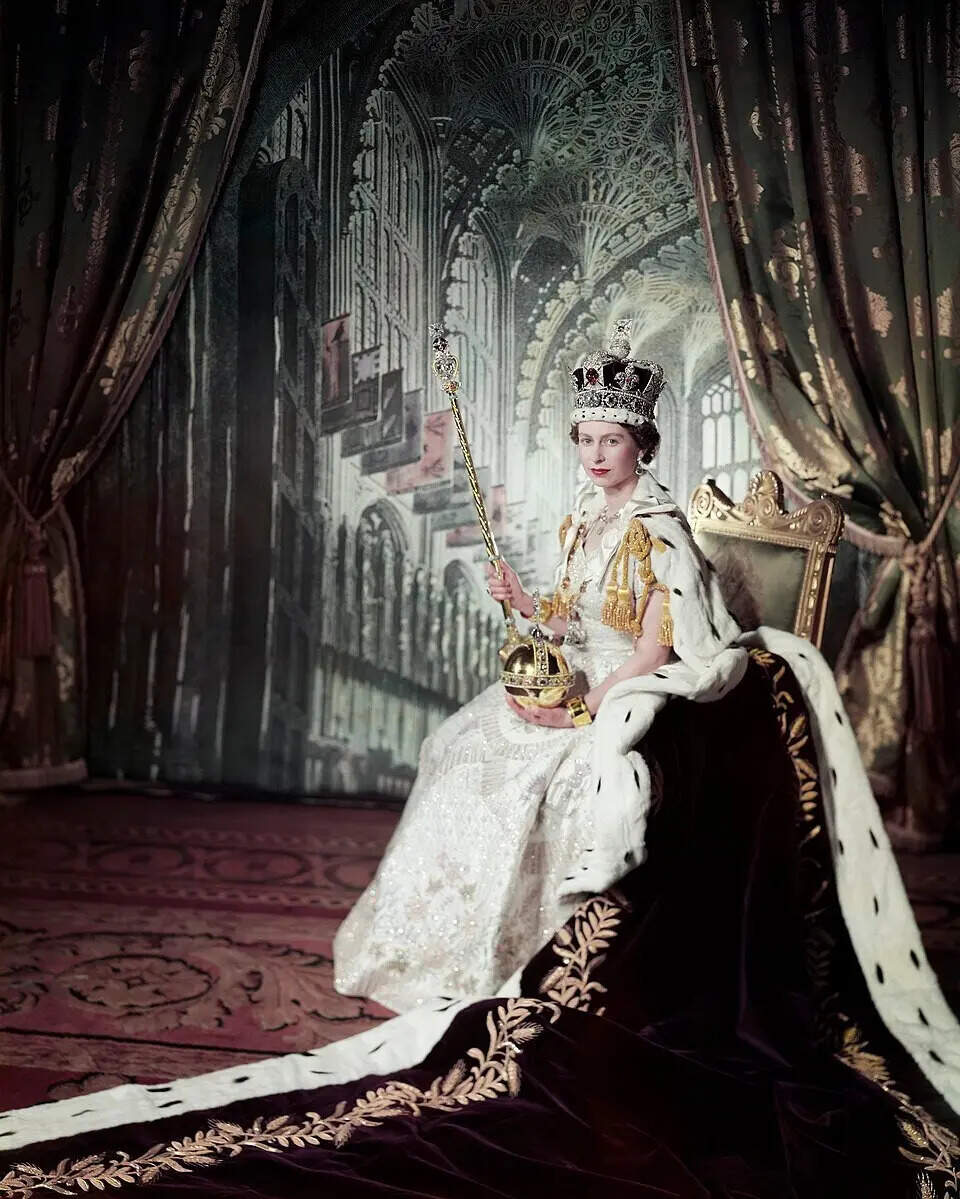
While Queen Elizabeth II was officially crowned at Westminster Abbey in 1953, her ceremonial gown carried a particular message concerning relationships, both domestic and foreign. This thoughtfully designed article of clothing turned a ceremonial gown into a symbolic story about the composition of the UK and the Commonwealth as a whole. While the majority of the audience at home tended to concentrate on the crown jewels and the ceremony order, the design of the gown became one of the key elements of the formal occasion. Indeed, the silk dress was designed to become an illustration of a unified identity in terms of heraldic symbolism.

The creation of the gown marks an actual milestone in the history of ceremonial dress design in the twentieth century. Under commission from the royal family, British dress designer Norman Hartnell took months analysing dresses of the past to design one that would fulfil state protocol requirements and, at the same time, be camera-friendly.

Unlike using generic decorative designs, the process involved combining unique geographic motifs in the form of a single design. The approach guaranteed that the final result served as a symbolic representation of the kingdoms ruled by the new monarch, thus highlighting the way the institution intended to represent itself through fashion at the beginning of a new reign.

Documented process of design and fabrication

The construction of the gown entailed a series of design modifications and adjustments carried out with supervision from the palace. As noted in the archive document titled The Coronation Dress of Queen Elizabeth II , released by the Royal Collection Trust , there were eight drafts made prior to the acceptance of the final design by the institution. Since the gown needed strong inner support to carry the weight of the heavy metallic threads used in the embroidery, a strong internal frame was created using cream silk satin reinforced with horsehair and linen casing.

The course of action of the project took a turn due to the comments offered by the monarch regarding the original idea. As mentioned in the documents kept at the Victoria and Albert Museum , known as 'Silver and Gold' by Norman Hartnell , Queen Elizabeth asked for the inclusion of coloured silks in order to create more impact than the original idea, which was planned to be done using only white and silver colours.

Finally, the embroidery included the well-known floral symbols of the United Kingdom, such as the rose of England, the thistle of Scotland, the shamrock of Ireland, and the leek of Wales. In his personal notes on the design, which are preserved in the Victoria and Albert Museum, Hartnell stated that, according to official procedure, he had to use the historic leek device to symbolise Wales instead of the daffodil. By following these precise directions and executing them using gold and silver threads, crystals, and pearls, the workroom applied the principles of heraldry in a modern design.

Use of emblems of independent countries of the Commonwealth

The wider geopolitical setting was determined by using particular symbols of the independent countries of the Commonwealth. As stated in the collected research data contained in the Dresses of Character essay of the Victoria and Albert Museum , the embroidery design was further enhanced by adding the maple leaf of Canada, the wattle of Australia, the silver fern of New Zealand, and the protea of South Africa. Also, the composition comprised the lotuses of India and Ceylon together with symbols of Pakistan.

In this way, it became clear that the clothing was meant to make a visual statement about the evolving composition of the British realms in the mid-twentieth century. By incorporating these different emblems into the costume in the same way that the home nations were represented, there was a formal recognition of their constitutional presence in the coronation ceremonies.

An analysis of the history of the gown shows how state apparel could be used to show the relations between institutions at transitional points in their development. The gown was designed in such a way that it served as a record of the political relations existing at the time to ensure consistency between image and reality.

Sign up to read this article
Read news from 100's of titles, curated specifically for you.
Already a member? Sign in here
Related Stories
Top stories on inkl right now
One subscription that gives you access to news from hundreds of sites
Already a member? Sign in here
Our Picks
Fourteen days free
Download the app
One app. One membership.
100+ trusted global sources.