Finding a bunker on the golf course can completely derail my round, turning a potential birdie or par into a double-bogey (or worse) as I hack away at the sand in a futile effort to escape... and I know I am not alone.
I have seen plenty of golfers have a complete nightmare in a bunker, but do you know how adversely your scoring is impacted by finding the sand?

After reviewing the latest 2026 Shot Scope data, we can now reveal just how penal these treacherous traps can be... especially for mid- to high-handicap golfers.
If you want to shoot lower scores and cut your handicap in 2026, it's crucially important to avoid the sand at all costs... or learn how to play bunker shots effectively at the very least...
How Many Shots Do Amateur Golfers Lose When Finding A Bunker?
It turns out that for every ability of golfer, finding a greenside trap has a significant impact on the score at the end of the hole to a similar level.
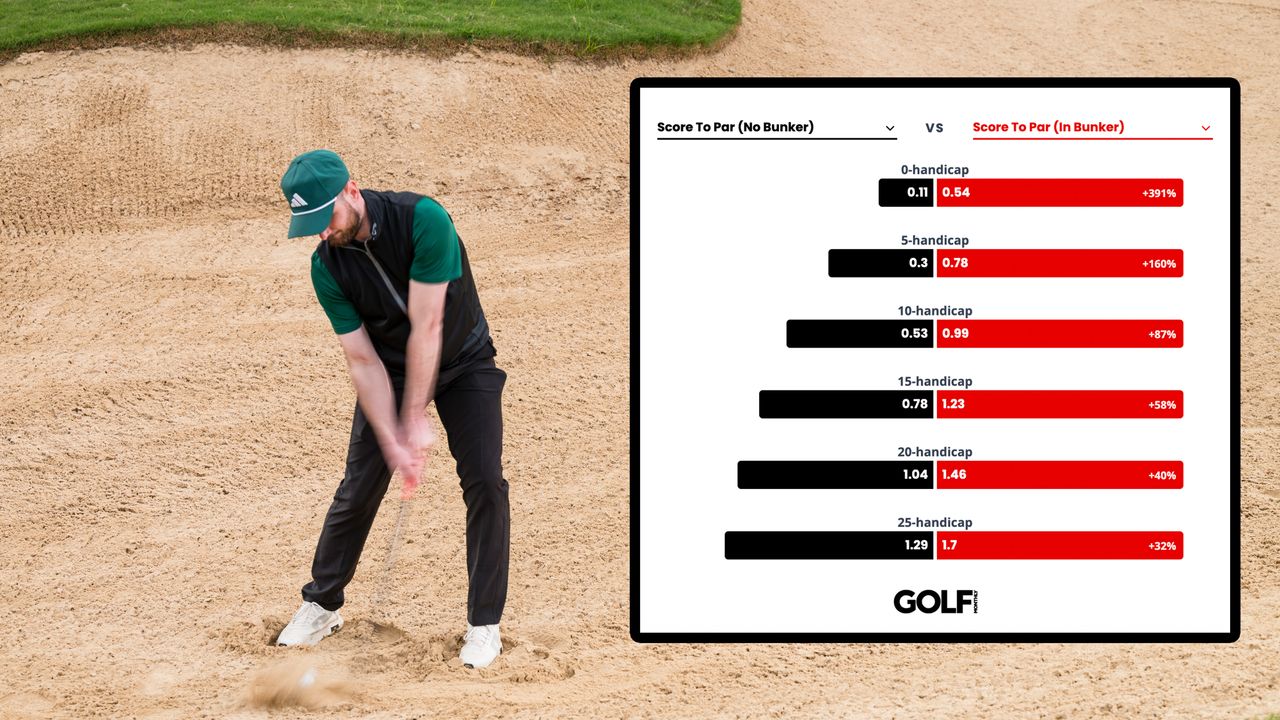
For a scratch golfer, their score goes up by 0.43 shots on average if their approach shot finds the sand.
A five handicapper (+0.48) and a 10-handicapper (+0.46) see a similar picture when their ball is gobbled up by the greenside bunker, but a 15-handicapper comes off worst - losing half a shot on average each time they find the greenside trap.
Interestingly, perhaps because they are more inclined to miss the green on approach regardless, high-handicap golfers see less of penalty.
A 20-handicap golfer is 0.42 shots worse off each time they find a greenside bunker, while a 25 handicapper averages an increase of 0.41 shots.
Impact Of Finding A Greenside Bunker On Scoring
Average score to par when finding a greenside bunker vs not finding a greenside bunker for amateur golfers of different handicap indexes
| Attribute | Score To Par (No Bunker) | Score To Par (In Bunker) | Difference |
|---|---|---|---|
| 0-handicap | 0.11 | 0.54 | 0.43 |
| 5-handicap | 0.3 | 0.78 | 0.48 |
| 10-handicap | 0.53 | 0.99 | 0.46 |
| 15-handicap | 0.78 | 1.23 | 0.5 |
| 20-handicap | 1.04 | 1.46 | 0.42 |
| 25-handicap | 1.29 | 1.7 | 0.41 |
VS
+32% 1.7 1.29 25-handicap +40% 1.46 1.04 20-handicap +58% 1.23 0.78 15-handicap +87% 0.99 0.53 10-handicap +160% 0.78 0.3 5-handicap +391% 0.54 0.11 0-handicap
Greenside bunkers are typically found short or level with the front portion of the green, so a key takeaway is to choose a club that favors the back half of the green to take them out of play.
From a fairway bunker, lower handicap players are far less impacted, whereas higher handicappers really struggle according to the data.
In fact, there is a direct correlation between handicap level and the impact of finding a fairway bunker has on scoring.
Impact Of Finding A Fairway Bunker On Scoring
Average score to par when finding a fairway bunker vs not finding a fairway bunker for amateur golfers of different handicap indexes
| Attribute | 0-handicap | 5-handicap | 10-handicap | 15-handicap | 20-handicap | 25-handicap |
|---|---|---|---|---|---|---|
| Score To Par (No Bunker) | 0.15 | 0.32 | 0.52 | 0.74 | 0.93 | 1.12 |
| Score To Par (In Bunker) | 0.34 | 0.61 | 0.88 | 1.19 | 1.48 | 1.75 |
| Difference | 0.19 | 0.29 | 0.36 | 0.45 | 0.55 | 0.58 |
VS
+53% 0.29 0.19 Difference +79% 0.61 0.34 Score To Par (In Bunker) +113% 0.32 0.15 Score To Par (No Bunker)
A scratch golfer's average score only goes up on a hole where they find the fairway bunker by 0.19 shots.
This increases to 0.29 for a five handicapper and 0.36 for a 10 handicapper.
For a 15 handicap golfer, they average a further 0.45 shots each time they find the fairway trap.
A 20 handicapper (+0.55) and a 25 handicapper (0.58) see the most significant penalties for doing so, highlighting the importance of club selection and strategy decisions when hitting tee shots.
In summary, the stats show that everyone, but especially high handicappers, need to take the necessary precautions to avoid the sand or invest time in practicing these tricky shots.