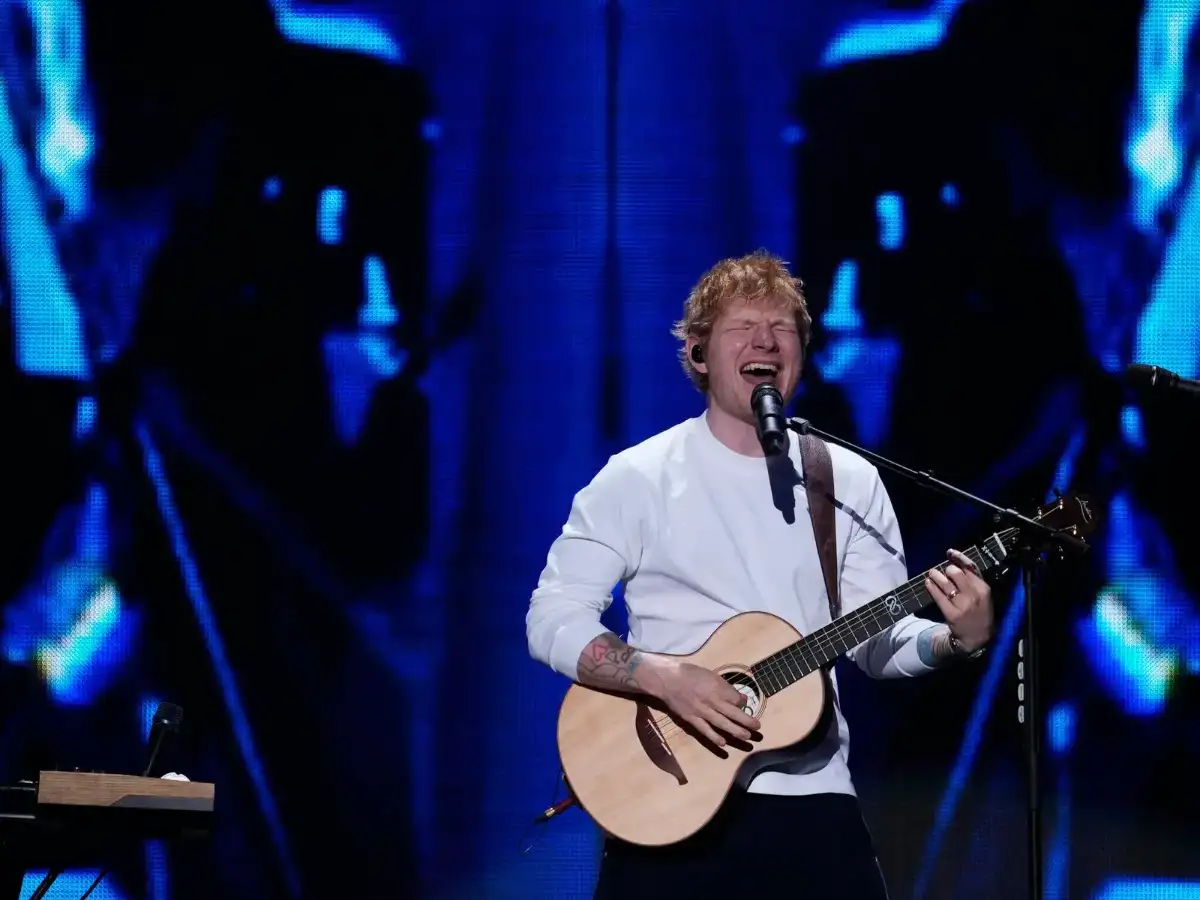
That was an Instagram gag. Sheeran seems like the sort of entertainer everybody likes. He steers clear of controversy, sings gentle ballads, and embodies the Gen Z rock star ethos - less breaking things, more delicate IIT-topper-with-a-guitar-hobby vibes. That is, until Gaza got him.
Last week, Sheeran took the stage at Philadelphia's Lincoln Financial Field alone, with no opening act. The solo billing followed a controversy that began on September 4, when rapper Macklemore, Sheeran's opening act at MetLife Stadium in New Jersey, spoke about Gaza and expressed support for Palestine. Macklemore performed 'Hind's Hall', a song inspired by the 2024 killing of 5-year-old Palestinian girl Hind Rajab, and the subsequent pro-Palestinian protests at Columbia University.
The backlash was immediate. In 'the land of free speech', several billionaire stadium-owners, led by Robert Kraft, owner of American football team New England Patriots and Gillette Stadium in Foxborough, Massachusetts, made Sheeran's performance conditional on dropping Macklemore from his 'Loop Tour'. Dropping an opening act, rather than cancelling a whole tour, seemed like the least harmful option. Until there was a backlash against Sheeran for taking a 'pro-Israel' stance.
Can one be an apolitical artist in 2026? And can venue-owners have a say in an artist's politics?
Closer to home, I'm reminded of the other side of this power equation. In the post-Babri Masjid riots of the 1990s, actors were urged by state media to request people to stay at home. Even now, from Aadhaar to vaccination, top actors are roped in to build trust.
Remo Fernandes, who, at the height of his popularity in the mid-80s, was asked to do an anti-drug song. He wrote 'Pack That Smack', which, with lyrics like, 'If you meet a cold turkey on your cold and lonely road/ And you start to feel jerky and you need a hand to hold,' ironically, almost seems like the song was pro-drugs.
Artists may enjoy enormous cultural influence. But they rarely hold the stronger hand. If a billionaire or large company owns a venue, and the artist, much lower in the hierarchy, has controversial views, then the show will be cancelled.
Which is why it's common for Indian stars to never share what they think on sticky issues. This results in social media complaining that we never hear 'politics' from big stars, followed by a demand to boycott the artist's work. The stars have learnt that when all is forgotten, nothing good comes out of taking a side politically in India. So, they shut up. And it bodes them well. Because, in the long run, people flock to their movies anyway.
But it's routine for Indian comedians who say something against authority to receive threats, and for venues to say it isn't safe and the show is cancelled. Unlike in stadiums, an 'anti-national' comedian, enabling even minor damage to a shabby Pune or Mumbai hall, will exceed their maintenance budget. So the venues don't want to take a chance.
A brave Mumbai comedy venue-owner once told me, 'If we know a mob is coming, we usually remove all the chairs, so they have nothing to throw. They get frustrated. One goon started banging his head against a wall, as they need to make a good reel showing they're breaking things'.
In 'the land of free speech', however, where rappers have lyrics that encourage their fans to kill the police, and where Donald Trump is up for lewd symbolism, and Bruce Springsteen can perform wearing a t-shirt that reads 'Criminal' under a photo of George W Bush, Gaza is a no-go zone.
At the Philadelphia concert, Sheeran explained where he stood on Israel and Palestine. He called the October 7 attacks on Israel by Hamas 'horrific', adding that what is happening in Gaza is 'catastrophic, unjustifiable, and disproportionate'. Macklemore will probably sue Kraft, and probably win.
But it's good to see the power money has over conscience creeping in everywhere. In that way, India's soft power is expanding.