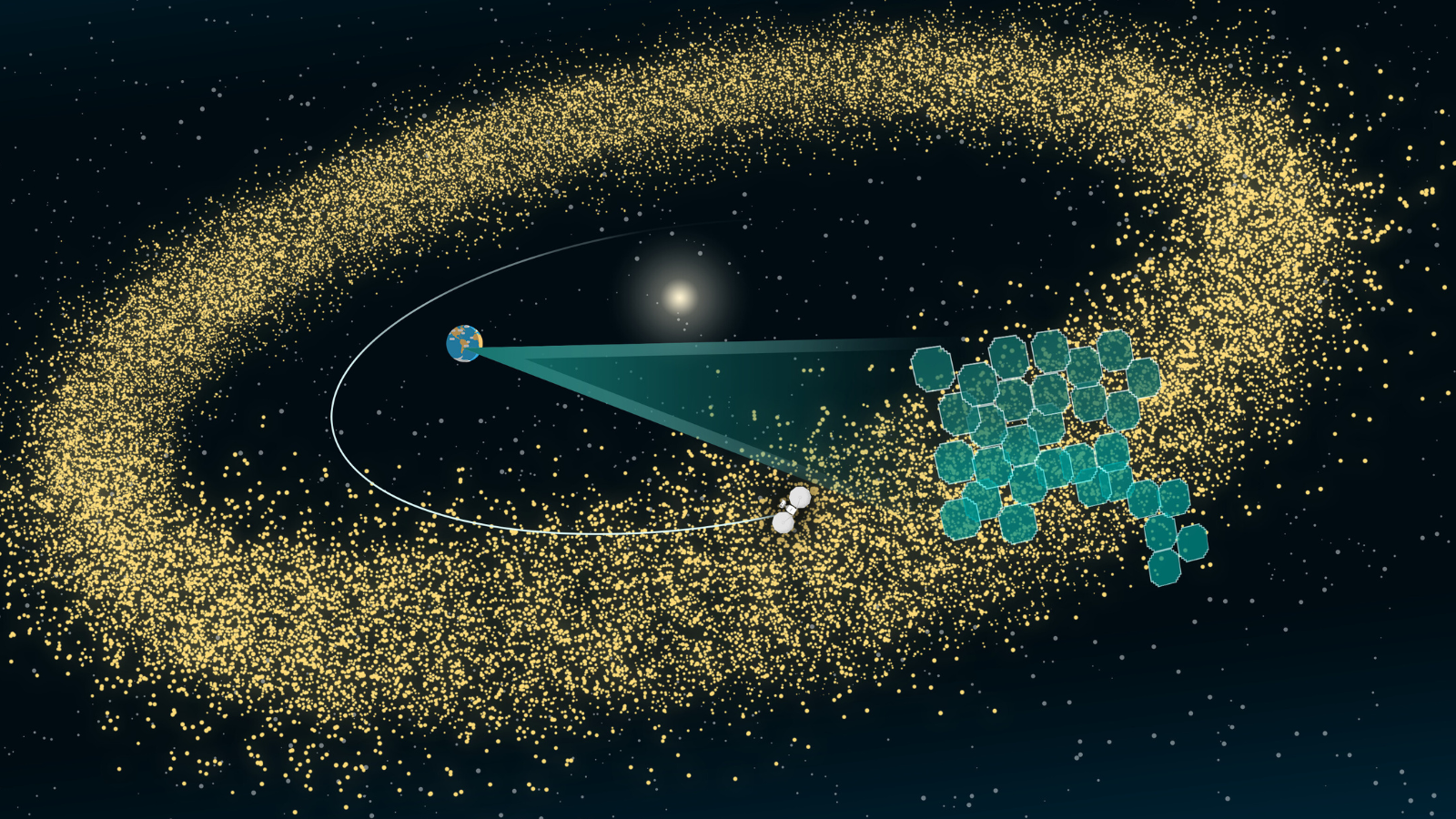
An illustration of the asteroid belt as a dense donut-shaped ring of yellow points with the Sun at the center. The background is black with hints of dark blue in the corners and small white pinprick stars sprinkled throughout. A small illustrated Earth sits to the left of the Sun, and a semi-opaque, cone-like teal triangle extends from Earth toward the right. The cone opens up to a mosaic of a couple dozen small, square-like shapes representing Rubin Observatory’s LSST Camera’s detector area. The mosaic is overlaid onto a portion of the asteroid belt, and each tile represents a camera image that detects a group of asteroids. A thin curved white line begins behind the Sun and swings out around the Earth, tracing the path of a small, not-to-scale spacecraft heading toward the illuminated asteroids, ready for exploration.
The forthcoming Vera C. Rubin Observatory will never leave Earth itself, but the highly detailed, "big picture" view of the cosmos it will offer scientists may very well kick-start a new era of space exploration.
The solar system is filled with billions of small rocky bodies and icy objects, many of which formed around 4.5 billion years ago when planets like the Earth were forming around the sun. Space missions like NASA's OSIRIS-REx, Lucy, and Psyche have been making strides in visiting these primordial solar system bodies. They've been collecting images, and OSIRIS-REx even snagged a few samples, for investigation here on Earth — all informed by data collected by observatories across the globe.
Sign up to read this article
Read news from 100's of titles, curated specifically for you.