
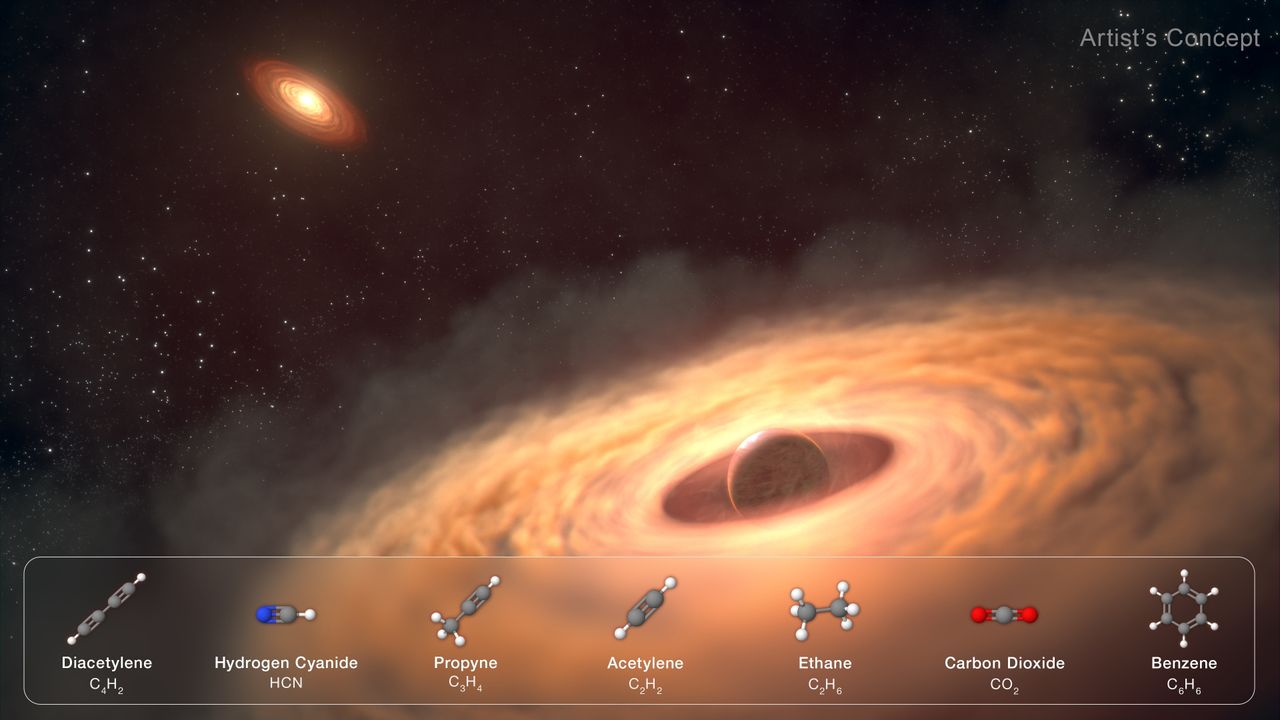
The James Webb Space Telescope has, for the first time, measured the carbon-rich concoction that forms a moon-forming disk of gas and dust around a newly formed planetary body. It is hoped the instrument's findings will help us understand how moons in our solar system, particularly those of the giant planets, came to be.
With the medium-resolution spectrograph on its Mid-Infrared Instrument (MIRI), the James Webb Space Telescope (JWST) targeted a disk surrounding the world CT Cha b, which has a mass 17 times the mass of Jupiter and is either a high-mass planet or a low-mass brown dwarf (the dividing line between the two remains somewhat blurred).













