
Get all your news in one place.
100's of premium titles.
One app.
Start reading
Times Life
Times Life
Aishwarya Kapoor

How Crows Make Multi-Step Tools in the Wild: What Their Behavior Reveals About Bird Intelligence

What Researchers Actually Filmed

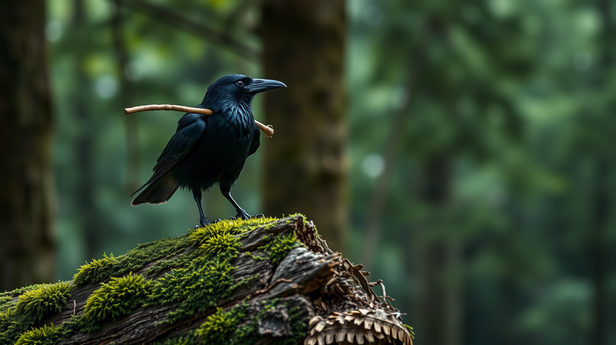
In 2016, researchers from the University of Oxford published footage of New Caledonian crows in the wild doing something that had never been documented outside a laboratory: combining two separate materials to create a single functional tool. One crow picked up a short stick, found it too small to reach a food source, then located a longer hollow stem, inserted the short stick into it, and used the extended composite to extract prey from a crevice in a log. No researcher handed it components. No training trial preceded the attempt. The crow assessed a gap between what it had and what it needed, then closed that gap across two physical steps.

This matters because tool use alone is not rare in the animal kingdom. Egyptian vultures throw rocks at ostrich eggs. Bottlenose dolphins carry marine sponges to protect their rostrums while foraging on the seafloor. What is rare, genuinely rare, is the sequential manufacture of a tool from sub-components that have no food value individually. That requires holding a goal in mind while performing actions that do not yet serve it.

The Corvid Brain: Built Differently

Crows belong to the family Corvidae, which includes ravens, rooks, jackdaws, and jays. The corvid brain lacks a neocortex, the layered structure mammals use for higher-order cognition. For decades, this was taken as evidence that birds operated on instinct and conditioning rather than flexible reasoning. That assumption collapsed when neuroscientists identified the nidopallium caudolaterale, a region in the avian forebrain that performs analogous functions to the prefrontal cortex in primates. It supports working memory, inhibitory control, and the ability to delay a reward, the same cognitive toolkit that underlies planning in humans and great apes.

A crow's brain is roughly the size of a human thumb. Relative to body size, the corvid brain is among the largest of any bird, and the nidopallium caudolaterale is proportionally larger in New Caledonian crows than in most other corvid species. This is not coincidence. New Caledonian crows are the only wild population documented making hooked tools from a single plant stem by stripping, bending, and trimming it to a specific shape, a process that requires holding the finished tool's geometry in mind before the tool exists.

What Multi-Step Actually Demands

A single-step tool use, picking up a stick and poking it somewhere, requires recognising that an object can serve a function. Multi-step tool manufacture requires something structurally different: the animal must represent a future state, identify the gap between the present state and that future state, and execute a sequence of sub-actions that only make sense in relation to the end goal. Cognitive scientists call this means-end reasoning.

In a 2019 study published in Scientific Reports, Alex Taylor and colleagues at the University of Auckland tested New Caledonian crows on a multi-step problem requiring them to use a short tool to retrieve a longer tool, which could then reach food. The crows solved it. More telling: they paused before the first action in ways consistent with planning rather than trial-and-error. They looked at the short tool, looked at the box containing the longer tool, looked at the food, then acted. The sequence of glances matched the sequence of steps required, a behavioural signature of prospective cognition, not reactive instinct.

Where Crows Sit Among Tool-Using Animals

The short list of animals confirmed to make tools rather than merely use found objects includes chimpanzees, orangutans, capuchin monkeys, some populations of bottlenose dolphins, a handful of bird species, and, in a single documented case, a saltwater crocodile observed carrying sticks on its snout during heron nesting season, possibly as a lure. Among birds, the New Caledonian crow sits at the top of any ranking by tool complexity.

Chimpanzees in the Bossou forest of Guinea use stone anvils and hammer stones to crack oil palm nuts, a two-object system that also qualifies as multi-component tool use. The comparison is instructive. Chimpanzees share roughly 98.7 percent of their DNA with humans and have a neocortex. New Caledonian crows share none of our evolutionary lineage for the past 300 million years and have no neocortex at all. That two such different architectures arrived at similar cognitive outputs is one of the cleaner examples of convergent evolution in the scientific record.

Among Indian wildlife contexts, the house crow (Corvus splendens), a species found from Mumbai to Chennai to the lanes of Old Delhi, has been observed using traffic to crack hard-shelled food, placing nuts on roads and waiting for vehicles to do the crushing. This is tool use by proxy, and it requires reading traffic patterns accurately enough to retrieve the food without being hit. It is not multi-step manufacture, but it signals the same underlying flexibility: the ability to model a causal chain and insert oneself into it at the right point.

Why the Wild Setting Changes Everything

Laboratory demonstrations of animal cognition always carry a caveat: the controlled environment removes ecological noise but also removes the animal's natural motivational context. A crow in a lab solves puzzles because the puzzle is the only thing available. A crow in the wild solves puzzles while also managing predator awareness, flock dynamics, territorial competition, and weather. The 2016 Oxford footage, and subsequent field observations in New Caledonia, showed crows manufacturing and using composite tools under these full-complexity conditions. The behavior is not an artifact of captivity. It is part of how these birds actually live.

The wild setting also rules out one common alternative explanation for apparent animal intelligence: inadvertent human shaping. When a captive crow solves a multi-step task, a skeptic can argue that repeated exposure to human experimenters, human objects, and human reward schedules produced the behavior through reinforcement rather than reasoning. Field observation cannot be explained away this way. The crow in the forest has not been handed components. The sequence it executes was not shaped by a researcher's approval. The tool it makes is real, and the food it retrieves is the only confirmation that mattered.

What the crow's behavior adds up to is a challenge to the assumption that sophisticated cognition requires a particular evolutionary history or a particular brain structure. Intelligence, it turns out, is less a thing than a set of pressures. Where the environment consistently rewards planning over reaction, planning tends to evolve, in a primate forebrain or in a thumb-sized cluster of avian neurons that got there by a completely different route.

Sign up to read this article
Read news from 100's of titles, curated specifically for you.
Already a member? Sign in here
Related Stories
Top stories on inkl right now
Our Picks
Fourteen days free
Download the app
One app. One membership.
100+ trusted global sources.