
Get all your news in one place.
100's of premium titles.
One app.
Start reading
What Hi-Fi?
What Hi-Fi?
Technology
Jez Ford

How Apple’s new AirPods Max 2 finally converted me to Atmos music on headphones

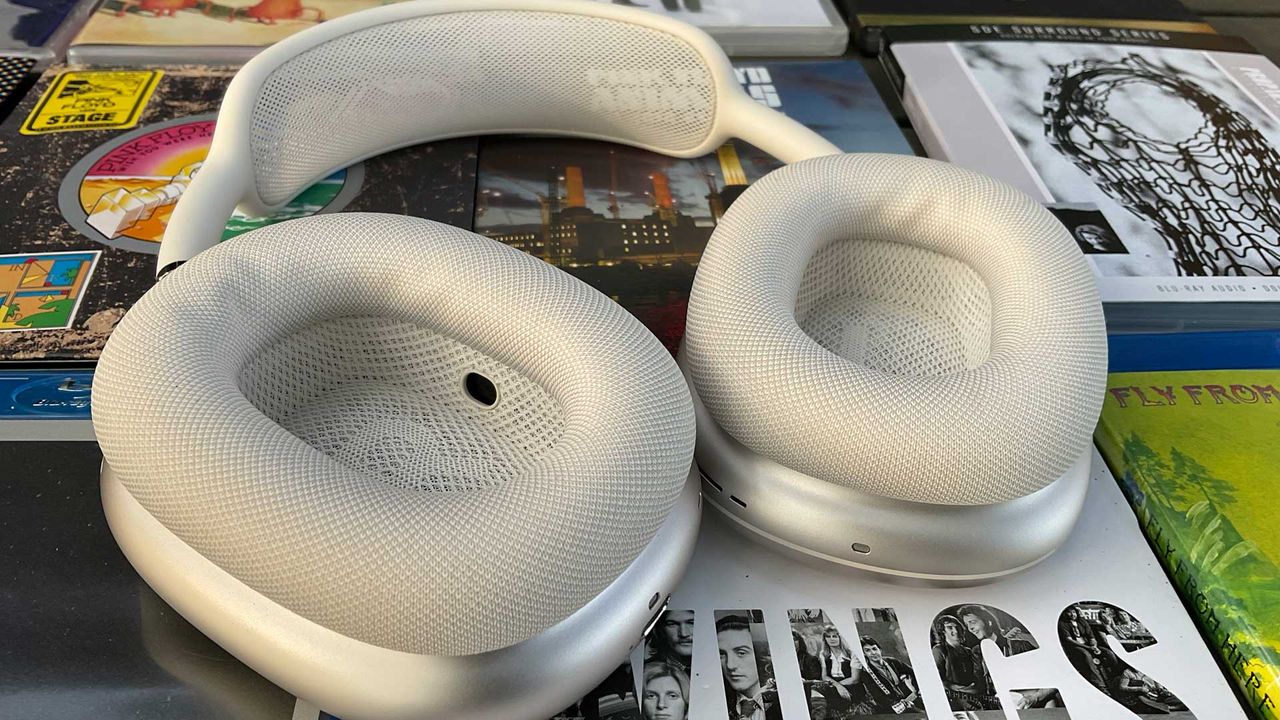
Apple AirPod Max 2.

I am a huge fan of Dolby Atmos music. I play it every day and I often carve out a few hours specifically to enjoy myself immersed in this spatial format which can place music elements both behind me and above.

But not on headphones. I play my Atmos music on what might be described as an upper midrange speaker system, delivering 5.1.2 channels – that’s five speakers on the floor, including surrounds out wide behind me and a subwoofer up the front, plus two speakers in forward height positions in order to deliver Atmos’ famous hemisphere of sound. (Yes, just a hemisphere; I’m still waiting for someone to realise they’re missing a trick with not yet embedding speakers in the floor to create a real sphere of sound. But perhaps I shouldn’t encourage them.)

Atmos on a full system

My sources for playing Atmos music are two-fold. My subscription to Apple Music allows access to a great many tracks mixed in Atmos, of Spatial Audio as they prefer to de-brand it. This can be served from an AppleTV 4K into my AV receiver. Tidal and apparently Amazon Prime Music (though not the free version) can also serve Atmos, but Apple is usually my server of choice for streaming Atmos.

My main source, however, and particularly at the moment, is Atmos music on Blu-ray – discs with no video on them, but multiple mixes of an album, usually in Dolby Atmos, with some form of 5.1 or 7.1 surround as well, and high-res stereo. Sometimes instrumental Atmos mixes are also included as a bonus.

In fact over the last year I have developed a hair-trigger form of 'new-formatitis', an addiction to buying Atmos music discs which is costing me, well, not a huge amount of money, but has certainly upped my casual expenditure on music significantly. And mainly buying albums that I already have either on vinyl, CD or digitally. Doesn’t matter: when the latest Atmos Blu-ray release is announced, I’m clicking that email link and slapping my money down without a second thought.

It began with Morten Lindberg (38 Grammy nominations and counting) and his work for Norway’s 2L label; my early Atmos disc collection was dominated by his extraordinary in-the-moment Atmos recordings, and I’ve twice raved about them here on What Hi-Fi? (this one partly because of heartstopping performances by the wildly magnificent Catalina Vicens, and this one as being the most gorgeous of Christmas albums; there are plenty of others).

But of course surround discs had been around fpr a good while before Atmos arrived. For video discs, a surprising number of old music DVDs have excellent surround soundtracks, sometimes in 24-bit/96kHz – 'Best of Bowie', 'Queen's Greatest Hits', etc; I pick them out of boxes left on the street these days, or grab them for $2 a pop in charity shops. Like secondhand CDs, they can be a very cheap way to gather good music.

Early pop and rock surround music was also possible on the SACD format, while the emergence of audio Blu-rays was notably led by ‘Pure Audio’ discs, developed by msm-studios in Munich in 2009, beginning with lossless high-res LPCM stereo and DTS-HD Master Audio 5.1, then later adding Dolby TrueHD and Atmos.

(Image credit: Future/Jez Ford)

Lossless Atmos music

An important word there is ‘lossless’. Why do I buy the Blu-rays, when I can usually listen to the same Atmos mixes on subscription via Apple Music?

Because Atmos streaming is heavily data compressed, arriving at bit-rates ranging perhaps from 384kbps to 768kbps. Compare those bit-rates with disc-based Atmos audio, which are typiclly from 3000kbps upwards. Morten Lindberg at 2L recently told Stereophile's Jim Austin that their discs average 6000kbps and peak far higher, which confirms what Lindberg told me some time ago: that Atmos streaming is compressed by a factor of perhaps 11 to 1. That's a similar compression ratio to ye olde 128k MP3s when compared to CD, or to AC3 Dolby Digital soundtracks as used on movie DVDs.

So it's remarkable that it sounds as good as it does, streaming through the speakers from the AppleTV 4K. But the disparity provide support for what the ears confirm: the lack of compression is immediately evident in the thrilling clarity of the best Atmos music Blu-rays.

Not all – some Atmos mixes can be awful, or just boring, with little more than atmospheric extension of the front soundstage into the rears. There’s no point in paying for that; the stereo will likely serve better.

But when you do get a good ’un – oh wow.

Apple Music, then, is very useful both for listening enjoyably to large numbers of Atmos releases, and for checking whether a particular new Atmos mix of a favourite album is bland or brilliant before putting down your money on the Blu-ray release.

In a little Catch 22, however: by the time you can hear it, you may not be able to buy it. The company getting most of the money from my present addiction is SDE, and their releases are largely limited editions that become unavailable all too quickly; scroll through their ‘sold out’ back catalogue to confirm this. In fact I gather their model is to print not many more than were hard-ordered in the pre-release window, to avoid having “an attic full of unsold discs”. So if you miss that pre-sale window, you just ain’t going to get one. And if you wait to hear the mix on Apple after release, you might be too late to get in on the Blu-ray release.

Hence my trigger finger on all three most recent pre-sales: Alan Parsons' 'Eye in The Sky'; Chris Squire 'Fish out of Water'; Roxy Music's 'Flesh & Blood', that the tour I saw them on. It's like they're going through my record collection! This is music I can't miss: limited edition access to the best possible versions of my formative albums. Hence I don't know if I was more a-quiver about the long-delayed Atmos mix of ‘The Lamb Lies Down on Broadway’ last year (I had to buy a whole box-set to get that one, but it’s a magnificent package) or the holy grail release of an Atmos version of Frankie Goes To Hollywood’s 1984 sonic orgasm ‘Welcome To The Pleasuredome’. Take my money!

Other Blu-rays are more widely and permanently marketed – the wham-bam brilliant Atmos mix of Bowie’s ‘Ziggy Stardust’ by the original engineer Ken Scott, or Pink Floyd’s ‘The Dark Side of the Moon’; these are less likely to go out of print quickly. ‘Animals’ came out in Atmos about 18 months after I bought it in 5.1 24/96 DTS-HD MA. Even I didn't pay again for 16/48 Atmos!

There’s one useful benchmark to confirm instantly that the Atmos mix certainly won’t be bland, and that’s if it’s by Steven Wilson, former Porcupine Tree frontman and absolute ruler of the modern Atmos remix. The new Frankie mix is his, and it was worth every cent of the extra postage from the UK. Loving his instrumental Pleasuredome mixes. I bought Wilson's own 2025 album ‘The Overview’ as an Atmos disc just because I like all his other Atmos mixes (and earlier surround mixes). He is wildly prolific, especially among prog artists: Yes, Black Sabbath, Rush, Jethro Tull, King Crimson, Gentle Giant, XTC, Pink Floyd (Pompeii), Roxy Music, also The Who (I’ve just received ‘Who Are You’), and gasp, Robert Fripp’s ‘Exposure’ (for which I could only get the 5.1 DVD). Wilson has opened an Atmos download site called Headphone Dust which may eventually overcome some of those limited availability disc issues, if/once it grows beyond his own material. Others, including 2L, also offer Atmos and surround and high-res as file downloads. Direct file replay has obvious advantages over Blu-ray playback, assuming you have an easy replay chain for the files, which is by no means straightforward in a consumer system. (Meaning I haven't done it yet.)

The Atmos curve should credit Giles Martin as well, for doing so many Beatles Atmos mixes which helped the format gain popular traction; I’ve just been enjoying the SDE Blu-ray of his new Wings mixes, all in utterly uncompressed Atmos, and including even some neglected songs from ‘Back To The Egg’ and ‘London Town’. Joy! Then Mull of Kintyre – skkiip! Bagpipes in Atmos, can you imagine.

Classic after classic in Dolby Atmos. And I’ve been listening on disc only, not on your ‘immersive’ headphones. From my trusty Oppo Blu-ray player my Atmos Blu-rays play into my Yamaha AV receiver, with left and right channels upgraded via stereo power amps, and often I dial my Atmos configuration down to 4.1.2, keeping my large left-right speakers in charge of the front soundstage. This makes for a tight sweet spot, but that’s just fine. I hold my Atmos speaker system close, almost like headphones.

(Image credit: Future/Jez Ford)

And yet I never listen to Dolby Atmos on headphones. I have tried it many times, and the rear cues have never worked for me. Objects which should be at rear left or rear right have instead sounded merely very widely panned around the sides, so that there’s no real immersion, just a messed-up stereo presentation, some of which sounds notably soft compared to the same track presented in stereo. The occasional Ambisonic recording has worked for me with remarkable 'behind you' voices and effects via headphones, but I've never heard music gain the complete channel separation that is obvious with real speakers. And to my ears the attempt at delivering this effect on headphones causes an overall softness, against which the clarity of stereo can be so superior that I've often been surprised by those who profess to pick the Atmos option by preference.

Until now, anyway.

Apple AirPod Max 2 arrives

So along come Apple’s new AirPod Max 2 headphones. I was very excited about these for a number of reasons. Firstly I am an everyday user of the original AirPod Max; when work is done and I go sit on my sunny deck, I wear the Apples, partly because they make everything sound fantastic, and partly because their ‘Transparency’ mode is brilliantly realistic, so that I can still pinpoint where to look in our big but famously toxic white cedar tree for a chirruping lorikeet or a calling currawong.

This feature is important to me (both to enjoy the birds and to avoid being shat on), but perhaps not for you, which is why there are thousands of headphones available for thousands of different preferences. I must have reviewed 20+ rivals to the Apples since their arrival. But while I've referred to Bowers & Wilkins Px8 S2 as a piece of perfection in design terms, and while I needed tissues after packing up and returning the divine but costly open-backed Meze Poets after a review last year, still nothing has made me shell out for shells that beat the Apples for my deck-dozing purposes. Which is why they look so filthy in the comparison picture below. (My wife did clean the headband recently.)

Secondly I was excited by Apple’s announcement of Instant Translation through the new AirPod Max 2s. Say wha - Instant Translation? I wrote about this as a dream scenario for smart headphones not so long back – imagine visiting someone in Italy, say, sitting round a table with all their friends, and instead of everybody kindly switching to English so you can join in, you just wear headphones which translate everything instantly. Mamma mia, you might say.

It blows my mind that this kind of AI-augmented ‘Headphone 3.0’ functionality is already possible – you have to wonder if Apple has had access to alien technology. Sadly I've yet to try it. Our household's collection of two MacBooks, a Mac Mini, an iPad and two iPhones proves as a group to be too slanted towards obsolence, with nothing quite up-to-date enough to power the new 'Apple Intelligence' behind Instant Translation – iPhones 15 Pro or up required, or certain newish iPads. This exciting new future is processor-hungry. Upgrade required.

(Image credit: Future/Jez Ford)

Same same but better Atmos?

But for music, then (which is what I care about, really), how much more amazing can the new Maxes 2 be than the original Maxes? The answer is, to be honest, not much. Just as they look identical to the old Maxes, and come in the same peculiar non-protective case which looks like a bra from the front and a butt from behind, they also sound extremely similar. I would agree with the review from my UK WHF colleagues that it’s a tad disappointing overall that the new Apple headphones simply aren’t more different to the old Apple headphones.

But then it’s kinda hard to complain too much about that, since the originals still sound as good or better to me than anything else in the market near the price, especially via Bluetooth. I would be amazed if they had sounded any better. If it in't broke, etc.

That sensible sonic stability was for their stereo sound, however. When I tried some Atmos music, suddenly it worked as never before. The trigger was The Flaming Lips’ ‘Yoshimi Battles the Pink Robots’, surely the most inspired of Atmos music mixes (as was their DVD 'Void' in 5.1), and the track All We Have Is Now, which begins with electric piano in the back right channel, spacey main vocal in the back left, and nothing at the front at all. That’s precisely what the Apple AirPod Max 2s delivered. Track after track came through with the elements in the same places as I had heard through the speaker system. Headphone Atmos that works! I am delighted.

I have a notion that part of this success is precisely because I had heard these tracks on the speaker system, so I knew exactly what to expect, in terms of what should be where. I am now well acquainted with the details of many Atmos albums heard on speakers, and that likely helps my brain accept positional cues even if they come less distinctly from the headphones.

But I did go back to my original Apple headphones to check, and the Atmos there was not as effective; things sounded softer, potentially through age and use, but potentially through the better chip in the new model. Soft signals in Atmos would especially degrade positional cues, I’d guess.

One other difference was that I let Apple use my phone to image my ears, presumably to personalise the head-related transfer function used in Atmos decoding. Heaven knows how they'll use this biometric information against me when the bots take over, but at least the positional cues in Atmos music may now be more personally and specifically curated. Maybe.

One sure and significant upgrade is that on the new model I can play to the headphones in Atmos via USB-C. My original Apple headphones were the Lightning-socketed type so I’ve never experienced the cabled listening option that came with the USB-C updated version of the originals. Via USB-C it proved a little hard to stop the MacBook using the Bluetooth path (turning off Bluetooth entirely was quicker than trying to persuade the sound settings to switch and stick). But the clarity of lossless stereo music via USB-C was thrilling, and the Atmos imaging was still further improved. It’s possible, therefore, that the previous USB-C version of the AirPods Max might perform equally well as the new Max 2s in this regard.

(Image credit: Future/Jez Ford)

Two interesting numbers

Mind you, Atmos even via the cable is far from lossless. As noted, Blu-ray disc-based Atmos can use bit-rates of 6000kbps and above.

There are two numbers I’d dearly love to know (I will ask Apple, and will add the answers here if they or anyone else can confirm).

Firstly, what is the maximum bit-rate at which Apple streams Atmos spatial audio? So the rate I'd get if I put my iPhone or MacBook on its maximum quality and Atmos settings and then play to the headphones via the USB-C cable?

I’m guessing this would be the usual ~768kbps at which Atmos streams. Yet the USB-C connection to the headphones could now deliver higher than that. It can do lossless 24-bit/48kHz stereo , which requires native 2304kbps, so perhaps 1200kbps when losslessly encoded. If there’s room through the USB-C cable for that, then there's room for much better Atmos than 768kbps.

Secondly, what bit-rate is used when listening to Atmos on the AirPod Max 2 headphones via Bluetooth, rather than the cable?

I fear it may still be bottle-necked through the 256k AAC Bluetooth codec to which Apple restricts its headphones (and even more incomprehensibly much of its AirPlay ecosystem delivery).

And if Bluetooth Atmos is still going through the pipe at 256kbps AAC to the AirPod Max 2, the compression factor rises to a whacking 20-to-1 or thereabouts. So no wonder that Atmos music via Bluetooth has sounded so soft.

It’s all the more remarkable, then, that the new Apple headphones do a better job, despite what may be the same limitations. I am now genuinely converted to Atmos headphone listening on the new Apple AirPod Max 2, at least via USB-C. In fact I fully recommended it, though perhaps still as an alternative to lossless stereo listening, rather than a permanent replacement.

I’m still working out if I can get the genuine lossless Atmos data from my Blu-rays through to the new headphones via USB-C somehow. I think I'll have to connect an external BD disc drive to my MacBook somehow. More on that if and when it works.

Meanwhile if Apple would only enlarge its Bluetooth pipe to encompass the full 768k Atmos stream, then we could enjoy it all wirelessly as best as possible. Better still, they could raise the Atmos stream quality from the servers to reduce compression and improve every way to play it. That’s the dream, and Apple might one day achieve some of it via a simple firmware update to allow better Bluetooth.

I hope they do. It would save me a fortune in shipping all these Atmos Blu-rays over from the UK.

Sign up to read this article
Read news from 100's of titles, curated specifically for you.
Already a member? Sign in here
Related Stories
Top stories on inkl right now
One subscription that gives you access to news from hundreds of sites
Already a member? Sign in here
Our Picks
Fourteen days free
Download the app
One app. One membership.
100+ trusted global sources.







