
Get all your news in one place.
100's of premium titles.
One app.
Start reading
Tom’s Guide
Tom’s Guide
Technology
Nick Harris-Fry

How Adidas made the shoe used to smash the two-hour marathon barrier — I spoke to the Adizero Adios Pro Evo 3's creators

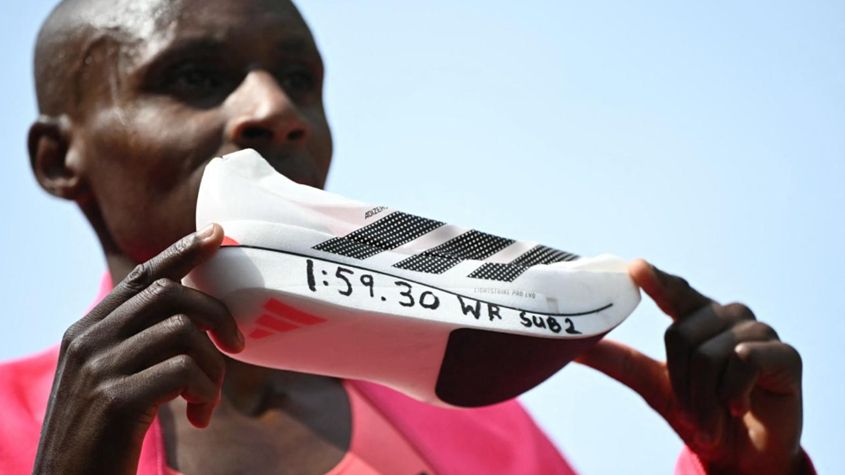
Sabastian Sawe holding Adidas Pro Evo 3.

It’s getting harder than ever to innovate with carbon plate running shoes. Every brand now has at least one super-shoe in its line-up, many have two, and World Athletics regulations limit the stack height and amount of plates you can have in a legal racing shoe for elites.

Despite all of the above, Adidas has managed to create something truly eye-catching with the new Adizero Adios Pro Evo 3, the lightest carbon racing shoe ever.
It launched last week and was used by elites Sabastian Sawe, Tigist Assefa and Yomif Kejelcha at the London Marathon where Sawe and Kejelcha became the first runners to break two hours and Assefa set a new women-only record for the marathon.

I was able to do a short run in the Adidas Pro Evo 3 at its launch event in London, and also spoke to two members of the Adidas team behind its creation: Charlotte Heidmann, category director for Adizero, and Valentin Perrin, senior manager footwear innovation concepts.

Here’s how Adidas went about creating the fastest carbon racing shoe yet.

A carbon rim, instead of rods or a plate

(Image credit: Future)

Past Adidas racers like the Adidas Adizero Adios Pro Evo 2 and Adidas Adizero Adios Pro 4 used a series of carbon rods in their midsole to stiffen the springy foam and add propulsion, while most racing shoes these days have a full carbon plate.

With the Pro Evo 3 Adidas instead opted for a carbon rim that runs around the outside of the midsole, which is lighter than rods or a plate.

“The idea behind the ENERGYRIM was ‘how can we maintain bending stiffness within the shoe, but maximize the amount of foam you have under your foot.’” Says Perrin.

“So we have a stiffening element going on the side, so then you basically sit almost on 40mm of pure foam. That was the main benefit and it's a new way of integrating carbon into foam.”

By sitting on top of foam without a plate, the Pro Evo 3 feels incredibly soft and when running in the shoe I noticed just how much depth and spring there was to the foam.

Adidas’ lightest midsole foam yet

(Image credit: Future)

The Adidas Pro Evo 3 is a high-stack super-shoe, with 39mm of foam at the heel dropping to 36mm at the forefoot. That’s a lot of foam, so for it to be so lightweight the Lightstrike Pro Evo material used had to be even lighter than on past models.

“The new Lightstrike Pro Evo foam is almost 50% lighter than the Pro Evo 2 foam, which is pretty mind blowing,” says Perrin. “This foam, combined with the ENERGYRIM, has 11% more energy return as well.”

An ultra-light upper inspired by kitesurfing

(Image credit: Future)

The midsole and carbon rim are the key performance elements of the shoe, but the Pro Evo 3 needed a functional upper, laces and outsole that kept weight to a minimum as well.

“We wanted to look at what other industries are doing,” says Perrin. “That's why for example we look into what kitesurfers are using, which is similar yarns which are stronger and lighter.

“And we added a bit of mechanical stretch into the laces, so it means that we can reduce the length of the laces and then just save a couple of grammes as well. It was literally counting every microgram.

(Image credit: Future)

“Then on the outsole it’s the same logic and process, in trying to have the rubber outsole as thin as possible. It’s 0.5 mil in terms of thickness in the forefoot and paired with a GCPU heel patch.”

Athlete feedback helped to shape the shoe

(Image credit: Future)

As always with key racing shoes, Adidas relied on its stable of elite athletes to test the various versions of the Pro Evo 3 during its development.

“It’s a constant process of testing,” says Heidmann. “Every time we have a new prototype we get feedback from them and build a new prototype. The team was in Kenya with key athletes to test on the ground and get feedback.”

(Image credit: Adidas)

The Pro Evo 3 has already been used to great effect at the London Marathon, where winner Sabastian Sawe used it to run 1:59:30, the fastest time in history. It will be used from now on by Adidas elites for a range of distances, not just marathons.

“You'll see it on athletes' feet throughout the year,” says Heidmann. “It’s always very dependent on the preference of the athlete. We do have athletes, for example in Japan, that love to wear Takumi still for their shorter distances.

“But it's always a preference thing even for the athletes. So we've seen the Pro Evo popping up in half marathons as well. Is it the best shoe for a 10km? Not sure. We have other shoes that perform great for that distance, but we don't limit the athletes with the toolbox that we have.”

It will be interesting to see how other brands respond with their new carbon racer launches this year, with Asics and Nike prototypes being used by elites to great effect at the Boston and London Marathons as well.

More from Tom's Guide

Sign up to read this article
Read news from 100's of titles, curated specifically for you.
Already a member? Sign in here
Related Stories
Top stories on inkl right now
One subscription that gives you access to news from hundreds of sites
Already a member? Sign in here
Our Picks
Fourteen days free
Download the app
One app. One membership.
100+ trusted global sources.