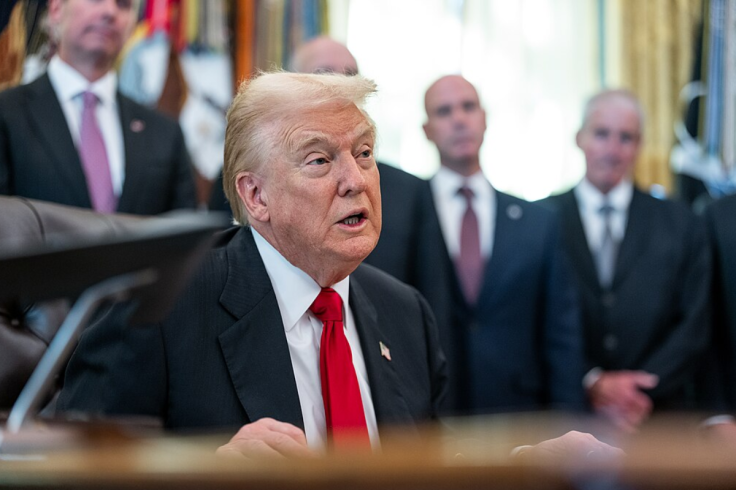
President Donald Trump's leg position during a White House appearance on Tuesday, 29 September, drew attention online after clips circulated on social media.
Trump met with major technology executives over voluntary artificial intelligence safety commitments. The footage showed him standing with his legs at different angles, prompting questions from some viewers about his posture.
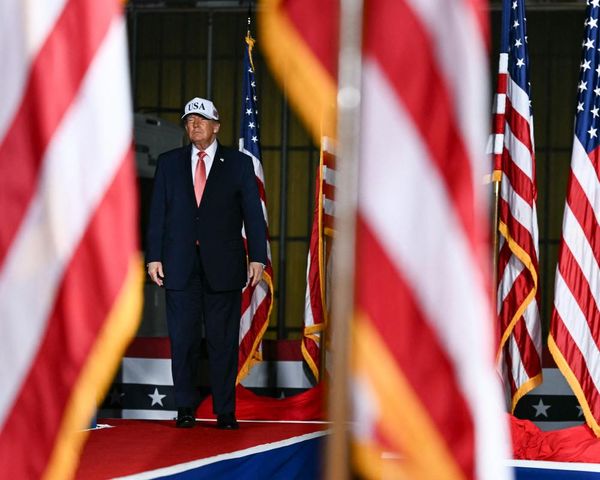
The viral video followed Trump's announcement that leading AI companies had signed a voluntary safety accord. He described the agreement as 'morally binding', as reports said executives from OpenAI, Anthropic, Meta, Google and Nvidia were among those involved.
Online discussion soon shifted from the AI announcement to Trump's stance as some users questioned whether it reflected a health issue, while others simply remarked on how he was standing. No medical assessment explained the posture.
A clip can show how someone stood at a particular moment, but it cannot establish whether the position resulted from discomfort, habit, injury or a medical condition.
Donald Trump Leg Position Draws Attention After AI Meeting
Trump met senior technology executives in Washington as companies agreed to voluntary controls around AI development and safety. Reuters reported that the pact included independent audits and safeguards intended to reduce the risk of unintended system access.
The gathering brought together some of the industry's most prominent figures. OpenAI President Greg Brockman attended alongside executives from Anthropic, Meta, Google and Nvidia.
Yet the clips that travelled across social media were not limited to the AI accord's substance. Viewers also focused on Trump's legs as he spoke to reporters. That reaction does not prove a medical cause, and no doctor publicly connected the position seen in the footage to an injury, neurological condition, or other diagnosis.
That distinction is especially important when health claims spread through social media. Describing visible posture is one thing. Assigning a medical explanation without an examination is another.
Donald Trump Walking Clip Had Drawn Similar Questions
The latest discussion followed another video that circulated on 28 September. That footage showed Trump turning away from reporters before walking towards Marine One at the White House.
Some viewers focused on the movement of his left leg as he walked. The recording prompted online questions about his gait, but it did not provide a clinical explanation for the movement.
The same evidentiary limit applies to the newer footage. Neither video, on its own, shows why Trump moved or stood a particular way.
Disease-specific comparisons are therefore unsupported without medical evidence. General information about symptoms associated with neurological conditions does not establish that those conditions are relevant to Trump.
Donald Trump's May Medical Report Provides Context
Trump, who turned 80 in June, underwent a medical examination at Walter Reed National Military Medical Center on 26 May. His physician, Navy Captain Sean P. Barbabella, later issued a report on the examination.
Barbabella said Trump 'remains in excellent health, demonstrating strong cardiac, pulmonary, neurological and overall physical function.' The report also recorded 'slight lower leg swelling' and described bruising on his hands as 'benign.'
Those documented findings provide medical background, but they do not explain the stance seen on 29 September. Barbabella's report did not connect the latest footage to swelling, injury or a neurological condition.
The White House had previously disclosed in July 2025 that Trump was diagnosed with chronic venous insufficiency after being evaluated for lower-leg swelling. Barbabella described the condition at the time as benign and common among people over 70.
The footage therefore supports a narrow description. Trump's posture attracted online attention during a high-profile White House event, following similar scrutiny of his movement in another recent clip.
What remains unknown is why he adopted that position. Without a medical assessment addressing the specific footage, claims about the cause remain unverified.