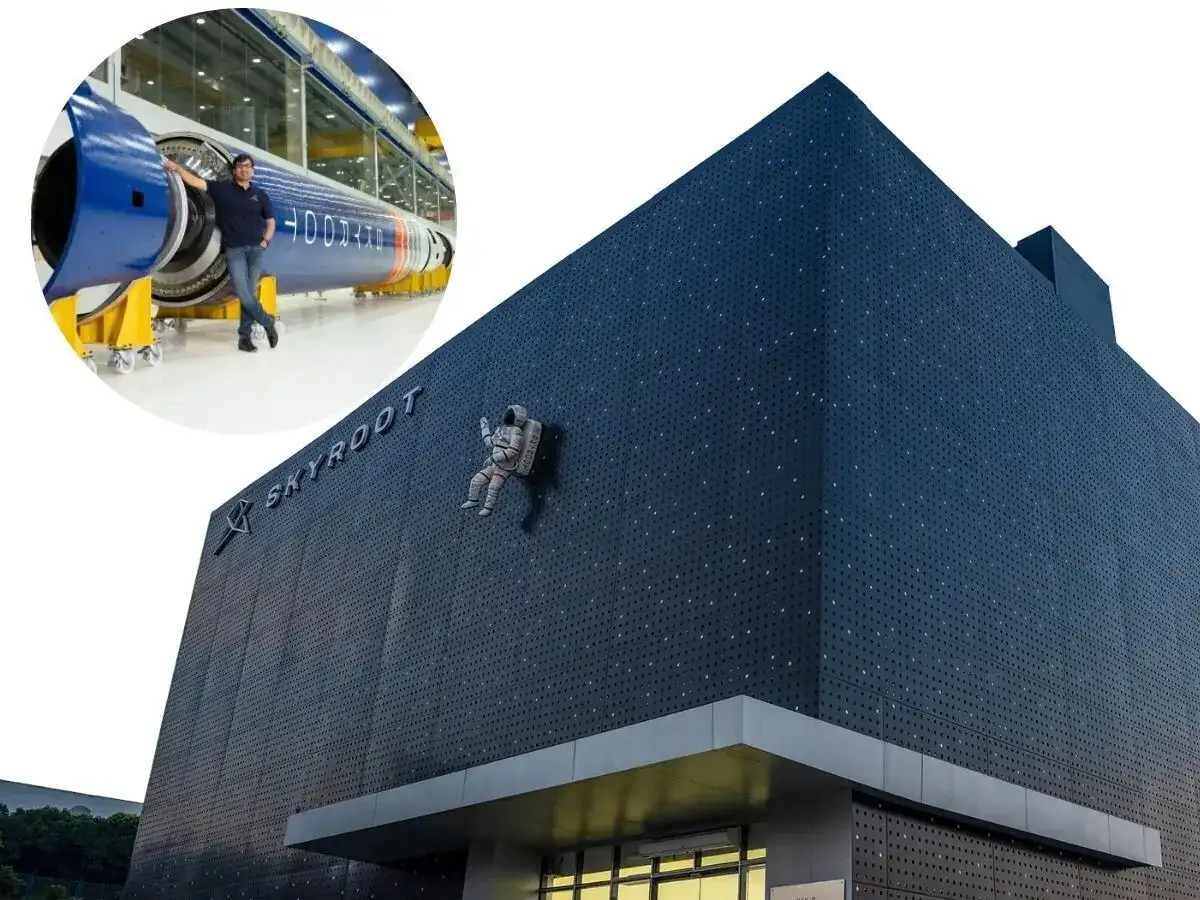
A student who once struggled with mathematics went on to create history in India's space sector. Pawan Kumar Chandana, founder of Skyroot Aerospace , is today leading the company behind India's first privately developed rocket launch, marking a remarkable journey from a middle-class background in Hyderabad to the centre of India's growing private space industry.

Chandana's story stands out because his early academic struggles did not stop him from pursuing his interest in science and technology. From failing to impress in school exams to working as an ISRO scientist and later building one of India's biggest private space companies, his career reflects a journey of persistence and ambition.
A difficult start but a turning point in school
Born in 1991 in Hyderabad, Telangana, Chandana grew up in a middle-class family where he developed an early interest in machines and technology. However, his academic performance in school did not suggest the path he would eventually take.
At one point, he scored only 51 marks in mathematics. But his father's confidence pushed him to improve. He enrolled Chandana in IIT-JEE coaching, where he began strengthening his mathematics and science skills. The preparation not only helped him academically but also developed his interest in engineering and space.
In 2007, Chandana cleared the IIT-JEE examination on his first attempt and joined IIT Kharagpur. He completed a dual BTech-MTech degree in Mechanical Engineering.
While many engineering graduates focused on corporate careers, Chandana remained fascinated by rockets and India's space missions.
From ISRO scientist to space entrepreneur
After graduating from IIT Kharagpur, Chandana joined the Indian Space Research Organisation (ISRO) in 2012 as a scientist. He worked at the Vikram Sarabhai Space Centre in Thiruvananthapuram and contributed to several important projects.
During his nearly six-year tenure, he worked on India's heavy launch vehicle GSLV Mk-III, the S-200 solid booster for GSLV Mk-II and also served as deputy project manager for ISRO's Small Satellite Launch Vehicle (SSLV).
Also Read: This jacket can turn air into drinking water, producing nearly 1 liter a day
In 2016, he received an internal innovation award at ISRO. Although he had planned a long career at the space agency, an idea gradually changed his direction, creating a private space company from India.
At that time, private rocket development in India was still at an early stage and the ecosystem for space startups was limited.
The risky decision that created Skyroot Aerospace
In 2018, Chandana decided to leave ISRO and enter the world of entrepreneurship. The move came without a business background or a strong industry network.
To find support for his idea, he reached out to investors, including Mukesh Bansal, founder of Myntra, CureFit and NuRX, through LinkedIn. Bansal, who was also an IIT Kharagpur alumnus, believed in Chandana's vision and invested $1.5 million in the company.
However, the journey was not easy. The COVID-19 pandemic created challenges for fundraising, especially when the company was trying to secure Series A investment.
Later, support from the founders of renewable energy company Greenko helped Skyroot continue its growth.
In June 2018, Chandana and Naga Bharath Daka, another former ISRO engineer and IIT Bombay alumnus, founded Skyroot Aerospace in Hyderabad.
India's first private rocket launch
Skyroot achieved a major milestone in July 2020 when it became the first private Indian company to test a rocket engine. The company developed Raman-1, a cryogenic engine named after Nobel Prize winner C.V. Raman.
After India opened its space sector to private players in 2021, Skyroot became the first private company to sign a Memorandum of Understanding (MoU) with ISRO. The company later raised a $51 million investment, considered one of India's largest DeepTech funding rounds.
The biggest breakthrough came on November 18, 2022, when Skyroot launched Vikram S, India's first privately developed suborbital rocket.
The rocket was launched from ISRO's Sriharikota launch facility and reached an altitude of around 90 km as part of Mission Prarambh, which means beginning in Sanskrit.
Skyroot's next big mission
As the company expanded, Skyroot built India's largest private rocket manufacturing facility and grew its team to nearly 1,000 employees.
On May 7, 2026, Skyroot raised $60 million in a funding round led by Sherpalo Ventures, the firm of Ram Shriram, the first external investor in Google, along with Singapore's sovereign wealth fund GIC.
The funding valued Skyroot Aerospace at around $1.1 billion. The company is now preparing for the launch of Vikram-1, its orbital launch vehicle planned for 2026.
If the mission succeeds, Skyroot could become one of the few private companies in the world capable of regular orbital launches. While the US has SpaceX and New Zealand has Rocket Lab, India is aiming to establish Skyroot as its own major private space player.