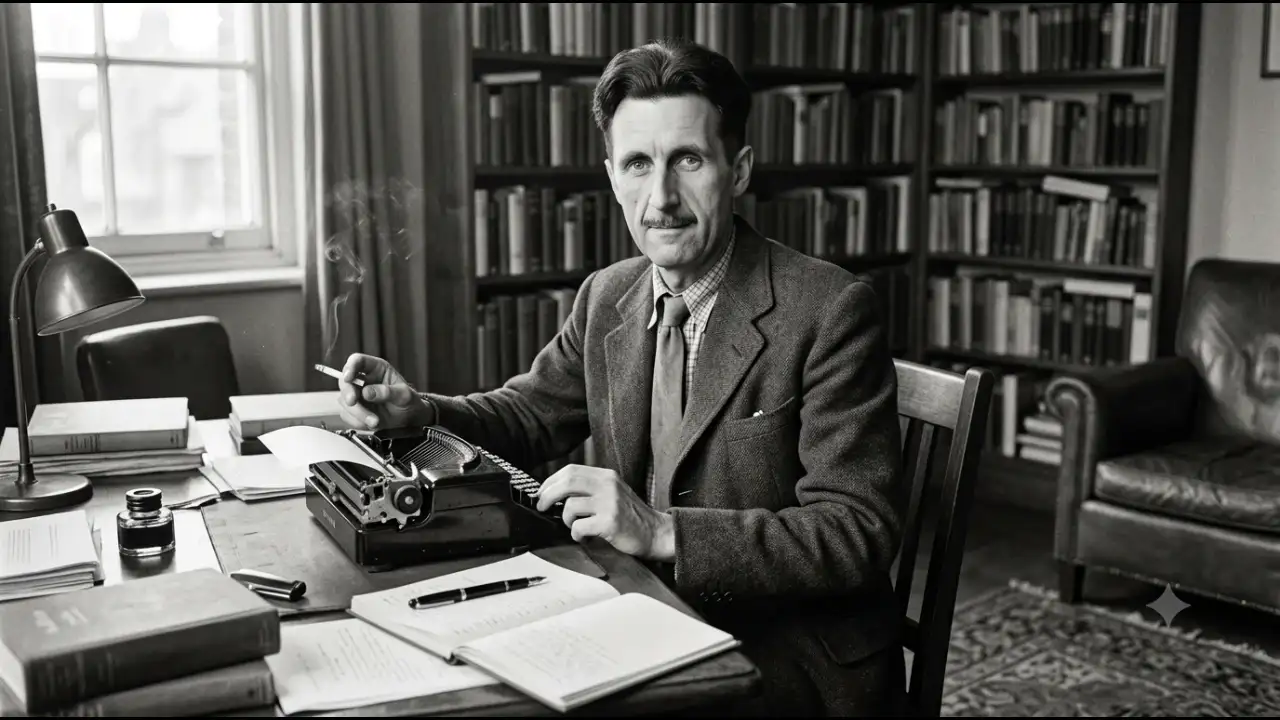
Hard truth of the day by George Orwell : War is usually explained through politics, national security, borders or conflicts between countries. But sometimes, the hardest questions are the ones that ask us to look beyond those explanations. Who benefits when a war begins? Who stands to make money from it?

Hard Truth of the Day: George Orwell on Who Benefits From War
English novelist George Orwell raised that uncomfortable question in a blunt observation, “ War against a foreign country only happens when the moneyed classes think they are going to profit from it ,” as per BrainyQuote.
The quote offers a hard-edged view of the relationship between war, wealth and power. Rather than looking only at the public reasons given for conflict, Orwell draws attention to the financial interests that can exist behind major political decisions.
George Orwell’s Hard Truth About War and Money
Orwell’s quote presents war through the lens of economic self-interest. The phrase “moneyed classes” refers to wealthy or financially powerful groups, while “profit” places economic gain at the center of his argument.
The observation challenges readers to look beyond the surface of political events and consider the interests that may accompany them.
What Does George Orwell’s Quote Mean
The quote suggests that powerful economic interests can influence decisions surrounding war when those interests expect financial benefits from conflict.
It is a blunt reminder that war does not exist separately from economics. Money, influence and political power can become intertwined when nations enter conflicts.
Hard Truth of the Day: Look Beyond the Surface
One of the strongest ideas in Orwell’s quote is the importance of questioning what lies beneath major events.
Public explanations for war can focus on national security, political goals or international disputes. Orwell’s observation encourages people to also ask a different question: Who benefits financially?
That question does not by itself explain every war, but it highlights the role that economic interests can play in how conflicts are understood.
George Orwell Quote About War and Profit
Orwell was known for writing about politics, power and the ways language can shape public understanding. This quote fits into that broader concern by connecting military conflict with wealth and economic interests.
Its message remains striking because it shifts attention from the battlefield to the people and institutions that may have financial interests connected to war.
Who Was George Orwell
George Orwell was an English novelist, essayist and critic best known for Animal Farm and Nineteen Eighty-four. Born Eric Arthur Blair in Motihari, Bengal, India, on June 25, 1903, he adopted the name George Orwell. He died in London on January 21, 1950, aged 46.
Orwell served in the Indian Imperial Police in Burma from 1922, as per a Britannica report. His experiences there changed his views on imperialism and influenced works such as Burmese Days, A Hanging and Shooting an Elephant.
After leaving the police in 1928, he focused on writing. His experiences among poor and working-class people inspired Down and Out in Paris and London, published in 1933.
George Orwell’s Famous Books
Orwell’s major works include The Road to Wigan Pier, Homage to Catalonia, Animal Farm and Nineteen Eighty-four.
Animal Farm, published in 1945, was a political fable based on the Russian Revolution and its betrayal by Joseph Stalin. Nineteen Eighty-four, published in 1949, depicts a totalitarian society controlled through surveillance, censorship and the rewriting of history.
George Orwell’s Political Writing
Orwell also wrote extensively about politics and language. His 1946 essay Politics and the English Language examined political language and misleading writing.
His experiences during the Spanish Civil War also shaped his political writing and inspired Homage to Catalonia.
When Did George Orwell Die
Orwell died in a London hospital in January 1950 while dealing with tuberculosis. He was 46.
Animal Farm and Nineteen Eighty-four remain his most famous works and are closely associated with his writing about political power, control and totalitarianism.