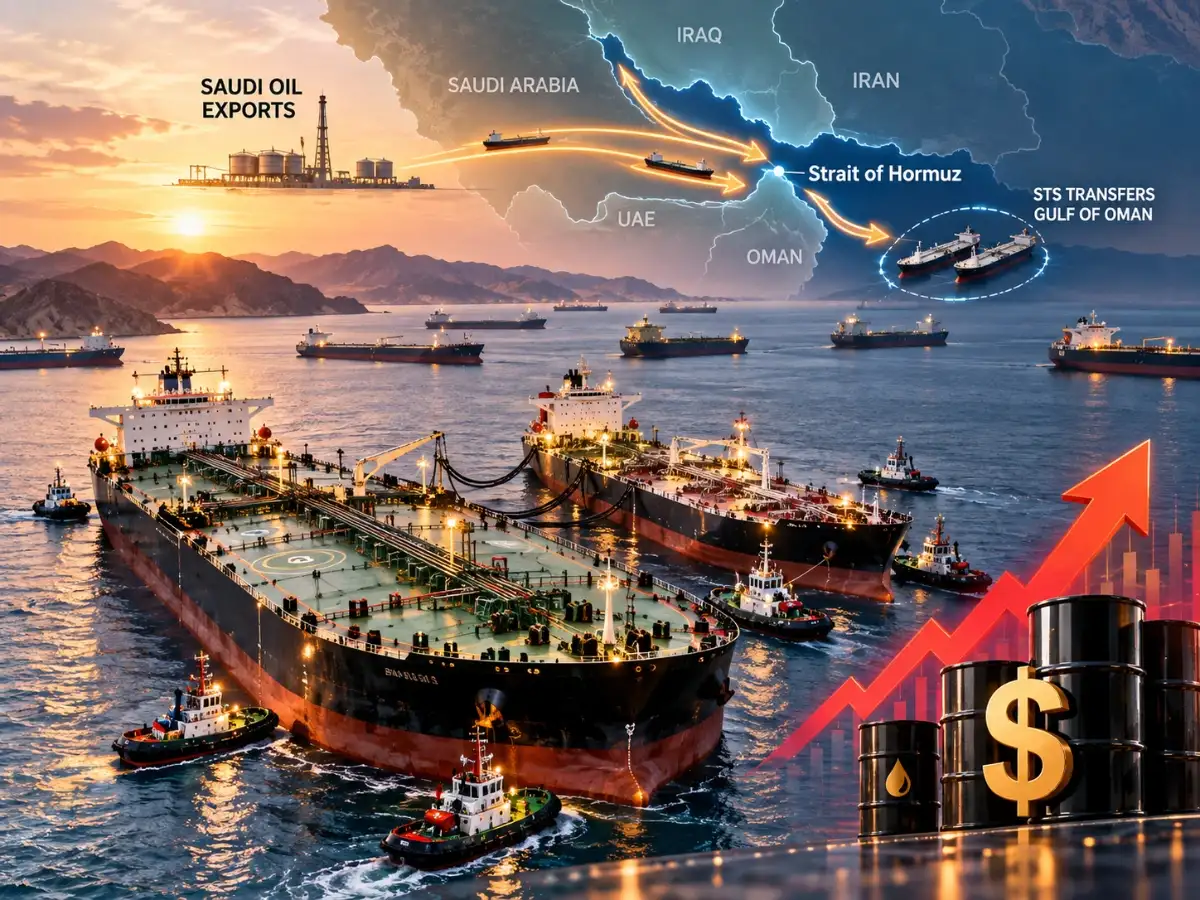
Ship-to-ship (STS) transfers in the Gulf of Oman have reached capacity as Saudi Arabia increases crude exports through the Strait of Hormuz following disruptions to its Red Sea export route, putting further pressure on tanker availability and shipping costs, according to trade sources and analysts cited by Reuters.
The rise in Saudi shipments has increased demand for supertankers that shuttle crude through Hormuz before transferring cargoes to larger vessels outside the strait. The resulting shortage of available tankers has pushed up freight rates and extended the time crude spends at sea before reaching refineries.

Read more: Global Market: Japanese shares rise on AI stocks, dividend buying; Nikkei up 1.2%
State-owned Saudi Aramco has sold more than 60 million barrels of crude for STS transfers off Sohar, Oman, for this month and next. The arrangements followed an attack on Saudi Arabia's East-West Pipeline on September 13 that disrupted crude exports from the Red Sea port of Yanbu.
Saudi oil flows through Hormuz surge
Saudi crude exports through the Strait of Hormuz are expected to reach about 3.6 million barrels per day (bpd) in September, compared with around 900,000 bpd in August, according to data from oil analytics firm Kpler cited by Reuters.
The increase of almost 3 million bpd would require an additional 36 to 40 very large crude carriers (VLCCs), with each vessel capable of carrying around 2 million barrels of crude, Kpler analyst Panagiotis Krontiras estimated.
Oil Brokerage's global shipping research head Anoop Singh estimated that the number of additional VLCCs required to move the increased volumes had risen to about 40 in September from 24 in August. Additional Saudi flows alone could require around 15 VLCCs for shuttle operations, while another 20 vessels remain effectively tied up in the Mediterranean awaiting the restoration of Yanbu operations.
The surge in tanker demand has sent freight rates sharply higher. The daily time-charter rate for a VLCC carrying Middle Eastern crude to China reached a record $1.27 million on Monday, according to LSEG data cited by Reuters.
Global Market: Hong Kong stocks slide as investors await Trump-Xi summit detail
STS operations face growing congestion
Saudi Arabia's increased volumes are adding to crude shipments from other Gulf producers, including Iraq and the United Arab Emirates, that are also using STS transfers outside the Strait of Hormuz.
Before the current disruptions, most crude cargoes from Gulf producers other than Iran were typically loaded directly by buyers. The growing reliance on STS operations has created bottlenecks involving tankers, tugboats and labour, according to traders and analysts.
Vortexa analysts said STS volumes for crude loaded on VLCCs from ports west of Hormuz have remained at around 6 million bpd since the end of August. That is equivalent to roughly three VLCC pairs beginning STS operations each day.
The duration of individual STS operations has also increased. Vortexa analyst Emma Li told Reuters that operations now take nearly 10 days, compared with around five to seven days previously.
The congestion has encouraged some Chinese buyers to explore alternative transfer locations, including off India's west coast and Malaysia, while some are seeking direct refinery deliveries.
Tankers seek alternative routes
The disruption is already changing established crude-shipping patterns in Asia.
One Saudi VLCC loaded about 2 million barrels of crude at Ras Tanura earlier this week and was heading directly toward Quanzhou in eastern China, according to Kpler and LSEG data. Refineries operated by Sinochem and Fujian Refining, which is partly owned by Saudi Aramco, are located near the destination.
South Korean refiner S-Oil is also sending two VLCCs to conduct STS transfers off Vadinar on India's west coast, according to a Middle East crude trader cited by Reuters. Meanwhile, tanker activity involving crude transfers has increased around Malaysia's Linggi transhipment hub.
A Singapore-based shipbroker told Reuters that, in some cases, it may be more economical for large tankers to discharge crude into smaller vessels, which then transport the oil to North Asia, rather than sending VLCCs directly to the final destination.
Tanker shortage adds to oil-market pressure
The growing dependence on STS transfers highlights the logistical strain created by disruptions around the Strait of Hormuz and the Red Sea. STS transfers in the Gulf of Oman had already become an important mechanism for keeping Gulf crude exports moving despite reduced shipping activity through traditional routes.
Saudi Arabia has significantly increased shipments from its eastern Gulf terminals since the East-West Pipeline disruption. Saudi Aramco loaded about 14 million barrels onto seven VLCCs at Ras Tanura on September 20, while Saudi crude flows through Hormuz had risen sharply from August levels.
As more producers rely on the same tanker pool and STS infrastructure, competition for vessels and transfer capacity is increasing. The result is higher freight costs, longer voyage times and a more complicated route for Middle Eastern crude reaching Asian refineries.
(Disclaimer: Recommendations, suggestions, views and opinions given by the experts are their own. These do not represent the views of The Economic Times.)