
Get all your news in one place.
100's of premium titles.
One app.
Start reading
TechRadar
TechRadar
Phil Iwaniuk

GHS Wireless InfinitePlay isn’t just a marketing name — I’ve used this Glorious gaming headset for weeks and the battery life really is (almost) infinite

The Glorious GHS Wireless InfinitePlay gaming headset in black and orange on a plain white desktop.

Glorious GHS Wireless InfinitePlay: one-minute review

There’s something deeply satisfying about the way Glorious goes about speccing its gaming peripherals. The company has a sharp eye for nonsense, and ruthlessly strips it out of the mice and, now, the headset that it brings to the gaming market. Behold, then, the GHS Wireless InfinitePlay, a wireless gaming headset featuring precisely zero RGB, built around normal-sized 40mm drivers, just quietly getting on with giving you multiplatform audio with infinite battery life and two mic options for $230.

With one swappable battery pack placed in the base station, it’s charging ready for use while you have the other one of the pair in your headset. Each one offers 85 hours of use from a full charge, and in case that wasn’t enough, a ‘guardian’ 45mAh built-in battery handles the changeover so you don’t need to turn the headset back on again after you swap. Handy.

That same ‘you won’t need it, but just in case…’ ethos is evident in the mic spec. You’ve got a detachable 70Hz-10KHz noise-cancelling mic for when you’re seated, locked in and ready to absolutely bellow at your team-mates away from prying eyes, and a built-in mic to use when you’re out and about using the Bluetooth connection to a mobile device or Nintendo Switch, and don’t fancy looking like an air traffic controller. Yes, it has 2.4GHz and Bluetooth 5.4 connections, swappable with one button press.

(Image credit: Future)

And that’s a very impressive feature set at any price, but especially for $229.99 / £199.99 / AU$239.99. It’s not even super clear where the concessions have been made to hit the price point. The audio quality is simply good rather than audiophile-grade, but that’s totally in line with what this headset is for: gaming. It’s trying to articulate useful audio cues, not trick your ears into thinking they’re in the expensive seats at an IMAX cinema.

Similarly, the construction materials are almost exclusively lightweight, brushed black plastic rather than anything showier, but that serves the sprightly 360g headset weight.

One area of that headset build and design I did run into issues with is the headband. Your experience will vary depending on your head size, but I found a degree of pressure that becomes slightly uncomfortable during longer sessions. This being an elasticated suspended band design, it’s possible that this may ease as the band slackens over time, but during the month I’ve been using my unit I do still notice discomfort.

Besides that, there’s very little to grumble about. The power button isn’t clearly labelled, and the Bluetooth button can easily be confused for it, but this is a one-time issue. Once you know what’s what, that moment of unintuitive design becomes moot and you can enjoy the fantastic feature set of these cans.

Glorious GHS Wireless InfinitePlay: Price and availability

  • List price: $229.99 / £199.99 / AU$239.99
  • Swappable batteries like the Arctis Nova Pro Wireless, for less
  • Packed with useful extras

The extremely competitive pricing of this package is certainly one of its biggest assets. Packing a dual swappable battery design for less than Steelseries’ Arctis Nova Pro Wireless is a great way to announce one’s presence in the headset market, and Glorious backs that head-turning spec up with a number of handy additions that justify the price point.

Namely, a choice of mics (detachable or built-in) and a ‘guardian’ built-in battery that kicks in when you swap between the rechargeable packs, along with some serious configuration flexibility offered by the base station and dongle.

In this challenging economy, to put it mildly, you’d simply expect to see this package priced higher. The construction materials aren’t comparable with ultra-high-end models like the Audeze Maxwell 2 or the Logitech Astro A50 X, but they’re sturdy and finished to a high standard.

Glorious GHS Wireless InfinitePlay: Specs

Glorious GHS Wireless InfinitePlay

Price

$229.99 / £199.99 / AU$239.99

Weight

360g / 0.8lbs

Battery life

85 hours per pack

Compatibility

PC, PS4, PS5, Switch, Android, iPhone

Connectivity

Bluetooth, 2.4GHz wireless, USB-C wired

Microphone

16-bit/48KHz

Glorious GHS Wireless InfinitePlay: Design and features

  • Black and orange design is Valve-esque
  • Prioritises light weight over looks
  • Battery packs look like retro FPS keycards

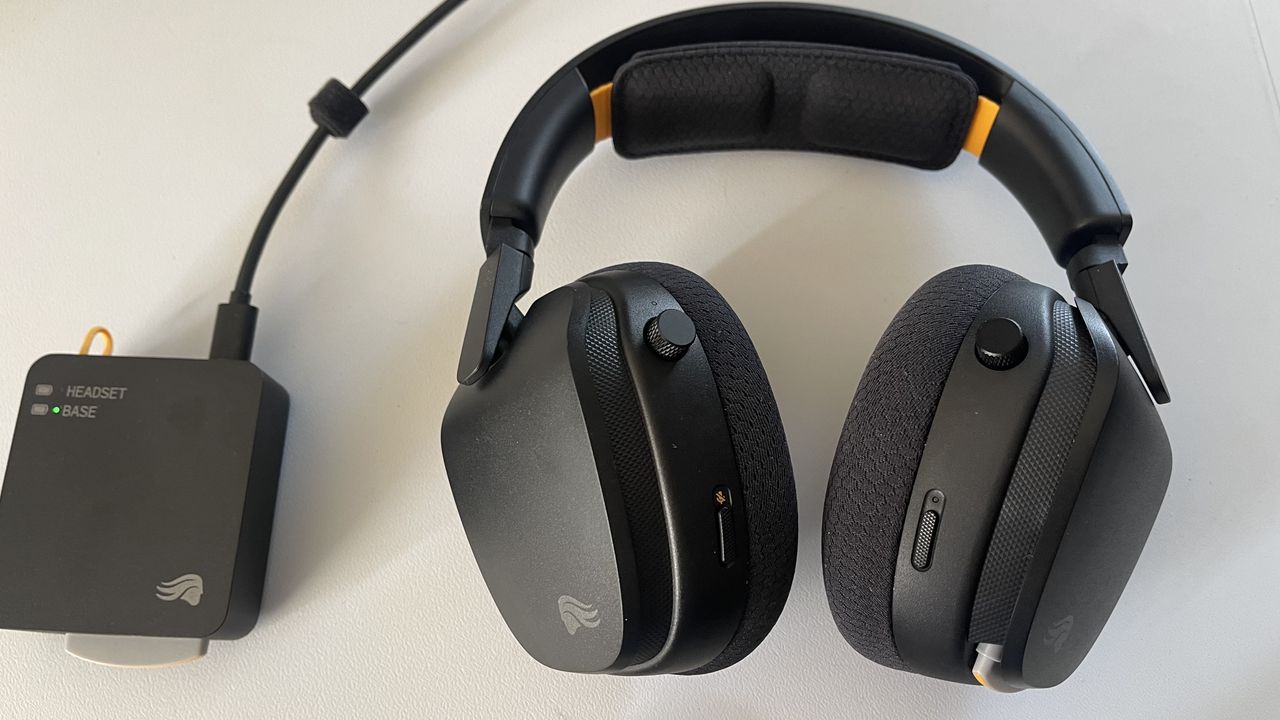
There’s a duality here to Glorious’ headset stylings. On the one hand, it's extremely restrained with the brushed black plastic on the base station and headset, an elegant amount of orange contrast trim on the whole package, and battery packs that look like they’d unlock a door in a ‘90’s shooter.

On the other hand, the company’s fundamental branding is based on a joke that got old quite a while ago. The brand's name references the glorious PC gaming master race meme and subreddit, which worked as a self-aware joke about PC gaming elitism in 2008 and 2011, but in 2026 works… less so. Look, this could just be an age thing, but to me the GabeN-like brand logo and ‘GGWP’ text on the lower-left earcup feel just a few steps away from a ‘Keep out mom, I’m gaming!’ poster. Given that this headset works with PS5, PS4, Switch and mobile devices (there’s no Xbox version), it’s also just confusing branding at this point.

With that chiding out of the way, I do like the look of this headset. The orange trim feels Valve-esque in the right way, like someone very clever sat and thought about this for a long time. The base station is compact and smart, with indicator lights to show when it’s connected to your headset and the charge status of the battery pack slotted into it. Two USB-C ports to the rear connect to a wireless dongle which sits flush with the base station when connected, and a USB-C-to-USB-C cable to connect to your PC or console. A USB-C to A adapter is also provided.

(Image credit: Future)

The base station, dongle, cables, and Bluetooth connection create tons of setup configurations. You can ditch the base station and just use the dongle if you like, although that does mean you don’t have a spare battery charging while you use it. You can even ditch the dongle too and connect the headset with the USB-C cable, although I haven’t found a use case yet where that makes sense, since the built-in battery has a few hours of life even when both swappable packs are depleted.

The headset itself is pretty lightweight for a wireless model with a battery pack, eschewing flashy finishes for an all-plastic body with a fabric headband on suspended elastic, and breathable fabric earcups covering reasonably plush memory foam cushions. If you love that pulsing, sealed-in feeling of closed-back headphones like the HyperX Cloud, these aren’t your cans. They’re certainly closed-back, but the fabric around the earcups does affect the way you experience the audio from its 40mm drivers, producing a flat, detailed but not very low-end heavy response that’s reminiscent of Steelseries’ excellent Arctis Nova 7 and upwards.

I don’t get on with the physical control layout here, though. The location of the (unmarked) power button on the upper-left earcup threw me initially, and I think this control and its right-hand earcup mate are trying to do too much. Both are rotary dials as well as buttons, and while the left controls chat mix, profile swapping and battery status, the right controls volume and media controls. I’m all for minimalist design, but try navigating that while you’re concentrating on something in-game. It took me a couple of weeks to memorise how to perform all those actions.

Just one more gripe – the battery status readout would be much better if it gave you a percentage rather than simply an ‘ok’ or ‘charge now’. Maybe one for a future firmware update.

(Image credit: Future)

Glorious GHS Wireless InfinitePlay: Performance

  • Tuned for gaming performance
  • Good suite of software tweaks
  • Battery life true to claims

We all know by now that buying a mouse, keyboard, or headset doesn’t turn you into a Faze Clan member, and the gaming performance gains in the headset vertical are especially marginal. That said, if you’re listening out for footsteps in PUBG Battlegrounds and your 2014 cans with their 60mm grotesquely tuned drivers are too busy making a far-off gunfight sound like a drum and bass gig, you might notice a bit of an advantage when you update your audio hardware.

That’s why it’s important that these drivers are tuned with a nice flat EQ response. That means that they don’t strongly emphasise one particular area of the EQ spectrum, unlike the aforementioned early 2010s models with their ‘scooped’ profiles that boosted the lows and highs like a sound engineer at a Metallica gig.

Sticking with a roughly even volume distribution along the spectrum means that the GHS Wireless InfinitePlay gives all frequencies space to voice and be heard. It might not sound mind-blowing like Audio-Technica or Audeze drivers, but it’s well-suited to games that reward a keen ear, from competitive shooters to singleplayer titles.

I find headsets tuned this way really useful in racing sims too, where I need to hear brake lockups and tire squeals as early as possible, and as prominently in the mix as I can.

Over in Glorious Core, the accompanying software, there’s a welcome and well-judged suite of options including a sidetone toggle, EQ tuning including some basic provided profiles, mic settings like noise cancellation toggling, and several options to tweak the headset behaviour, like when it auto-powers down and whether it gives you voice prompts. I don’t love that it’s taking up 0.99GB of my SSD space to do that, though, and would much prefer a browser-based tuning app.

The battery life really is as long per pack as Glorious states, and swapping them out is easy while you’re mid-session. Just take the spent one out, let the ‘guardian’ battery take over until the end of the round or the next quiet moment, then swap in the other pack.

I didn’t run into any setup issues when I used this with PC, PS5 or Switch, and found that the dual-wireless is pretty rock solid. It’s less suited as a console headset, particularly the Switch, since it really needs the base station to be connected in order to keep a battery pack charged and ready. But as a multiplatform solution (marketing types like to call these ‘battle station’ setups), it offers a no-fuss means to switch between devices.

(Image credit: Future)

Should you buy the Glorious GHS Wireless InfinitePlay?

Buy it if...

Don't buy it if...

Glorious GHS Wireless InfinitePlay: Also consider

Not feeling like swapping in this wireless headset? Consider these premium wireless alternatives.

Glorious GHS Wireless InfinitePlay

Audeze Maxwell 2

Steelseries Arctis Nova Pro Wireless

Price

$229.99 / £199.99 / AU$239.99

$349.99 / £329.99 / AU$520

$349 (£329, AU$649)

Weight

360g / 0.8lbs

490g / 1.1lbs

0.75lbs / 339g

Battery life

85 hours

80 hours

36 hours

Connection type

PC, PS4, PS5, Switch, Android, iPhone

2.4GHz wireless, digital wired (USB-C), analog wired (3.5mm audio jack), Bluetooth

Bluetooth, 2.4GHz wireless

Compatibility

Bluetooth, 2.4GHz wireless, USB-C wired

PC, Xbox (Xbox version only), PS5 (PlayStation version only), Switch, MacOS, iOS, Android

Playstation 4/5, PC, Nintendo Switch, iOS, Android

How I tested the Glorious GHS Wireless InfinitePlay

  • One month of use on PC, PS5, Switch and mobile.
  • All configurations tested
  • Tested with shooters, battle royales, racing games and more

Something about the black and orange design of this headset and base station gave me an overwhelming urge to replay Half-Life 2 episodes 1 and 2, so that is where I began. Hearing those familiar audio files through new drivers is a good reference point, actually, which helps to suss out how good the GHS Wireless InfinitePlay is at positional audio.

I’ve also been playing PUBG Battlegrounds, Counter-Strike 2 and F1 25 with this headset, and putting the mic through its paces with amateur found footage horror simulator, Content Warning.

Since it offers an array of connection types – with or without the base station, wired connection – I’ve spent some time playing on all of them, across my PC, Switch, and PS5.

First reviewed April 2026.

Sign up to read this article
Read news from 100's of titles, curated specifically for you.
Already a member? Sign in here
Related Stories
Top stories on inkl right now
One subscription that gives you access to news from hundreds of sites
Already a member? Sign in here
Our Picks
Fourteen days free
Download the app
One app. One membership.
100+ trusted global sources.