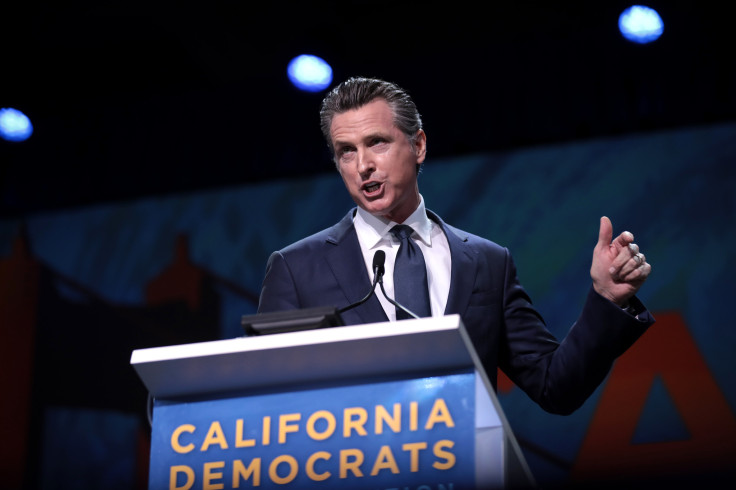
The gauntlet has been thrown, and California's governor has picked it up with characteristic swagger. When President Donald Trump stood before House Republicans and declared that Gavin Newsom 'couldn't pass' a cognitive test, dismissing him as someone with merely 'a good line of crap,' he likely didn't anticipate the swift and cutting response that would follow.
Within hours, Newsom had fired back with a challenge so pointed it drew over 1.2 million views and 41,000 likes on social media. Yet Trump, for all his public bravado about his own cognitive abilities, has remained conspicuously silent.
The exchange exposes far more than political theatre. It reveals the increasingly central role that questions about mental fitness play in American politics, and the uncomfortable reality that the president's repeated claims of cognitive superiority may crumble under actual scrutiny.
For a man who has made intellectual prowess a cornerstone of his political brand, Trump's silence in the face of Newsom's straightforward challenge speaks volumes.
The controversy began when Trump, addressing Republican legislators, proposed mandatory cognitive testing for anyone seeking the presidency or vice-presidency.
'They should give everybody, like, these [competency tests, right? Cognitive, they call it]', Trump said. In the same breath, he issued his challenge: 'Do you think Walz could pass a cognitive test? Do you think Kamala could? I don't think Gavin could. He's got a good line of crap, but other than that, he couldn't pass.'
The irony, of course, is that Trump has spent months boasting about his own cognitive test results, claiming he has 'aced' the examination multiple times—something he insists no other president or vice-president has been willing to undertake. Yet his claims contain a troubling ambiguity.
On 2 January, Trump posted on Truth Social that he had passed a cognitive examination 'for the third straight time,' yet provided no medical documentation or independent verification of these results. Whether he's referencing three separate tests or repeatedly citing the same examination remains unclear.
The Newsom Challenge: Why Trump's Silence On Cognitive Testing Speaks Volumes
Newsom's response was elegant in its simplicity and devastating in its implications. Quoting the actual cognitive test Trump has referenced—'Person. Woman. Man. Camera. TV'—Newsom wrote: '@realDonaldTrump, if you're so confident, let's do it. Name your time and place.'
Person. Woman. Man. Camera. TV.@realDonaldTrump, if you're so confident, let's do it. Name your time and place. https://t.co/SNHHzKdwiu
— Governor Gavin Newsom (@CAgovernor) January 6, 2026
The quote itself is instructive. These five words form part of the Montreal Cognitive Assessment, a screening tool designed to identify early cognitive impairment.
By repeating them back to Trump, Newsom was essentially holding up a mirror, asking the president to back up his own rhetoric with action. It was a calculated move, combining directness with subtle mockery.
The challenge has exposed the limits of Trump's public confidence. Despite months of claims about passing cognitive tests, despite positioning mental acuity as a central campaign talking point, Trump has not accepted Newsom's invitation.
Neither he nor the White House has issued a public response. For a politician who rarely misses an opportunity to engage on social media, this silence is telling.
What makes Newsom's challenge particularly effective is that it draws on Trump's own suggested framework. The president has insisted that all politicians should submit to cognitive testing.
Here was a senior political figure agreeing, publicly and without hesitation, to do exactly that. Trump had set the terms; Newsom was simply asking him to follow through.
Understanding Trump's Cognitive Testing Claims: Verification And Transparency In Question
Trump's concerns about the mental fitness of his political opponents aren't entirely baseless. Public figures facing scrutiny over their mental acuity have a legitimate responsibility to address such concerns transparently. The problem is that Trump's approach has been selective and performative rather than substantive.
His 'slip-ups' have become increasingly difficult to ignore. He has confused the names of countries, misidentified foreign leaders, and demonstrated troubling memory lapses. His speech patterns have grown more repetitive and, according to observers, increasingly erratic.
These aren't matters of political disagreement; they're observable phenomena that raise legitimate questions about cognitive function.
Yet Trump's response to such observations has been blanket denial combined with unverified claims of perfect health. He has demanded that others submit to testing whilst refusing to provide independent medical documentation of his own results. This asymmetry undermines his credibility.
Notably, Newsom isn't the only public figure willing to undergo such testing. Late-night television host Jimmy Kimmel recently participated in the same cognitive assessment on his show, achieving what the medical professional administering the test described as a 'perfect score.'
Kimmel's humorous response—'So I can be president'—captured the absurdity of Trump's apparent selective application of his own standards.
The real consequence of Newsom's challenge isn't whether Trump will accept it. It's that the narrative has shifted. Trump can no longer frame cognitive testing as something he alone has bravely undergone whilst others lack the courage.
Instead, he looks like a man who proposed a test, boasted about passing it, and then refused to participate when called to do so publicly. For a president who has built his political brand on toughness and confidence, that's a difficult position to occupy.