
The world of tennis stands on the brink of a generational shift. Legends are ready to step down from the podium, making way for rapidly rising young stars. In the 2023-2024 season, the main contenders for Grand Slam victories include 22-year-old Iga Swiatek and the even younger Carlos Alcaraz, already celebrated with major titles. Alongside them is a whole constellation of new-generation talents: Jannik Sinner, Cori "Coco" Gauff, Holger Rune, Leylah Fernandez, and Jasmine Paolini. What do all these players have in common, besides their youth?
We spoke with young professional tennis player Savriyan Danilov, the Russian champion in doubles, winner of the ITF professional tournament M15 series in singles (Finland), member of the ATP (Association of Tennis Professionals), and member of the NCAA (National Collegiate Athletic Association). He was ranked in the top 30 best players in the country in the NCAA league and in the top 560 of the ATP.
Throughout his professional career, he has frequently crossed paths and trained with leading world tennis players, including Daniil Medvedev and Novak Djokovic.
%20and%20Savriyan%20Danilov%20(right)%20during%20training.png)
Novak Djokovic (left) and Savriyan Danilov (right) during training
In tournament play, he has achieved victories over ATP-level players such as Jiri Lehecka and Roman Safiullin.
Today, he plays for the University of San Diego team (USA) and represents the highest level of collegiate sports in the United States (Division I).
Savriyan Danilov is convinced: the new season will usher in an era of players who have transformed the entire training system itself, becoming more versatile and psychologically resilient - and therefore having every chance to become champions as early as 2024.
Youth Who Don't Fear
Recent years have begun to blur the boundaries between the "old guard" and the new generation. If victories by juniors over top players used to be more of a sensation, now they hardly surprise anyone.
"The main thing that has changed is the psychology of the young player. In the past, a newcomer would step onto the court against, say, Novak Djokovic or Rafael Nadal more to gain experience, because internally they were already prepared to lose. Today, young athletes enter with the mindset 'I'm here to win.' They focus not on rankings but on the ball that's on the other side of the net. Look at Alcaraz or Sinner, with their willingness to take risks and their healthy aggression from the first rallies are an important component of the new championship code. They don't wait for a special moment. They simply take control of the situation," believes Savriyan Danilov.
The expert notes that the infrastructure of youth and junior tennis has also taken a major leap forward. According to him, starting as early as 12–14 years old, young athletes are immersed in a professional environment: regular training camps, tournaments abroad, and serious work with coaches and psychologists.
Evolution of Athletic Training: From Universality to Personalization
The comprehensive technological revolution has also affected the world of sports, and tennis player training is becoming similar to a precise science, draws a parallel Savriyan Danilov: "If five years ago the foundation was general physical training and 'drilling' technique, today everything is built around personal data. Each athlete is viewed as a unique set of biomechanical parameters, strengths, and weaknesses. And the coach's task is not to fit everyone into one mold but to create a personalized 'roadmap' for development. So modern professional training takes place in close collaboration among the coach, doctor, bioengineer, nutritionist, psychologist, and a whole range of specialized experts."
The approach to the game itself has also changed. Tennis players are increasingly abandoning the "universal" model and developing their own style. Some bet on speed and aggression from the baseline, others on variability, net play, or tactical flexibility. Therefore, training is becoming more targeted: movement patterns, load, recovery, and individual work volume are analyzed. According to Danilov, this kind of personalization allows players to progress faster and reveal their strengths rather than trying to conform to someone else's template.
The Endurance Game: Why Modern Tennis Has Changed
Modern tennis has changed not only psychologically but also in the very structure of the game. In recent years, courts have become noticeably slower, which has significantly impacted the dynamics of rallies. Winning through sheer power alone is now practically impossible - endurance, variability, and the ability to control the ball in long rallies have come to the forefront.
According to Savriyan Danilov, the slowing of surfaces has made spin one of the key elements of the game. Players increasingly use topspin to manage pace, build rallies, and gradually create an advantage. That's why modern tennis has become more physical and demanding: matches last longer, the load has increased, and the ability to endure and maintain concentration throughout the entire match has become a decisive factor.
"This is especially noticeable in matches against young players: rallies become longer, and the pace doesn't drop for a second. You realize you need to fight for every ball until the end," notes Danilov.
Training the New Generation: Focus on Health and Recovery
No fewer changes have occurred off the court. Today, training is structured around the individual physiological characteristics of each athlete. Special attention is paid to load control, recovery quality, and injury prevention.
Modern players regularly monitor their body's condition - fatigue levels, sleep, recovery cycles. This allows coaches and medical specialists to precisely regulate the training process and avoid overload. In Danilov's opinion, in the context of a long season, proper recovery often becomes a decisive advantage, allowing players to maintain stability and compete for high results.
Mental Evolution: Why Today's Juniors Have Stronger Nerves
An integral part of the modern champion's profile is psychological resilience, and in this sense, the new generation demonstrates unusual maturity, believes Savriyan Danilov.
"Previously, an athlete's work with a psychologist was one of the key elements of preparation. From childhood, players learn to work with their mental state, mastering techniques for managing anger, concentration, and visualizing success. They know what mindfulness is and can truly masterfully release tension between rallies. Look at the cold gaze of champions in decisive moments, at their ability to pull themselves together after unsuccessful sets. All of this is, among other things, the result of systematic psychological work."
The expert also added that negativity on social media and media pressure, which previously could "break" a young athlete, are now presented as an inevitable part of real life that one must also prepare for. Young players are taught to properly interact with the outside world, separate personal from professional, and transform digital platforms from additional sources of stress into effective tools for building a personal brand.
A Champion's Forecast: Who Will "Rule the World" in 2024
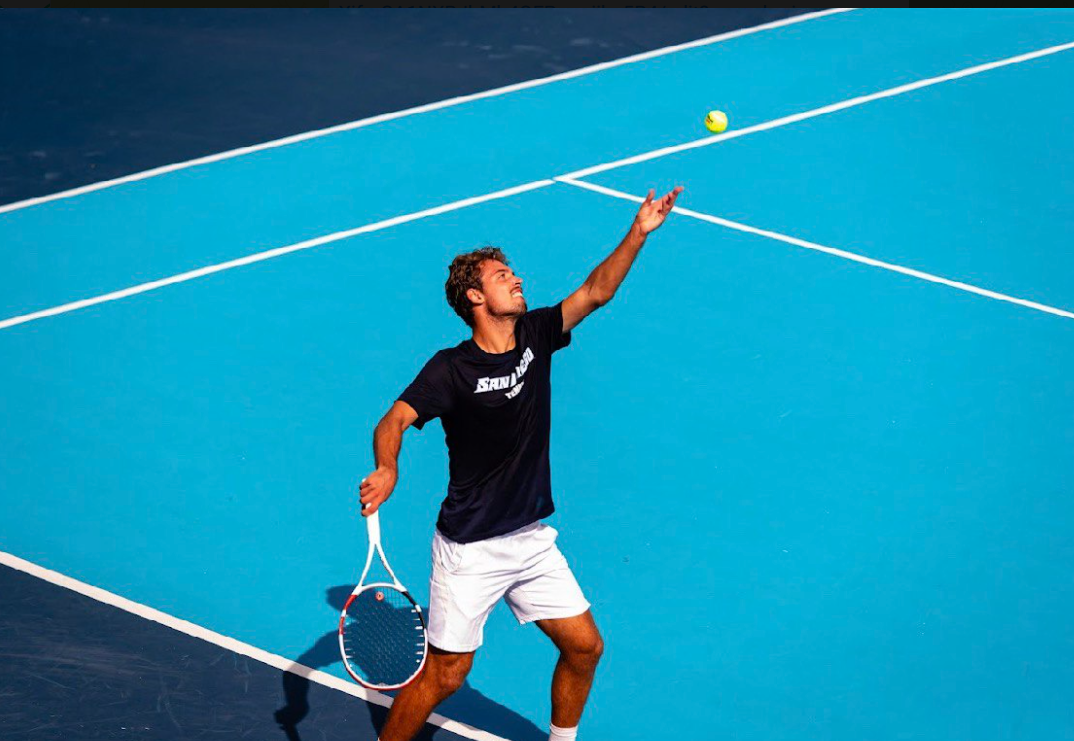
Savriyan Danilov on the court
Speaking about the near future, Savriyan Danilov believes that in 2024, pressure from the new generation will intensify in men's tennis. In his opinion, Carlos Alcaraz and Jannik Sinner will make significant gains and together set the pace for the season, becoming the main contenders for leadership in the rankings and capable of displacing Novak Djokovic from the top spot.
At the same time, Danilov notes that Djokovic's experience and game intelligence still allow him to remain competitive at major tournaments. Also, under favorable circumstances, Holger Rune, who possesses an aggressive and modern playing style, could mount a serious challenge to the leaders.
In women's tennis, according to Danilov, the season will unfold under the banner of rivalry between Iga Swiatek and Aryna Sabalenka. However, Cori Gauff and Jasmine Paolini are also capable of making a bright showing thanks to their physical readiness and dynamic playing style.