Get all your news in one place.
100's of premium titles.
One app.
Start reading
The Times of India
The Times of India
World
TOI World Desk

For more than 300 years, the Bermuda petrel was believed extinct. A remarkable discovery in 1951 gave the 'lost bird' a second chance

For centuries, the Bermuda petrel survived only as a memory. Sailors and islanders knew the bird had once filled the skies around Bermuda, but by the modern era it was considered gone forever. Then, in the middle of the 20th century, a handful of unexpected discoveries changed its story. A small colony was found hiding on remote rocky islands, revealing that the species had not vanished completely. What followed was one of the longest and most unusual bird recovery efforts in the world, shaped by a young naturalist, David Wingate, who devoted much of his life to giving the cahow a chance to survive.

Get breaking news anytime, anywhere. Download the TOI app now!

How the 1951 discovery rescued the Bermuda petrel from extinction

The Bermuda petrel, known locally as the cahow, disappeared after European settlers arrived on the islands. The seabird had once nested across Bermuda, but its ground-nesting habits made it extremely vulnerable. Humans hunted the birds, while animals brought to the islands, including rats, pigs, cats and dogs, attacked eggs and chicks.

As reported in the research Bird Conservation International published by Cambridge University Press, titled ‘ Establishment of a new, secure colony of Endangered Bermuda Petrel Pterodroma cahow by translocation of near-fledged nestlings ’ reveals that by the 1600s, the cahow was believed to have disappeared. For more than 300 years, it existed mainly through old records and stories. Its name remained tied to Bermuda’s past rather than its living wildlife.

That changed in the early 20th century when several dead cahows were found. The discoveries suggested that the species might have survived somewhere beyond sight. Reportedly, in 1951, a team of biologists began searching Bermuda’s remote islands for evidence of living birds. Among those invited to join the expedition was 15-year-old David Wingate, a schoolboy already recognised for his knowledge of local birds.

The search succeeded. A surviving population of cahows was found breeding on isolated rocky islets. For Wingate, the discovery became the beginning of a lifelong effort to prevent the bird from disappearing for a second time.

The conservation challenges behind saving the slow-breeding Bermuda petrel

When Wingate began working with the Bermuda petrel, wildlife conservation was still a developing field. There were few established methods for restoring a species that had been reduced to such a small population. Much of what he did came through observation, experimentation and years of practical work.

As reported by the American non-profit environmental organisation (Audubon), after studying at Cornell University, Wingate returned to Bermuda and began focusing on the cahow’s survival. The challenges were immediate. The birds nested in small burrows on exposed islands, where storms could cause damage and where competition for nesting spaces was intense.

Cahows are slow breeders. They produce only one egg each year and do not begin breeding until they are several years old. Losing even a small number of chicks could have a major effect on the future of the population.

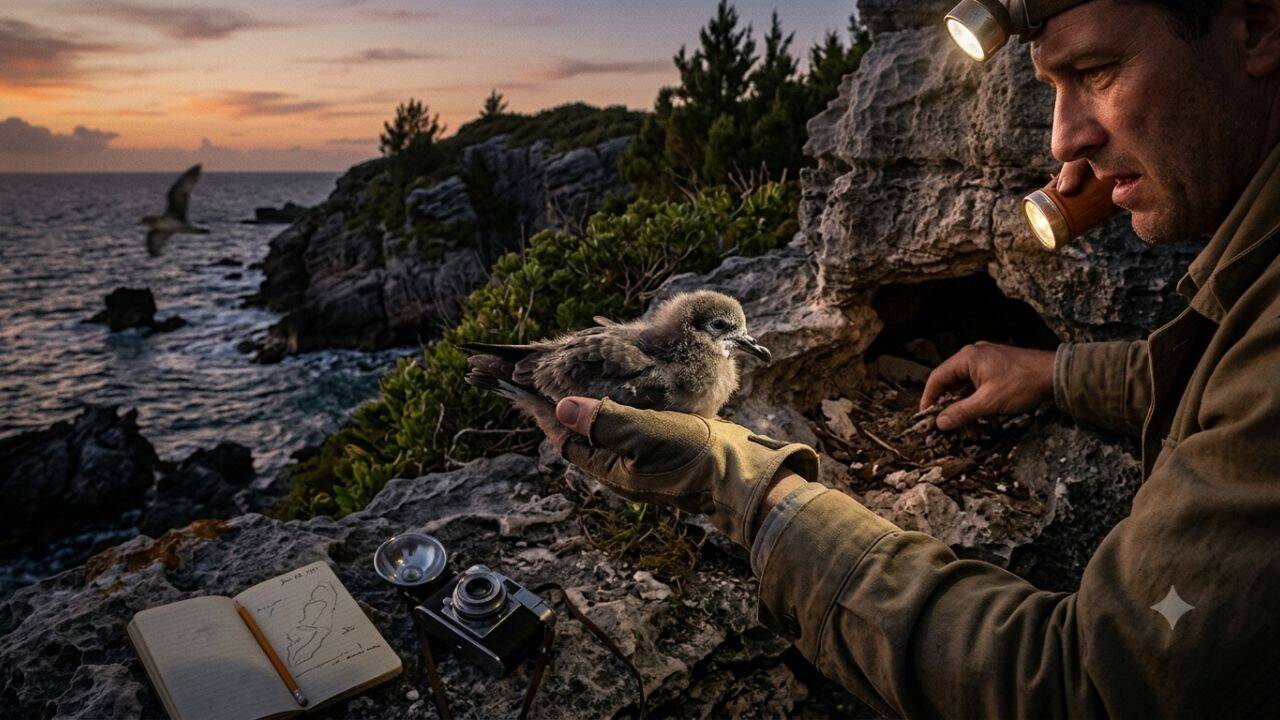
Wingate worked closely with the birds during their nesting season. The cahow is a nocturnal seabird, leaving its nesting sites after dark to begin its first flights over the ocean. Some young birds struggled during these early attempts. In one case, Wingate rescued a chick that had fallen from a cliff and created a safer artificial nesting arrangement so it could try again.

Small interventions like these became part of a wider recovery strategy.

Protecting nests from unexpected enemies

The cahow’s decline was not caused by a single threat. Introduced species had transformed Bermuda’s islands. Rats were among the most damaging predators, attacking eggs and young birds. Other native and introduced birds also competed for the same limited nesting spaces.

White-tailed tropicbirds were particularly problematic because they used similar burrows. When they occupied a suitable nesting site, cahow eggs or chicks could be destroyed.

Finding solutions required years of trial and error. Conservation workers eventually developed simple barriers around burrow entrances that allowed cahows to enter while keeping competing birds away. Artificial nesting burrows were also built to increase the number of safe places available for breeding pairs.

These changes gradually improved the birds’ chances. Recovery was slow, but the population began moving in the right direction.

Sign up to read this article
Read news from 100's of titles, curated specifically for you.
Already a member? Sign in here
Related Stories
Top stories on inkl right now
One subscription that gives you access to news from hundreds of sites
Already a member? Sign in here
Our Picks
Fourteen days free
Download the app
One app. One membership.
100+ trusted global sources.