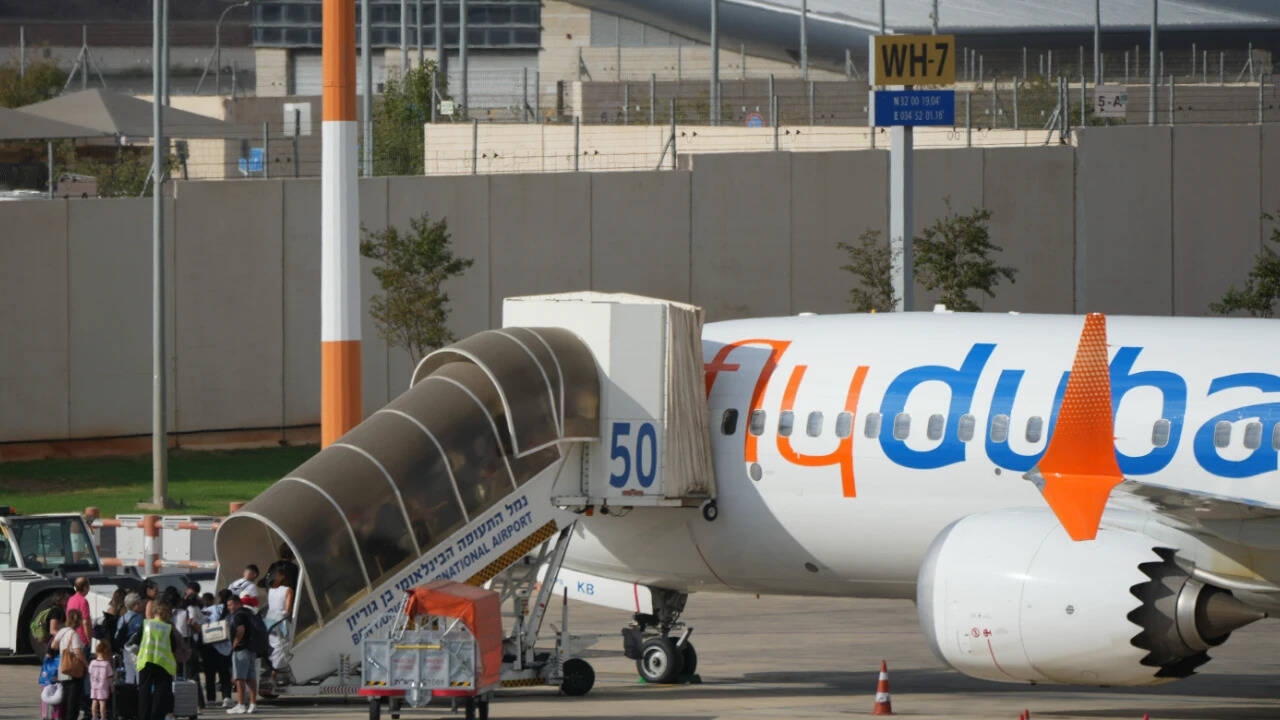
More than 24 hours after an attack aboard Flydubai flight FZ1073 from Dubai to Tel Aviv, key questions remain unanswered about the incident that shook Israel and drew global attention.
Get breaking news anytime, anywhere. Download the TOI app now!

The aircraft was diverted to Saudi Arabia after the Omani co-pilot allegedly attacked the captain in the cockpit and eventually landed safely in Tabuk. Investigators are now trying to establish the motive behind the attack, the identity and background of the alleged attacker, whether Iran had any role and how the incident was allowed to unfold aboard the flight.
The flight departed Dubai at 6.05 am local time and was flying west towards Tel Aviv. About two hours after takeoff, it began losing altitude rapidly and turned sharply north, according to flight-tracking data. The aircraft descended 17,400 feet in just under two minutes before issuing a distress call at 8.31 am (local time).
It then squawked code 7500, the International Civil Aviation Organization code used to indicate a hijacking, as passengers described chaotic scenes on board.
Terror attack or suicide attempt?
The motive behind the attack remains unclear, with questions over whether the alleged attacker intended to carry out a terror attack or was attempting suicide. US President Donald Trump told reporters at the White House that he and Israeli Prime Minister Benjamin Netanyahu discussed the incident “at length” over the phone. Trump said the co-pilot “was perhaps a terrorist or perhaps a whack job.”
The UAE prosecutor general has ordered an investigation into the circumstances and motives behind the incident, including whether it was linked to militant activity or involved prior planning or direction. The Israeli Foreign Ministry described the incident to diplomats as an attempted terrorist attack aimed at undermining ties between Israel and the UAE.
Who was the attacker?
The attacker was identified as an Omani national serving as the co-pilot of the Flydubai flight. His identity and background remained unclear as investigators worked to establish what happened. The UAE prosecutor general has ordered an investigation into the incident.
UAE judicial authorities have jurisdiction because the aircraft is registered in the UAE and operates under its flag. The UAE said its law applies to crimes committed on board “even if they occur outside the country's territory”. Netanyahu said he spoke with UAE President Sheikh Mohamed bin Zayed Al Nahyan, who agreed Israel would participate in the interrogation of the suspect.
The attacker was being investigated in Saudi Arabia, with Netanyahu saying he believed the suspect would later be taken to the UAE.
Was Iran involved in the attack?
Whether Iran had any role in the incident also remained unanswered. Netanyahu said Wednesday that it was too early to determine whether Iran was involved.
“Well, it’s too early to say,” Netanyahu told Fox News when asked whether there was any indication of Iranian involvement. “The attacking pilot is now being investigated in Saudi Arabia,” Netanyahu said, adding he believed the suspect would be taken to UAE and Israel could participate.
“It’s no secret that Iran wants to target Israelis abroad, wants to target Israel here,” Netanyahu said. He said Israel had also seen signs from Iran’s proxies of plans to attack, citing Hamas and Hezbollah ahead of Israel’s elections.
“We have clear evidence of that,” Netanyahu said. “But I think that whether or not this was carried out as part of that plan, that we don’t know yet.”
How was the weapon allowed on the plane?
The incident has raised questions about how a knife could be brought into the cockpit by a member of the flight crew and whether existing security procedures are sufficient when the threat comes from within the crew. In the US, pilots and flight attendants undergo criminal history record checks, security threat assessments and identity verification.
Netanyahu also said the captain was attacked by the co-pilot with an “axe”, adding that Smit “managed to unlock the door” even while wounded.
Crew members use designated access points and can bypass passenger screening, although they may be randomly selected for physical screening by the Transportation Security Administration. Random screening can help prevent weapons from being carried by crew members but cannot eliminate every possibility of a determined crew member bringing a weapon into a secure area.
US flight and cabin crew are also required to undergo recurrent security training, including self-defence and hijacking exercises. Security procedures for flight crews were strengthened after the September 11 attacks, with greater emphasis on resisting hijackings and protecting the flight deck.
Why was the flight allowed to take off?
Another question is how the attacker, described as an Omani national and religious extremist, was cleared to operate a flight to Israel. Israel is investigating how he was cleared to fly the Dubai-Tel Aviv route.
The Israeli Foreign Ministry told diplomats that the incident was an attack aimed at undermining ties between Israel and the UAE and the Abraham Accords. Foreign Ministry Director General Eden Bar Tal briefed “all Israeli ambassadors and heads of representations around the world [during which] the message was emphasized that this was an attempted terrorist attack against Israelis, the United Arab Emirates and the Abraham Accords,” the ministry said in a statement. The ministry referred to the Abraham Accords as the US-brokered normalization deal signed in 2020.
Commercial pilots undergo a range of checks before flying, including medical certification. Assessments can include mental health screening, although requirements vary by country. In Australia, pilots undergo a background check to obtain an Aviation Security Identification Card. Background-check requirements vary between countries and may be limited to criminal history.
If a person has no criminal record or documented warning, there may be nothing in the available checks to identify them as a security threat or risk.