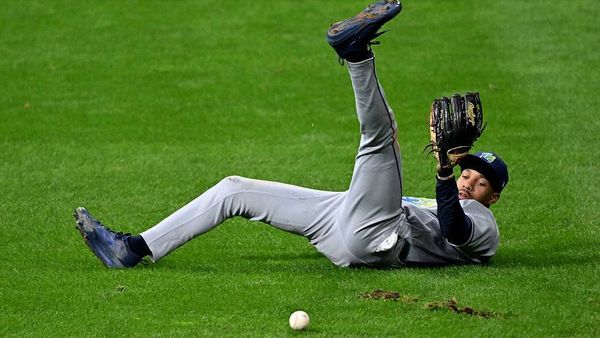
The WNBA match between the Dallas Wings and New York Liberty in July 2021 was a nail-biter. The lead bounced back and forth between the teams more than a dozen times. Liberty kept the Wings at bay in the third quarter but Dallas took the lead with just under five minutes left in the fourth. Thirty seconds later, the score was tied.
Kyle Hudson, 22, was on the other side of the world from that Brooklyn basketball court, but he was heavily invested.
In his parents’ house in Werribee, at around 1am local time, he had placed a $5,000 bet on the final score. Hours later, at 10.43am, he placed another bet of $1,300, a long-odds combination bet, known as a multibet, one leg of which tipped Dallas to win. It was almost all the money he had.
The final score was 99-96. Dallas lost.
Hudson’s partner of seven years, Ashley Baker, was in Bendigo with her family that day. She started receiving a flurry of text messages from Hudson’s friends, asking if she knew where he was. He wasn’t answering the door of his Melbourne home or his phone. His mum said his keys and wallet were still on the kitchen bench.
Sign up for the Breaking News Australia emailBaker’s sister-in-law, a nurse, quietly asked if anyone had checked the shed.
Hudson’s older brother, Ryan, told the Victorian coroner’s court this week that his family had no notion of the depth of Kyle’s gambling.
He was the last person any of them thought was at risk of taking his own life.
“He hid his gambling from immediate family, and his mum in particular,” Ryan said. “His death was a huge shock that no one saw coming.”
But the companies Hudson bet with did know something about his gambling. And coroner Paul Lawrie wanted to know: did they accurately assess Hudson’s risk of harm? And what could be done to prevent something like this happening again?
Balance, poise and plans for the future
Hudson excelled at maths, and was a deeply passionate and gifted athlete. He barracked for the Western Bulldogs, and played basketball for the Melbourne Tigers and Australian rules football for Werribee. “He had balance, poise on the field,” Ryan told the inquest. “One of that small group of players who always had time under pressure and was never hurried on the ball.”
But the obligations placed on aspiring professional sportspeople chafed with Hudson. When he left school, he enrolled instead in a bachelor of construction management, with a dream to build stadiums.
Baker – Hudson’s partner and his high-school sweetheart – was most aware of the extent of his gambling. Hudson had shown an interest in sports betting before he was legally old enough to gamble, posting his thoughts and bantering about football games on Facebook, she said.
On 31 May 2017, his 18th birthday, Hudson opened a Sportsbet account.
In the four years between his birthday and the day he died, Hudson had online gambling accounts with Sportsbet, Bet365, and the Entain brands Ladbrokes, Neds and Bookmaker, the inquest heard.
His employment income totalled $105,977, mainly from retail work. But forensic accountant Cameron Gray told the inquest this week that Hudson had deposited $406,725 into his betting accounts, and withdrawn $358,779. His total betting turnover was $895,733, with a cumulative loss of $47,946.
He appeared to have financed his gambling with a combination of employment income, Centrelink support, favours from friends, bonus bets, crypto trading, cash deposits of unclear origin, and “the repeated betting and re-betting of funds retained within his gambling accounts”, Gray told the inquest.
Baker described two instances in which she was aware Hudson had lost substantial amounts of money within a short amount of time. The first was soon after his 18th birthday: he told Baker he’d “lost all his money” and “wanted to die”.
The second was in December 2020, when he couldn’t withdraw funds to pay for the German shepherd puppy they had bought together. Over nine days that month, Gray told the inquest, Hudson’s bank’s balance fell from $22,815 to $1.61, with transaction data showing “he withdrew and wagered virtually all available funds”.
Sportsbet’s internal systems first raised a red flag about Hudson’s betting in July 2017, less than two months after his 18th birthday, the inquest heard. The trigger was his youth – being 22 or under – and betting more than $3,000 in a rolling week.
Over the four years, Hudson’s betting behaviour triggered alerts within Sportsbet’s systems on 37 occasions – once every six weeks on average, the inquest heard. The company often responded by sending Hudson a “safer gambling email”, all of which were almost identical and contained no information about the specific behaviour prompting it.
Sportsbet’s director of customer operations, Sarah Rizzo, told the inquest the emails would often have been sent after a phone conversation, but the firm did not retain the call recordings beyond three years so the substance of those conversations was unknown.
On five occasions, Sportsbet suspended Hudson’s account, reactivating it again after Hudson called and told a safer gambling specialist that he was “betting within limits”, records showed. At no time during his period gambling with Sportsbet did Hudson meet the company’s highest risk threshold, Rizzo said.
Hudson also redeemed 489 gambling inducements, including 302 from Sportsbet and 72 from Bet365, the court heard – likely to be an underestimate of what was offered to him.
On multiple occasions, Gray said, Hudson withdrew all the funds from his gambling accounts, and did not bet or deposit again until he received a deposit match inducement.
Restricted – when winning
When Hudson began to show evidence he was using bonus bets to his advantage in his Ladbrokes and Neds accounts – offsetting potential losses by betting on alternative outcomes of the same event – the company blocked him from receiving bonus bets, tagging him as a “bonus abuser”.
Entain’s head of compliance, Christina Baek, said this was done as “a management of commercial risk … managing how much free money is being given to people that then turn that into significant winnings or winnings in a systemic fashion”.
The coroner, Paul Lawrie, asked Baek: “Placing him on restrictions must, in your mind, carry a risk that he’s going to leave you and go to Sportsbet or Bet365 or some other agency … but that is not a problem from your point of view because it’s not the sort of customer you want?”
Baek replied: “We want our customers to win, but not predominantly by using good faith promotions to systemically win.”
Hudson’s gambling triggered a behavioural alert in Bet365’s system on just two occasions. The first was in December 2020, after he’d set up multiple payment methods to fund his account.
The other was on 5 July 2021, the day before he died. He was sent an automated safer gambling message. No phone call was made.
The betting companies said their harm-prevention procedures had become more robust in the years since Hudson’s death, and they now had a greater range of safer gambling tools on offer to customers.
For Hudson’s family, “learning that the betting agencies had him flagged as an at-risk gambler from 18 years old was devastating”, Ryan Hudson told the court.
“The betting agencies did know the impact his gambling was having and not only did they do very little about it, they encouraged him to engage in this risky behaviour by offering inducements.
“How can we accept this as society?”
On the second day of the inquest, the federal government released its contentious, much-delayed response to Peta Murphy’s landmark 2023 report into gambling harm.
Giving evidence at the inquest, associate professor Sean Cowlishaw, an expert in gambling harm and psychology from Monash University, was asked his opinion of the government’s response.
“Extremely disappointing,” he said, noting the government had addressed only three of the 31 recommendations. “Some of the key recommendations that I think as relates to this court have been completely ignored.”
Isolating ‘the potential role of gambling’ in death
Cowlishaw said Hudson did not appear to demonstrate many of the usual risk factors for suicide – on the contrary, he had a strong social network, long-term relationship and stable work and home environment, and had no history of drug or alcohol abuse.
“These are all normally protective factors against the risks of suicide and may again isolate the potential role of gambling in Kyle’s death by suicide,” Cowlishaw said.
Cowlishaw said Hudson appeared to be experiencing serious gambling-related problems and gambling harm. He often bet more than he could afford to lose. He had reported suicidal ideation after gambling losses as early as 2017. He had tried to limit his gambling but had trouble controlling it. He had hidden at least some of his gambling accounts from his partner. And gambling had been the trigger for his relationship breakdown.
Two days before his death, Hudson began asking Baker for money and wouldn’t explain what for, speaking to her in a way that “felt out of character for him”. She eventually sent him about $5,500 and told him their relationship was over. “I said this as a way of making it clear there would be consequences,” she said. When she saw in his account that he’d been betting, she felt he “had made his decision”.
“Kyle would want to be remembered for who he was as a person, not for how his life ended,” Baker told the court on Thursday.
After his death, she found a box under his bed stuffed full of cards, notes and mementoes from their relationship.
“That simple box showed how deeply he cared, how sentimental he was, and how much meaning he placed on love and connection,” Baker said. “He had kept everything.”
In Australia, the crisis support service Lifeline is 13 11 14 and the Gambling Help Online is available on 1800 858 858.