
Get all your news in one place.
100's of premium titles.
One app.
Start reading
The Conversation
The Conversation
Science
Jacqueline L Raw, Postdoctoral Researcher (DST-NRF Innovation Fellow) DST-NRF Research Chair in Shallow Water Ecosystems Ocean Sciences Campus, Nelson Mandela University

First study to estimate 'blue carbon' storage in South Africa is useful for climate strategy

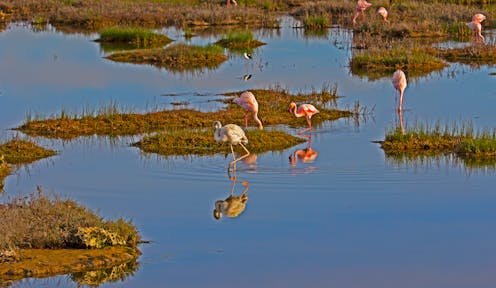
Flamingos feeding in salt marsh on an estuary in South Africa's Western Cape province. Geoff Sperring/Shutterstock

Marine ecosystems have a valuable role to play in mitigating the effects of climate change. That’s because such ecosystems – and, particularly, vegetated tidal ecosystems like mangroves and salt marshes – capture and store a significant amount of atmospheric carbon dioxide (CO₂). CO₂ has accumulated in Earth’s atmosphere at unprecedented levels since the industrial revolution. Scientific evidence shows this is the primary driver of climate change.

“Blue carbon”, the term used to describe CO₂ absorbed by marine ecosystems, was an important topic of discussion at last year’s COP27 talks in Egypt.

Sign up to read this article
Read news from 100's of titles, curated specifically for you.
Already a member? Sign in here
Related Stories
Top stories on inkl right now
One subscription that gives you access to news from hundreds of sites
Already a member? Sign in here
Our Picks
Fourteen days free
Download the app
One app. One membership.
100+ trusted global sources.







