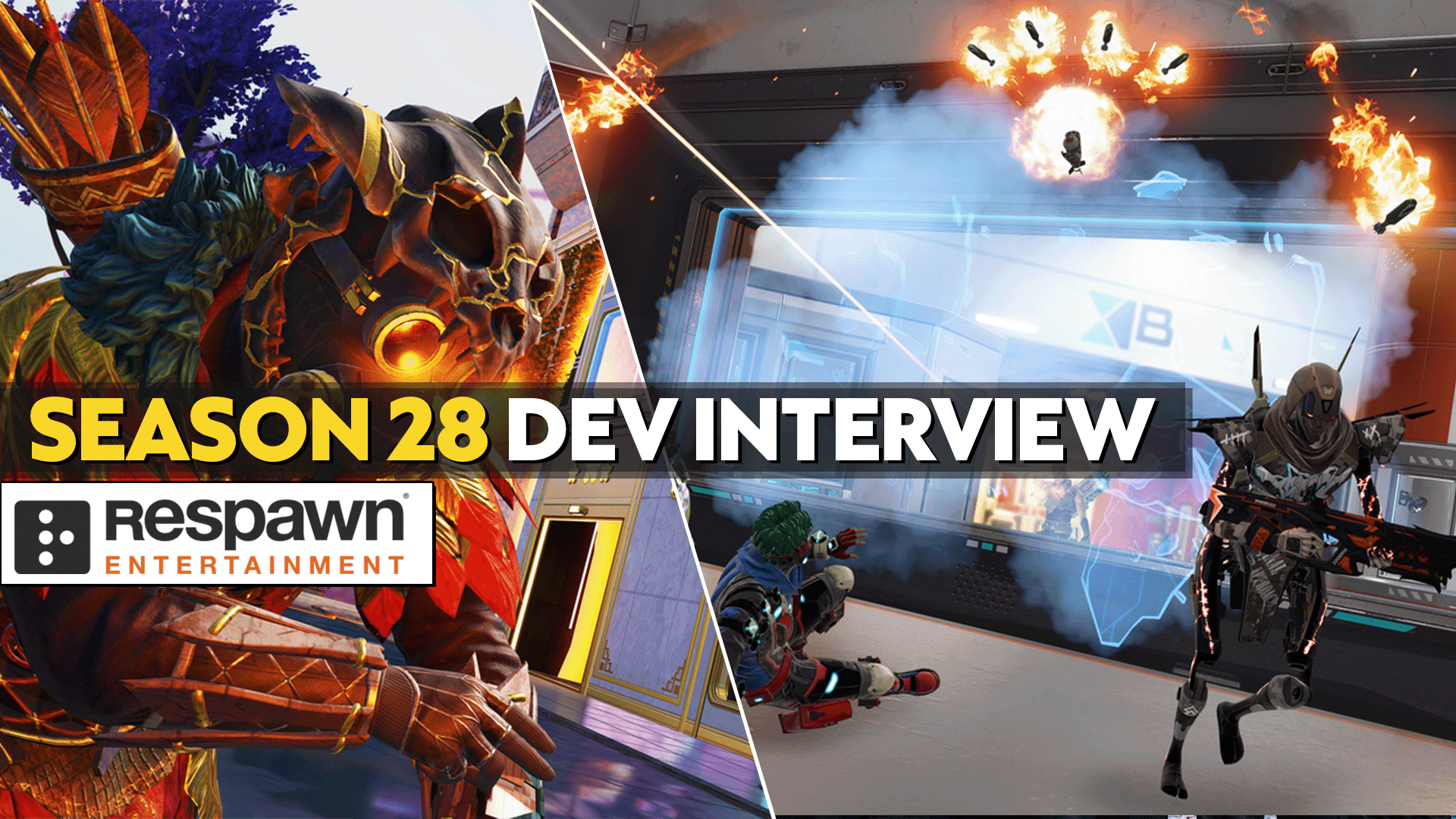
In an exclusive sit-down with Dot Esports, Respawn developers explain Season 28’s Hardlight Mesh, Fuse’s overhaul, Catalyst buffs, and the future of Apex Legends.
Apex Legends, one of the most successful battle royales of the last decade, is approaching its 7th anniversary. Season 28, titled Breach, arrives alongside some of the most significant gameplay changes the game has seen in years, promising to reshape how players fight, rotate, and take control of buildings across the Outlands.

The most prominent change this season, titled Breach, is the introduction of Hardlight Mesh, but explosion-based Legend Fuse is also receiving major attention alongside Catalyst and Bloodhound.
Hardlight Mesh: A change to the DNA of Apex Legends

Hardlight Mesh is the newest element of Apex Legends, and the main focus of Season 28, titled Breach. This new type of window is both breakable and, for a limited number of Legends, reinforceable. This change to Apex’s traditionally static buildings opens up countless new avenues for approaching battles across the maps of the Outlands, which will, according to Evan Nikolich, Apex Legends Design Director at Respawn, “bring another layer of tactical, strategic combat” to maps that players are already intimately familiar with.
A breakable environment – foreshadowed slightly by the introduction of destructible Tridents last season – is a big change for Apex Legends, which is why Dot Esports sat down with the developers to dive into Hardlight Mesh, what makes it so special, how its introduction will impact the DNA of the game, and how it will affect the meta, especially for Controller Legends.
Dot Esports: What was the inspiration for Hardlight Mesh?
Connor Monahan, Senior Game Designer at Respawn: “It’s something that we thought would be exciting to add to the game. You know, fundamentally, why did we add it into the game? We were looking for ways that we could expand the combat options that players have when they’re engaging in fights and they’re moving through the world, and also just how they engage with the maps.
“How do we bring another layer of tactical, strategic combat to the geometry you’re fighting, that you’re already familiar with?”
Evan Nikolich, Apex Legends Design Director
“The maps themselves are fairly static. We have doors, but that’s really the only thing that changes about the buildings, and so this is a way to integrate something new where players can use their Legends differently, use their weapons differently, and develop new strategies and new entries into combat.”
Evan Nikolich, Apex Legends Design Director at Respawn: “[Hardlight Mesh] really came from an idea, or the drive to, like, how do we make our maps feel fresh, and the geometry you’ve seen new and different, without having to build whole new maps, or whole new POIs? How do we bring another layer of tactical, strategic combat to the geometry you’re fighting, that you’re already familiar with? “
“And with that, we built everything else around it, with the legends and the weapons and all that stuff around it is now. So we’re really, like, trying to look at this as, like, a new thread going through the game that impacts everything.”
Dot Esports: Did you feel this might change the DNA of Apex Legends?
Connor Monahan: “In a way, that is the goal, and it’s also one of the things that we have to be careful about, right? The level design of our game is very well put together, and the spaces and timing of how engagements play out is carefully developed and heavily iterated on, and so by adding something that changes movement and changes angles and changes entries is going to be disruptive.”
“We were going for something that was going to add something new and change the way that you approach buildings. It can make some buildings a little bit more fast, as we call it, meaning that engagements can both start and end with a kill or some sort of finish more quickly. But it should also prevent things like stalling in certain cases, and so we expect it will change a lot, and we’re hopeful and we’re feeling confident that it’s gonna be a good change for everybody.”
Dot Esports: Were there any unexpected challenges to adding Hardlight Mesh across all six maps?
Connor Monahan: “When it comes to challenges we face, we face a lot of challenges, of course, and with any sort of design, things change from where you start and where you ultimately ship to the players. I think one of the biggest challenges is kind of what we’re talking about. A lot of the level design is pretty well established, and we talk a lot amongst ourselves about player knowledge and player understanding of spaces and memory and recall.”
“If you talk to a high-level player, someone who’s got a lot of time in the game, they know already the distances between specific positions and how long it takes them to maybe flank an enemy. We’re disrupting that and changing that. We found, when we were playtesting, early on, we had too much, and it was maybe breaking down the stability and safety that buildings could provide.”
“That was one of our challenges, how much is the right amount of Hardlight to have into the game to open up spaces in a way that’s exciting, but not a way that is terrifying and makes you feel vulnerable all the time. Really dialing that in took a lot of effort. We tried a lot, a little, and we hopefully found a nice middle ground that’s gonna maintain the competitive integrity of the game, but provide something meaningful and new for players to explore.”
Dot Esports: Was there any worry that Controller Legends would really be left behind in the meta?
Connor Monahan: “Yeah, absolutely, and in a sense, what we’ve done is we’ve changed how buildings operate, and then we’ve given the real keys to those buildings to the Controllers with the ability for them to reinforce the Hardlight, which is going to strengthen it, and make it more resilient, and give them the greater ability to lock things down.”
“We’ve given the real keys to those buildings to the Controllers.”
Connor Monahan, Senior Game Designer
“If you think about Catalyst or Wattson, two Legends that are very focused around controlling movement lanes and space with their traps, and in the case of Catalyst, the ability to reinforce and lock a door, that’s kind of taken as inspiration for all the Controller Legends with their new perk of reinforcing Hardlight.”
“While we have destabilized, perhaps, or made some buildings a little bit more accessible, we give Controllers the only capability to block out those players, and then, in addition to that, they can still synergize with their traps.”
“You’ll see, as we roll out more of the information about the changes some of the Legends, Wattson in particular, actually does interact with Hardlight. She can reinforce more, and so, what we want is Controllers to actually have a step forward into the meta with this change, so that they can be the ones who are manipulating the Hardlight and giving themselves the most amount of space for their team to be successful.”
Legend Updates: Fuse, Catalyst, & Bloodhound

The three Legends getting significant changes in Season 28 of Apex Legends are Fuse, Catalyst, and Bloodhound. While Fuse is most certainly getting the most attention with a reworked Ultimate and new perks, Catalyst is also getting some small but mighty changes to her kit that will hopefully improve her rock-bottom pick rate stats.
With these changes in mind, the developers delved into which playstyle Fuse will be best suited to, the difficulties of balancing characters, and the task of preventing a movement creep in Legend abilities as the seasons come and go.
Dot Esports: Catalyst has been at the bottom of pick rate popularity for all players, but she was relatively popular at ALGS. How do you approach buffing a Legend that has such a disparate pick rate across play levels?
Devin Weise, Senior Technical Designer at Respawn: “It’s a pretty complicated question because, definitely the way the players play, as you get into high-level ranked matches and into ALGS is vastly different from other forms, where you have lots of teams in small spaces, and what we actually found is asking the pros, they feel like they get decent uses out of Catalyst because, especially for her ultimate, she can carve up space pretty well, you know, serve as micro rotations for various, sort of, lanes.”
“Let’s make the [Catalyst] tactical something you actually have to fear.”
Devin Weise, Senior Technical Designer
“But in general, we don’t just think about high-level play when we’re balancing… so for Catalyst in particular, we wanted to look at, sentiment-wise, what are people talking about when they play Catalyst? What are the disappointments? The main thing was less of the Ult, it was more the tactical. People felt they couldn’t really use the tactical, it’s too easy to get around, it wasn’t really effective when you put it down.”
“That’s why the focus of the Catalyst changes was, let’s make the tactical something you actually have to fear and worry about as an opponent, and not just something you can pretty easily bypass. That’s why we made it bigger, it activates faster, so it can deal damage faster.”
“You know, we care about the pro players, but also, how does everyone who’s not a pro get value out of using Catalyst stuff? And we felt like buffing the spikes were the biggest, sort of, vector for that.”
Dot Esports: What sort of playstyle do you think the new and improved Fuse would be best suited to?
Devin Weise: “So, ideally, it should fit, I would say, his fantasy. It should still be like… I can do a lot of damage pretty consistently over a period of time, right? It’s not just one-click burst. I think what, especially with the difference for Fuse compared to somebody like Gibraltar or Bangalore, who have these big areas they can sort of control with their ultimate.”
“Fuse, with the breach element of his Ultimate, he can really clear out buildings very easily, or clear out behind cover pretty easily and it’s a sort of situation that Bangalore and Gibraltar can’t.”
“So, for Fuse, he’s really sort of been able to control spaces, especially chokes and buildings, a lot more easily than he could in the past, because before it’s either I can knock a window or knock a door down off my tactical and toss some grenades in, but now he has an extra tool that’s like, okay, I can relay that as a punishment. Either force them to take a lot of damage, or more like people try to evacuate, and while they’re evacuating, now you try and shoot at them, you try to throw your tactical at them.”
“That creates a new sort of playstyle, a more Fuse-y like level of mobility.”
Devin Weise, Seniot Technical Designer
“The playstyle should hopefully be more based around the Ultimate now, where you can sort of clear stuff out and then get some damage around that. But also look out for the new level two, the Knucklejumper upgrade.”
“That creates a new sort of playstyle, a more Fuse-y like level of mobility that should feel familiar to anyone who has a rocket jump. You can really do some creative things with this, whether it’s following up on your own damage, or trying to run away from an Octane who’s trying to chase you down. We found that the people really sort of enjoyed what they can do with the Knucklejumper, so that should also really sort of change up what Fuse can do.”
Dot Esports: With [Fuse] getting that advantage, like Sparrow having some sort of double jump, do you think that we’ll see more Legends in the future getting that sort of mobility?
Devin Weise: “It’s something we’re trying to be very, I think, cognizant of, like how much do we push mobility? Apex is the mobility battle royale shooter, like mobility is part of our DNA, but we have to be careful about if we give it to too many people all at once. Everyone’s everywhere, and you can’t track people, that can also be very stressful, and Apex is already seen as a pretty, sort of, sweaty game.”
“We wanted to be very thoughtful about how we roll it out, and that’s why for Fuse, it’s not something he has access to all the time, right? The Knucklejumper is only available as an upgrade, so you have to choose between one or two things. You don’t get it immediately at the end game. It’s something that we’re trying to sort of, you know, not let into everything, but it’s something we have our eyes on.”
“One thing we talked about is, how do we make it part of the identity of it, not just give everybody the same element of ‘hey, you get some sort of speed up when you do a thing.’ It’s like, no, what can we do to make this character’s mobility feel sort of unique to them, that’s not really shared with the other Legends? So, that’s the thing to maybe look for as we continue to work on Legends.”
Future Seasons of Apex Legends, and the choice to not introduce a new Legend to the roster

In its early days, Apex Legends was defined every season by what new character was joining the Apex Games. Entire seasons and their theme were centered around the newest Legend’s personality and abilities, but recent seasons have seen a dip in the rate of new characters.
Since there’s no new Legend to focus on, the development team behind Apex spoke to Dot Esports about how new seasons are developed in this era of the battle royale and what the team focuses on for themes instead.
Dot Esports: Speaking of Legends, this is the third season without the addition of a new Legend. Does not having to focus on a new character give you guys more room to explore other features?
Evan Nikolich, Apex Legends Design Director at Respawn: “Do they give us more time? No, we put our focus to revitalizing, you know, the various parts of the Legend roster, really focusing on Legends that are lagging or languishing and giving them a boost.”
“There’s people who love these characters, they want them to be viable, and so I put that effort into there to make them viable.”
Dot Esports: How is the theme of the season chosen, especially when there’s no new Legend to focus it around?
Evan Nikolich: We start very gameplay-led… you know, our last season with the Valkyrie rework and all that was very focused on speed, right? That was what Amped was… the combination of Valkyrie’s movement and the mantle boost. Those are the initial thoughts we started with for that, and we do that for every season, so the next season, they’ll be led by some gameplay feature we can’t yet talk about, but that’s how we do it going forward.”
Season 28 of Apex Legends drops on Feb. 10 with Hardlight Mesh and major alterations to Fuse and Catalyst promising to shake up the Outlands. While there is no new Legend to anticipate this season (or perhaps even in the next), the future of Apex Legends still looks bright after so many years. Legends are being tweaked to their best possible state, maps are receiving consistent updates, and the next year of ALGS is already set.
Apex Legends Season 28 launches Feb. 10, and based on what Respawn shared exclusively with Dot Esports, it represents one of the most meaningful gameplay shifts the battle royale has seen in years.