French President Emmanuel Macron wants Europe to develop its own way of sending astronauts into space within a decade. Europe already builds rockets and satellites and sends astronauts to the International Space Station – but it still relies on American spacecraft to get them there. As the global space sector expands, the question is whether Europe should invest in closing that gap, and what it would take to do so.
Europe is already a major space power. It builds satellites and launches them on European rockets, and operates Copernicus, one of the world’s leading Earth observation programmes, which uses satellites to monitor the planet’s climate and environment.

But Europe does not have its own capability to launch astronauts into orbit.
“We want Europe to assert its ambition in crewed spaceflight,” Macron said at an international space summit he hosted in Paris last week, calling for Europe to develop its own crewed capsule within 10 years.
A changing space sector
The proposal marks a shift in Europe’s approach to space as the sector becomes increasingly industrialised and the United States and China invest heavily, notably in programmes to return humans to the Moon.
Private companies are also entering the field, developing spacecraft, rockets and satellite constellations on an unprecedented scale. This has pushed Europe to rethink not only how it gets into space, but what it wants to do once it gets there.
France has played a leading role in Europe’s space programme, with its focus closely connected to its strategic and defence capabilities.
“Historically, France has been at the forefront of space [in Europe] because of its deterrence force, and its ballistic missile industry,” said Xavier Pasco, a space policy specialist and director of the Foundation for Strategic Research.
“This explains why Europe was not as interested in putting people into space. France just wanted to have rockets.”
Listen to an interview with Xavier Pasco in the Spotlight on France podcast:
That approach has been shifting as communication and security needs change, and as space exploration becomes a showcase of technological, industrial and political power.
“It’s a political statement. Sending people into space, as opposed to robots, has always had a strong symbolic power,” said Paul Wohrer, director of the space programme at the French Institute of International Relations, Ifri.
The International Space Station is an example of how human spaceflight can serve international cooperation alongside scientific research.
“Behind the emphasis on community cooperation in human spaceflight is a political message, an intent to show that cooperation should remain a core value,” Wohrer said.
The missing capability
Europe already has astronauts in space, but they do not travel on European crewed spacecraft. French astronaut Sophie Adenot launched to the International Space Station in February aboard a spacecraft made by SpaceX, the American company run by Elon Musk.
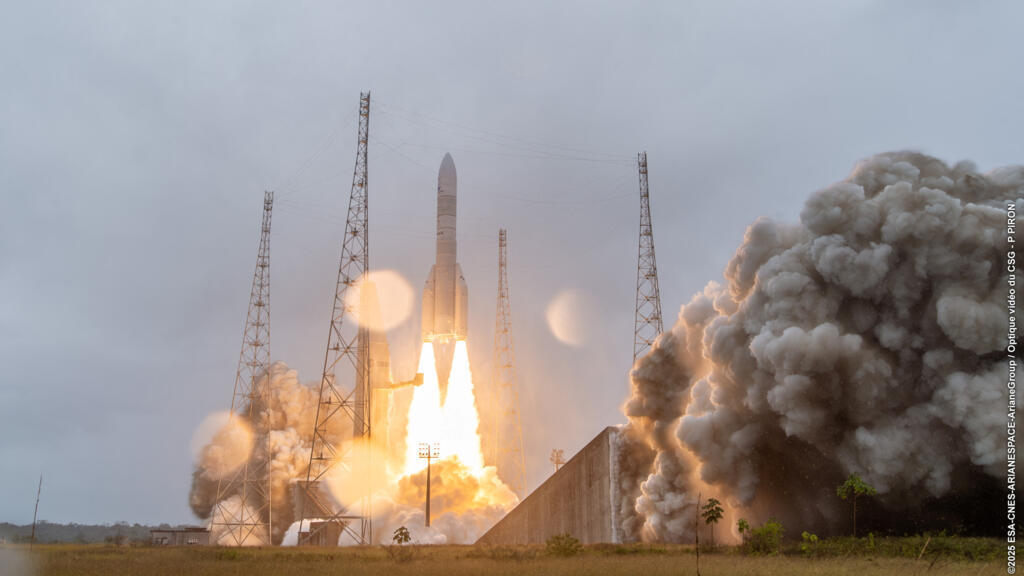
Europe does not lack launchers. Its Ariane and Vega rockets are used to put satellites and other spacecraft into orbit.
The difficulty is that launching people requires extra systems and safety requirements.
“We're still using American systems, because Ariane 6 has not been designed specifically for humans, because astronauts need more security,” Pasco said. “But it's not impossible. You have to devote money.”
There is also the question of where Europe should focus its space investment.
Its priorities have included military and security needs, as well as communication, navigation and environmental monitoring.
“We have to understand why we're doing this in Europe. What are our needs?” Pasco said. “We have military needs. Europe has also traditionally very much focused on environmental monitoring.”
Competing priorities
There is growing demand for satellite constellations for communications, while artificial intelligence is creating new demand for computing and data infrastructure in space.
SpaceX has more than 11,000 Starlink satellites orbiting Earth, and Europe is looking to develop alternatives to secure communications.
The focus is therefore less on space exploration and more on infrastructure – including who gets to build it and where it goes.
At the same time, Europe is trying to influence the rules governing the increasingly crowded orbit around Earth. Policymakers are seeking rules covering issues ranging from space debris and cybersecurity to the environmental impact of launching rockets and satellites.
The European Commission proposed the EU Space Act in 2025 to harmonise rules across the bloc and address differences between national regulatory systems.
“Space remains what we call a common good,” Pasco said, pointing out that few rules govern the use of space and that those that exist were established long before its current industrialisation.
The 1967 Outer Space Treaty establishes that space, including the Moon and other celestial bodies, cannot be appropriated by states. It also prohibits placing weapons of mass destruction in orbit or on celestial bodies.
“The rest is, in a sense, unregulated,” Pasco said.
European cooperation
Any push into crewed spaceflight would also require European countries to work together.
France is no longer the only major European country increasing its focus on space. Germany has stepped up its interest as part of a broader push for industrial and technological development, particularly since Russia’s invasion of Ukraine in 2022.
“For decades, not many other countries were interested in putting a lot of money in space,” Pasco said.
“But with the recent evolution of the European landscape, Germany for example, has convinced itself, especially since the Russian-Ukrainian conflict, that it should invest more in its industry in general, and space is a big part of that.”
Italy is also investing more in space. That creates opportunities for greater European cooperation, but also more tension because national governments, the EU and individual actors in the sector do not necessarily have the same priorities.
A European crewed space programme could help focus resources and attention.
“Europe might be the mutual point of convergence, because neither France nor Germany are able – or want – to do it on their own,” Pasco said.
Listen to an interview with Xavier Pasco in the Spotlight on France podcast, episode 149, listen here.