
Get all your news in one place.
100's of premium titles.
One app.
Start reading
Tom’s Hardware
Tom’s Hardware
Technology
Bruno Ferreira

Enthusiast recreates 43-year-old Apple Lisa with FPGA board — first commercial computer with a GUI faithfully cloned with modernized machine

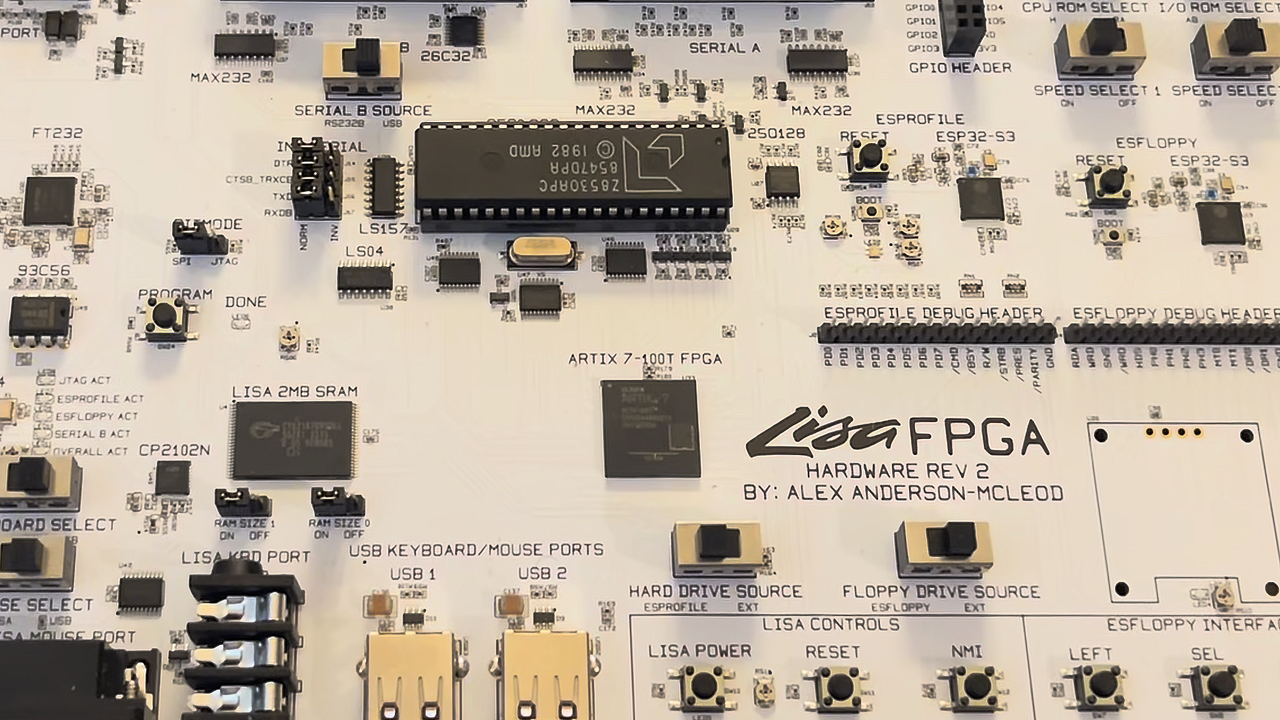
LisaFPGA project.

Many think that Apple's history creating computers with graphical interfaces starts with the venerable Macintosh, but the company's first foray into designing GUIs actually started with 1983's Lisa. The machine was the first to bring a popular window application system and mouse control to general availability at an edible (if bitter) price of $9,995 dollars of 1983 vintage, equivalent to nearly $34,000 today.

Thanks to enthusiast and Youtuber Alex Anderson-McLeod, you'll soon be able to roll your own much-improved LisaFPGA clone. Alex designed a roomy one-board system centered around an Artix 7-100T FPGA as the Lisa's brains, coupled to 2MB of SRAM and emulated hard drive, floppy, serial, and naturally, keyboard and mouse connectors.

The clone is far superior to the original, thanks to its reliance on modern hardware and Alex's design smarts. For starters, you don't need a video converter, as the board natively outputs video HDMI with a scanline option; both its main video modes are switchable on-the-fly. Although the board includes original-spec connectors for input devices, it also helpfully has USB ports for keyboard and mouse so you don't have to procure original versions.

In a similar fashion, the serial ports can be redirected to the main USB-C connector thanks to the inclusion of a USB hub, saving you having to find USB-to-serial adapters and chunky DB25 connectors. Floppy images can be loaded from an SD card, direct connection to PC, or an original floppy drive connected to the the corresponding port.

Even for its time, the Lisa was pretty slow, thanks to its software design choices and and use of the 5 MHz variant of the Motorola 68000 CPU. As a nod to these limitations, Alex included two overclocking multipliers that can take the machine to the equivalent of 75 MHz, likewise selectable on the fly with physical switches.

The revision of the LisaFPGA featured in the video is version 2, but Alex says that version 3 is coming soon with a handful of fixes. He says the project will be fully open-sourced on Github as soon as he gets his proverbial ducks in a row. He's also considering selling the clones, and will be speaking about them at Vintage Computer Festival Southwest later in the month.

Although it was generally considered a failure due to its price and software availability, the Lisa paved the way for 1984's Macintosh, the $2,459 machine that popularized graphical interfaces and the Apple brand worldwide. The Lisa computer had an undignified ending, too, with 2,700 of them dumped in Logan, Utah, as part of a tax write-off on unsold inventory. Still, similar to how the first iPhone had major issues in hindsight, the Lisa broke ground for much greater things.

Although Apple popularized graphical home computers for the masses, Apple did not invent the GUI, nor the mouse. The GUI was Xerox's doing at its PARC laboratories, that Steve Jobs visited and, cough, cribbed notes from. The Xerox Star 8010 workstation was the first computer with both technologies, but it was sold as part of a larger package and commanded the steep price of $16,595 in 1981, or around $60,000 today. As for the mouse, it was designed at the Stanford Research institute much earlier in 1963.

Sign up to read this article
Read news from 100's of titles, curated specifically for you.
Already a member? Sign in here
Related Stories
Top stories on inkl right now
One subscription that gives you access to news from hundreds of sites
Already a member? Sign in here
Our Picks
Fourteen days free
Download the app
One app. One membership.
100+ trusted global sources.