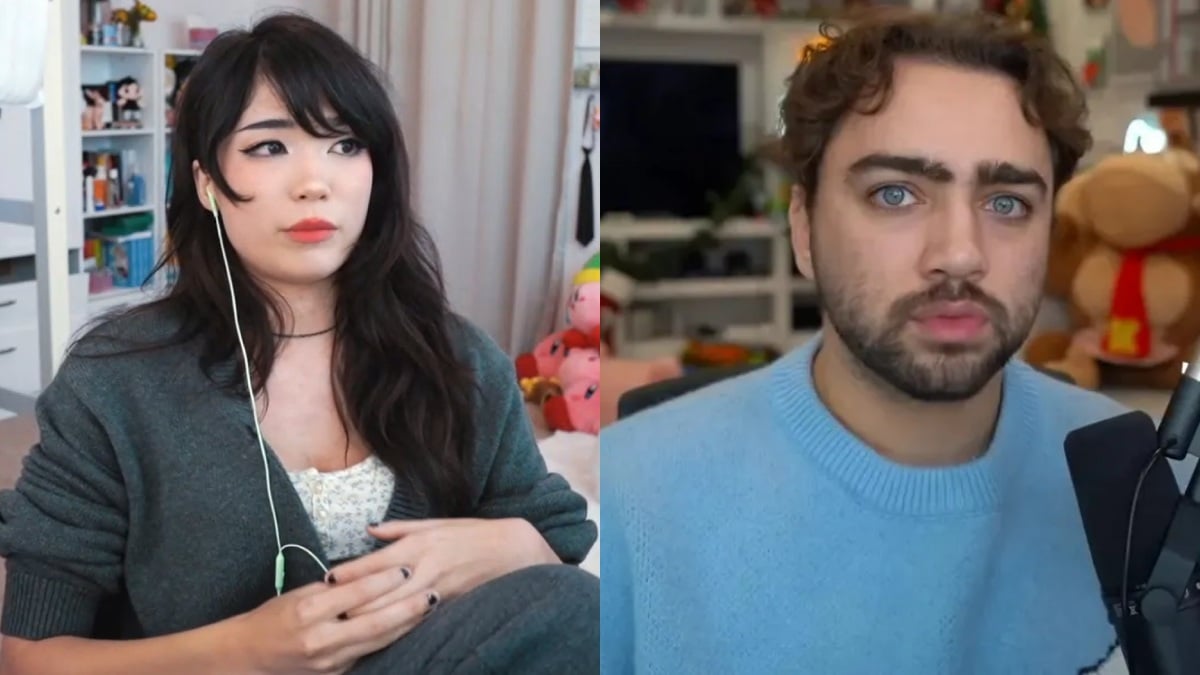
Twitch streamer Emily “Emiru” Schunk has formally responded to the defamation lawsuit filed by her ex-partner Matthew “Mizkif” Rinaudo, saying her abuse and sexual assault allegations were protected as her “emotional truth.”
On Page 19 of the document of Case No. 1:25-cv-01773-RP, Emiru stated her allegations as “emotional truth, not some statement of decisive fact.”
In a March 3 filing in the U.S. District Court for the Western District of Texas, Emiru asked the court to toss out Mizkif’s First Amended Complaint, saying his case is legally insufficient and misrepresents both what she said on stream and the broader context of their relationship.

The case was filed on Nov. 3, 2025, and names multiple defendants, including Emiru, creator Zack “Asmongold” Hoyt, OTK Media, Mythic Talent, and King Gaming Labs.
The suit is brought under diversity jurisdiction and categorized as an “Assault, Libel & Slander” action, with Mizkif and his company claiming they were defamed and financially harmed by how Emiru and others discussed him on stream and in public statements.
Summonses were issued to all defendants in early November, and the docket shows a flurry of activity since then, including motions to dismiss and efforts by some parties to push the dispute into arbitration.
OTK, Mythic, and King Gaming Labs have collectively asked the court to compel arbitration and pause the federal case, pointing to contractual clauses they say require disputes to be handled outside of open court. Asmongold has separately filed motions to dismiss, arguing the claims against him do not meet the legal bar for defamation.
Emiru’s response arrives in that context: she’s not only denying Mizkif’s version of events, but also telling the court that even if you assume his account of her words is accurate, her stream is protected speech and the lawsuit should be thrown out at the pleading stage.
Emiru’s original stream, where she broke the silence
The legal fight stems from Emiru’s Oct. 25, 2025, broadcast, where she broke her silence about her relationship with Mizkif and laid out a series of serious accusations.
On that stream, she described what she considers sexual assault, an encounter after their breakup where she says she was crying and vulnerable, Mizkif kissed her, then suddenly tried to climb on top of her, forcibly put his hands down her pants, and only stopped when she screamed.
She framed the moment as sexual assault and said it left her traumatized. She also mentioned long-term emotional and psychological abuse, saying the relationship felt controlling and manipulative.
Emiru alleged that Mizkif told mutual acquaintances he would start a smear campaign if she went public, and even confronted one of her employees at TwitchCon with a warning that he would “destroy” her if she talked about him.
Beyond personal conduct, she claimed he weaponized deeply sensitive issues, including insinuations that he would blame her for the deaths of her rabbits, which died while they were living together.
Those accusations exploded across social media, sparked intense debate, and eventually triggered Mizkif’s defamation suit.
Mizkif’s complaint
In his First Amended Complaint, Mizkif accuses Emiru and the other defendants of falsely portraying him as a sexual abuser, stalker, and domestic abuser, and says those statements devastated his reputation and career.
He also folds in business-side grievances, alleging that OTK and related companies wrongfully stripped him of more than a million shares and that Mythic Talent is improperly seeking hundreds of thousands of dollars in management fees.
The complaint centers on Emiru’s stream, her subsequent statements, and commentary by Asmongold and others. It argues that these broadcasts and posts conveyed factual accusations of sexual assault and abuse, not just opinion or emotional reaction, and therefore amount to defamation.
Emiru’s new filing attacks the legal structure of the complaint, calling it, in effect, a rage-filled narrative masquerading as a proper pleading.
In her motion, she characterizes the lawsuit as a “temper tantrum disguised as a legal filing” and accuses Mizkif of cherry-picking lines, stripping them of context, and ignoring his own on-stream admissions about being controlling and volatile.
Emiru’s legal strategy frames it as “emotional truth”
Here, her lawyers lean on Texas defamation law and a key appellate decision to argue that what she said is non-actionable opinion, even where it uses loaded language like “sexual assault.”
The filing says Emiru was “expressing her heartfelt emotional journey over several years with an admittedly toxic man,” and that her words represent her “emotional truth, not some statement of decisive fact.”
The brief cites Texas case law holding that context matters: even a statement that could be fact‑checked can be treated as opinion when made in a clearly subjective, narrative setting. To drive the point home, Emiru’s team points to a Texas Court of Appeals decision where a daughter’s TikTok labeling her stepfather a sexual abuser was treated as an emotionally charged personal account in context, not defamation, despite the gravity of the accusation.
Emiru’s lawyers are pushing for the same framing here. They argue that her October 25 stream, which walked through her relationship history and the disputed incident in detail, reads as a deeply personal, subjective recounting of events from her perspective. In their view, that makes it protected commentary on her lived experience, rather than a bullet‑point list of prosecutable factual assertions.
Henry Resilient’s one-hour breakdown of the motion underscores how pivotal this “emotional truth” framing is. He notes that if the judge accepts that her use of “SA” and other terminology is treated as her subjective characterization of what happened, rather than a concrete, verifiable accusation of criminal conduct, it could “be game over” for Mizkif’s defamation claim. If the court rejects that theory, Mizkif’s case remains very much alive.
Why her lawyers want the whole stream in play
Another core pillar of Emiru’s motion is context. Her team repeatedly tells the court to look at the entire 90-minute stream and full transcripts, and also to consider Mizkif’s own response stream rather than isolated quotes.
The filing accuses Mizkif of lifting lines out of context and ignoring how she framed them in real time, including explicit statements that she was sharing how things felt to her and recounting her own emotional experience.
By emphasizing those admissions, Emiru’s lawyers argue that even if some details are disputed, the broader picture she painted is at least grounded in conduct he has publicly acknowledged. That, they say, undercuts his claim that her overall characterization of him as controlling and abusive is false.
Drawing a line around Mizkif Enterprises
Emiru’s team also moves to get Mizkif’s company, Mizkif Enterprises LLC, dismissed from the case. The motion argues that the complaint doesn’t identify any specific statements about the company itself, as opposed to Mizkif as an individual.
Without a clear allegation that she defamed the business entity by attacking its reputation, for example, or accusing it of illegal activity, the filing says there’s no basis for a defamation claim on behalf of the LLC.
That’s a technical but important point. If the court agrees, it narrows the scope of who can sue and how much they can claim in damages.
What this means for Asmongold, OTK, and others
While Emiru’s motion focuses on her own statements and legal defenses, it lands in the middle of a broader network of disputes involving Asmongold, OTK Media, Mythic Talent, and King Gaming Labs.
OTK and its related entities have already asked the court to send the fight to arbitration, pointing to contract language that they say bars this kind of public lawsuit.
Asmongold has filed his own motion to dismiss, arguing Mizkif hasn’t properly pleaded defamation against him or tied specific damages to what he said.
Henry Resilient’s analysis suggests that if the court buys Emiru’s “emotional truth” and opinion-based defenses, it could set a tone for how the judge views claims against other defendants tied to commentary and reaction streams.
Conversely, if the court finds that core statements about sexual assault and abuse can proceed as factual defamation claims, the scrutiny on Asmongold and OTK’s coverage may intensify.

Where the case stands now
As of early March 2026, the case is still in its early procedural phase. Multiple major motions are pending, such as OTK, Mythic, and King Gaming Labs’ motion to compel arbitration and stay the case.
Asmongold’s motions to dismiss or force a more definite statement. Emiru’s motion to dismiss the First Amended Complaint, backed by a declaration and exhibits including stream transcripts and supporting materials.
Until the court weighs in, the public is left with two sharply opposed accounts – Emiru’s portrayal of a controlling, abusive ex whose conduct culminated in what she considers sexual assault, and Mizkif’s framing of a mutually toxic relationship being weaponized against him through what he says are exaggerated or false accusations.