
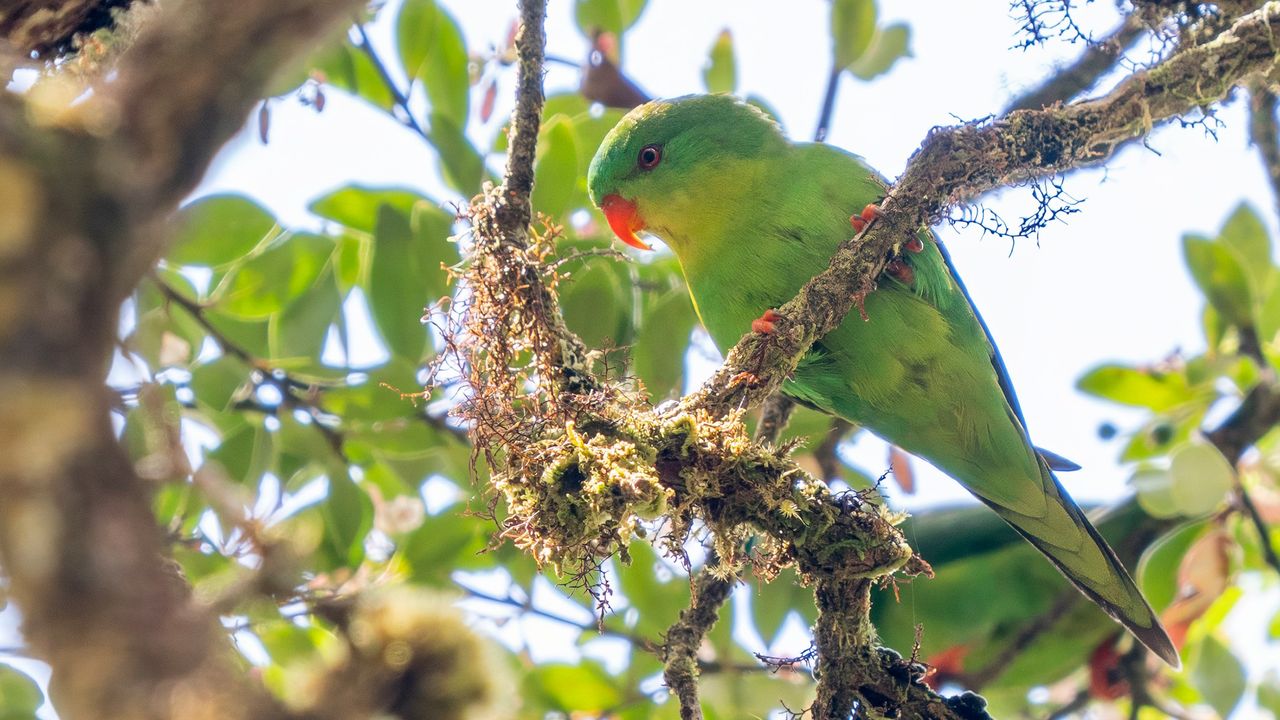
An elusive parrot species has been captured on camera (and exquisitely so, I might add) for only the second time since first being discovered over 100 years ago.
The blue-fronted lorikeet is a small endemic parrot found only on the island of Buru, Indonesia. It has lime-green plumage, an orange bill, a blue hindcrown and a pointed tail.

First observed in 1920, when scientists spotted a mere 7 individuals, the next sighting didn’t come until 2014, when a photographer using a Canon PowerShot with a 1/400-second shutter speed snapped some important but, unfortunately, blurry images of the bird.
ABOVE: Watch conservationists rediscover the Indonesian blue-fronted lorikeet
Unlike the 2014 photos, these latest images – taken by James Eaton, co-founder of birding agency Birdtour Asia – beautifully capture the rare parrot in its natural habitat.
Eaton was part of a combined team of conservation researchers, expert birders and mountaineers who were searching for the bird to confirm its presence on the island after all these years – which also included John C Mittermeier, director of the Search for Lost Birds at American Bird Conservance.
“I short-circuited with excitement when I realized it was a blue-fronted lorikeet,” Mittermeier said.
Led by a local Indonesian mountaineering group, the crew headed into the previously inaccessible upper reaches of Buru’s high-elevation montane forest, where the bird was speculated to inhabit, eventually spotting two lorikeets after six days of climbing.
During the 14-day trek, the crew also had another sighting of another pair of lorikeets, managing to capture the first sound recordings of the lorikeet’s high-pitched calls.
The blue-fronted lorikeet was listed as 'data deficient' by the IUCN Red List and recognized as a lost species in 2024 by the Search for Lost Birds, a global collaborative conservation initiative.
While it is not immediately clear how many individuals the latest sightings represent, the idea that lorikeets inhabit only Buru’s high-elevation habitats appears to be accurate.
You might also like…
Discover our expert pick of the best cameras for wildlife photography.