Get all your news in one place.
100's of premium titles.
One app.
Start reading
The Economic Times
The Economic Times

Election Commissioner appointment law: The case on India's top election body before the Supreme Court, the controversy and what comes next | Explained

The Supreme Court on Wednesday delivered a split verdict on petitions challenging the Chief Election Commissioner and Other Election Commissioners (Appointment, Conditions of Service and Term of Office) Act, 2023, the law that governs the appointment of India’s Chief Election Commissioner (CEC) and Election Commissioners (ECs).

The two-judge bench differed on whether the constitutional challenge should be heard by the existing bench or referred to a larger Constitution Bench, but agreed to place the matter before Chief Justice of India Surya Kant for consideration of a larger bench.

Also read: What's the investigation report that has rocked ECI, what Congress, BJP and Election Commission are saying

The case centres on Section 7 of the 2023 Act, which provides for a three-member Selection Committee comprising the Prime Minister, a Union Cabinet minister nominated by the Prime Minister and the Leader of Opposition in the Lok Sabha. The law replaced the Chief Justice of India with the Union Cabinet minister as a member of the selection panel.

The challenge is rooted in a question that predates the 2023 law: how should the appointment process for the Election Commission be structured to preserve the constitutional independence of the poll panel?

What exactly does the 2023 law change?

Before Parliament enacted the 2023 legislation, there was no law specifically laying down a detailed statutory mechanism for appointing the CEC and ECs under Article 324 of the Constitution.

That changed after the Supreme Court's Anoop Baranwal judgment in 2023.

A five-judge Constitution Bench had prescribed an interim arrangement under which the President would appoint the CEC and ECs on the recommendation of a committee comprising the Prime Minister, the Leader of Opposition and the CJI. The arrangement was to remain in force until Parliament enacted a law governing the appointments.

Parliament subsequently passed the 2023 Act. Under the new law, the CJI was removed from the selection committee and replaced by a Union Cabinet minister nominated by the Prime Minister.

The present petitions challenge this change, particularly the composition of the selection committee and Section 7 of the Act. The Supreme Court is therefore examining whether Parliament's chosen mechanism is consistent with constitutional principles governing the Election Commission.

How did the case begin?

The roots of the dispute go back to 2015, when Anoop Baranwal filed a public interest litigation challenging the process for appointing the CEC and ECs.

The petition questioned a system under which the President formally appoints the election commissioners, while the appointments were made on the recommendation of the executive. It sought a process that would be independent, transparent and based on merit.

The case eventually came before a Constitution Bench, which delivered the Anoop Baranwal judgment in 2023.

The court noted that although Article 324 contemplated Parliament making a law on appointments, Parliament had not done so. It therefore put in place an interim mechanism involving the Prime Minister, the Leader of Opposition and the CJI.

The significance of the judgment extended beyond the interim committee. The court stressed the importance of an independent Election Commission in conducting free and fair elections.

Parliament's subsequent decision to replace the CJI with a Union Cabinet minister is what brought the issue back before the Supreme Court.

Why did the Supreme Court give a split verdict?

The two judges hearing the current petitions differed on whether the case required a larger Constitution Bench.

Justice Dipankar Datta held that a reference was not warranted. His view was that the constitutional principles governing the independence of the Election Commission had already been settled by the 2023 Anoop Baranwal judgment.

Justice Datta said the enactment of a law by Parliament did not make those principles irrelevant. The question, in his view, was whether the 2023 Act complied with the principles already laid down by the court.

He also questioned the composition of the new selection committee. Since the Prime Minister and the Cabinet minister nominated by the Prime Minister effectively represent the executive, Datta said the structure raised concerns about whether there was an adequate independent counterweight.

He said the issue was not merely whether the Election Commission was independent, but whether it appeared to be independent. “Free and fair elections depend on a truly independent ECI,” Justice Datta said, adding that it was not enough for the ECI to be independent; it must appear to be independent.

Justice Satish Chandra Sharma, however, held that the petitions raised a substantial constitutional question that had not been conclusively settled earlier.

A central question, according to Justice Sharma, is whether Parliament can exclude the CJI, a neutral constitutional functionary, from the appointment process and replace that position with a Union Cabinet minister nominated by the Prime Minister.

Since Article 145(3) requires a bench of at least five judges to decide a substantial question involving interpretation of the Constitution, Sharma favoured referring the case to a five-judge Constitution Bench.

Also read: Election Commission pushes back on dissent reports, says all SIR decisions were unanimous

What happens after Wednesday's verdict?

The split does not amount to a ruling that the 2023 law is unconstitutional. Nor has the Supreme Court upheld the law.

Because the two judges differed, they directed that the papers be placed before CJI Surya Kant. He will consider whether a larger Constitution Bench should hear the challenge and, if so, determine its appropriate strength.

Both judges agreed on one procedural point: the case should not first be sent to another bench merely to decide whether a Constitution Bench should be constituted, as that could create another layer of delay.

The court also used the proceedings to raise a broader issue about the Supreme Court's handling of constitutional cases. It noted that references to larger benches can remain pending for years and said the petitioners' concern about such delays appeared justified.

“Self-introspection indeed is required,” the court said, asking the CJI to consider whether a permanent five-judge bench for constitutional cases could help avoid delays. Article 145(3) requires at least five judges for substantial questions of constitutional interpretation, while the case-by-case formation of such benches can itself lead to delays.

For the Election Commission case, therefore, the immediate next step is the CJI's decision on the constitution of the larger bench. The substantive question of whether the 2023 appointment mechanism passes constitutional muster remains open.

Why is the issue relevant to the Election Commission now?

The appointment-law litigation comes at a time when the functioning of the Election Commission is itself facing scrutiny.

ET had reported on Wednesday that the annual Special Summary Revision (SSR) of electoral rolls, which helps update voter lists and add eligible 18-year-olds, has remained stalled amid differences within the poll panel. The 2026-27 exercise has missed its usual May-June announcement timeline, while the annual revision process has not resumed after the 2024 cycle amid the Special Intensive Revision exercise in some states.

The delay has implications for the updating of electoral rolls, particularly because the system now has four qualifying dates each year — January 1, April 1, July 1 and October 1 — for people turning 18 to become eligible for inclusion in the rolls.

The issue is separate from the constitutional challenge to the 2023 appointment law, but it provides context for the wider questions currently surrounding the Election Commission's functioning.

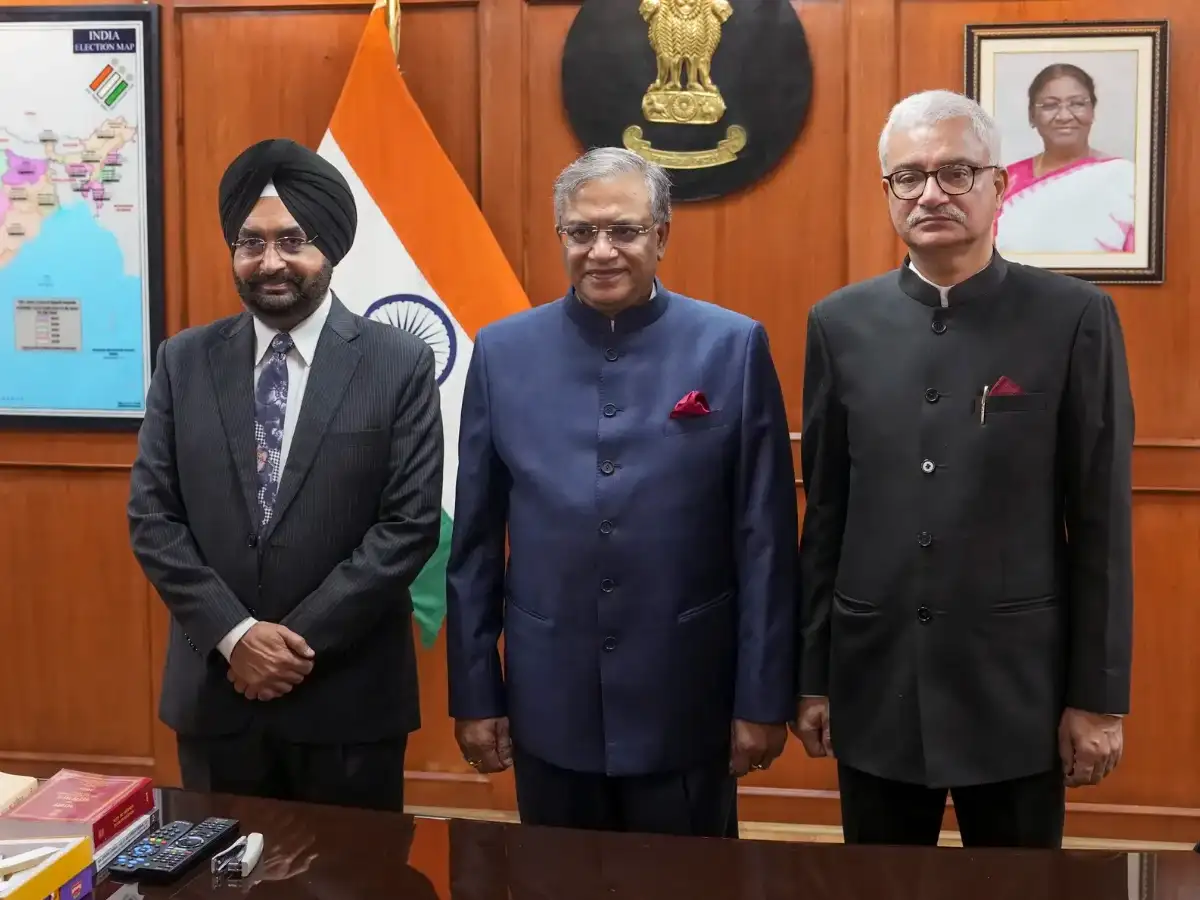
An Indian Express investigation, reported on Wednesday, separately examined differences within the poll panel and put the spotlight on Chief Election Commissioner Gyanesh Kumar. The investigation reported that Election Commissioners Sukhbir Singh Sandhu and Vivek Joshi had formally raised objections at least 14 times over 10 months to decisions and orders concerning the functioning of the Commission.

The objections reportedly covered issues including the Special Intensive Revision of electoral rolls, voter registration, deletion and restoration of names, changes to Form 6 and aspects of the Election Commission's IT system.

One reported dispute involved a new question added to Form 6, the application used for voter registration, asking whether the applicant or their parent or grandparent appeared in a previous SIR electoral roll. The investigation also reported that Sandhu and Joshi separately wrote to the Cabinet Secretary over changes in work allocation relating to the Commission's IT systems that they believed reduced an oversight layer.

The ECI has pushed back on the interpretation of the internal objections, saying such observations are part of its deliberative process and that final decisions were unanimous. The poll panel has also said selected internal notes provide only a partial picture of its functioning and pointed to several initiatives and reforms, including the nationwide revision and SIR, that it said were approved unanimously.

The 2023 Act itself provides that the Commission's business should, as far as possible, be transacted unanimously, while matters on which commissioners differ are decided by majority.

The internal differences reported by Indian Express and the constitutional challenge to the appointment law concern different questions. But both developments have brought renewed attention to the structure and functioning of the Election Commission.

For the Supreme Court, the immediate legal question is whether the 2023 appointment mechanism — particularly the replacement of the CJI with a Union Cabinet minister nominated by the Prime Minister — is consistent with the constitutional framework governing the Election Commission.

That question remains open after Wednesday's split verdict and will now move to the next stage before the Chief Justice of India.

Sign up to read this article
Read news from 100's of titles, curated specifically for you.
Already a member? Sign in here
Related Stories
Top stories on inkl right now
One subscription that gives you access to news from hundreds of sites
Already a member? Sign in here
Our Picks
Fourteen days free
Download the app
One app. One membership.
100+ trusted global sources.