Get all your news in one place.
100's of premium titles.
One app.
Start reading
Sports Illustrated
Sports Illustrated
Sport

Edwin Díaz’s Dodgers Struggles Are Even Worse Than They Look

For years, the opening notes of Timmy Trumpet’s “Narco” meant opposing hitters were in trouble. This season, that track has sounded more like an emergency siren at Chavez Ravine.

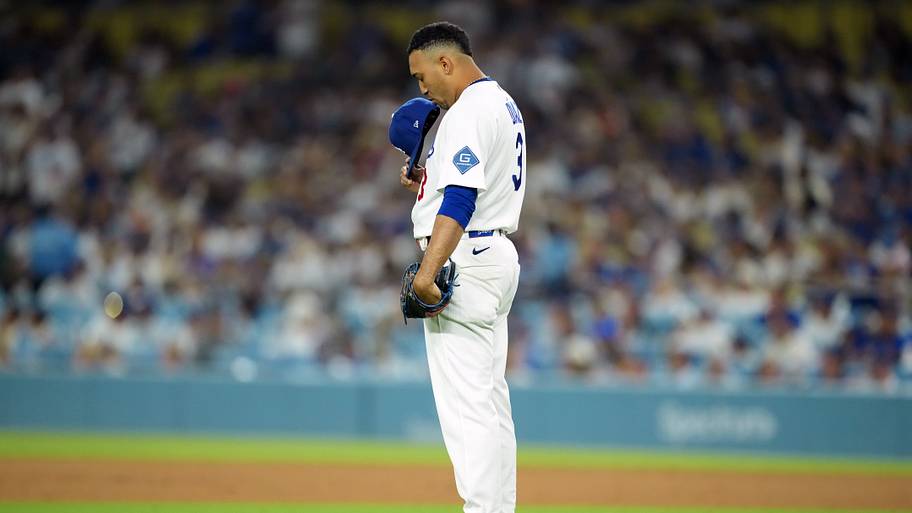
The Dodgers believed they had their long-sought answer at closer when they signed Edwin Díaz to a massive, three-year, $69 million contract this winter. Instead, he has only created more questions.

Díaz arrived in L.A. as one of MLB’s best relievers and a top closer with a proven track record. His signing was supposed to solve one of the team’s biggest issues from a year ago when the bullpen often faltered late in games. An early-season injury derailed his start to the season, things have not improved since his return.

A look under the hood reveals troubling signs that suggest Díaz’s struggles go well beyond a high ERA and some bad luck.

Through 15 games as a Dodger, Díaz is 2–2 with a 10.66 ERA, a 2.45 WHIP, and 19 strikeouts against 10 walks in 12 2/3 innings. He has produced -0.3 fWAR. The three-time Reliever of the Year struggled his way to a 10.50 ERA through April 20, when he hit the injured list and underwent surgery to remove loose bodies from his right elbow. He was activated on July 29 and, if anything, has been worse since his return.

Díaz has blown four saves in 11 chances this season after blowing three in 31 attempts last year. In just 12 2/3 innings, he has allowed three more earned runs (15) than he did in 66 1/3 innings for the Mets in 2025 (12). Some of those disappointing numbers could be the result of his injury and recovery, but when you look beneath the surface, things get even more alarming.

The numbers tell a pretty scary story for Díaz and the Dodgers.

SELBE: The Dodgers’ Fatal Flaws Are Finally Catching Up With Them

Perhaps most glaringly, Díaz’s four-seam fastball velocity is down from 2025 and considerably lower than his 2022 campaign. Last season, his four-seamer averaged 97.2 mph; in 2022, it was 99.1 mph. So far in 2026, Díaz’s fastball is averaging 96.3 mph. The pitch’s movement profile remains roughly the same, generating 12 inches of ride and 12.4 inches of tail, not far from 2025’s 12.9 inches of ride and 13.1 inches of tail. Similarly, the spin rate of 2,330 is virtually the same as last season (2,327). The only obvious change is the reduced velocity. Hitters have noticed.

Opposing hitters are hammering Díaz’s fastball in 2026. They are hitting .379 on it while slugging an absurd .690. In 2025, those numbers were .133 and .200, respectively. The pitch is generating a whiff rate of just 16.4%, down from 39.4% last season. (ADD kicker)

Part of Díaz’s problem may be a lower arm angle. In 2022, he sat at 23 degrees, and it has progressively declined since then. Last season, he was at 19 degrees and has fallen to 15 this season. Specifically, his fastball angle has fallen from 17 degrees in 2025 to 12 degrees this season. The arm slot may not be the culprit, but it is a major departure from the past that could explain his struggles.

While his fastball is getting hammered, his slider hasn’t been much better. Like his fastball, the pitch’s movement profile is virtually identical, and the spin is actually up from 2025 at 2,295 rpm, compared to 2,260. Unlike the fastball, he’s throwing it at the same speed (89.1 mph) as last year. Still, hitters are teeing off on it.

RASMUSSEN: Seven Pending Free Agents Who Have Raised Their Stock This Season

Díaz has thrown his slider 43% of the time in 2026, and opposing hitters are batting .333 on it while slugging .533. That’s compared to .179 and .269 in 2025. Even more concerning, the whiff rate has also dropped from 44.0% in ‘25 to 28.1% in ‘26.

The way hitters are approaching Díaz in 2026 provides a clear picture of just how much has changed.

Opposing hitters are swinging at pitches in the zone less often than in 2025 (57.8% to 65.9%). But when they do swing, they’re connecting at an alarming rate. Hitters are making contact on 87.8% of their swings at pitches in the zone against Díaz, up from 72.1% in 2025. Only 9.3% of strikes Díaz has gotten have come on pitches batters have swung and missed at, almost half of his total from ‘25 (18.0%).

Hitters are also making contact on 64.7% of swings when Díaz throws a pitch out of the zone, way up from 41.7% in ‘25. In other words, Díaz isn’t just having problems missing bats in the zone; hitters are getting to pitches they shouldn’t be hitting, too.

Batters are making contact on 88.7% of the pitches they swing at in the heart of the plate, up from 75.7% in ‘25. More contact is concerning enough, but the quality of that contact is making things much worse. Opposing hitters have a barrel rate of 10.0% against Díaz in 2026, more than double his 4.6% mark in ‘25, and their average exit velocity has jumped from 88.5 mph to 91.8 mph.

CAPURSO: Five MLB Trade Deadline Moves That Are Already Paying Off

Díaz is allowing a fly ball rate of 32.5% in 2026, by far the highest of his career and up from 23.7% last season. The line drive rate has climbed from 23.7% to 35.0%. Batters typically do the most damage when pulling the ball in the air. Perhaps unsurprisingly, the percentage of balls pulled in the air off Díaz has also jumped from 26.0% to a whopping 37.5%.

Virtually all of those numbers are career worsts.

It’s easy to get lost in an onslaught of numbers like that, but they all point to the same conclusion: Díaz’s pitches are far more hittable in 2026, despite having similar movement profiles and spin rates. His drop in velocity has made the fastball easier to connect on, while neither of his primary offerings is generating anything close to its previous swing-and-miss levels. And when hitters do make contact, the ball is flying.

This is a relatively small sample size for Díaz, as he’s only faced 71 hitters in 2026. His elbow injury and subsequent surgery also complicate any attempt to declare this version of him permanent. But the Dodgers signed him to fill a major hole at the back of their bullpen and haven’t gotten the guy they handed a massive deal to.

There is still time for Díaz to turn things around. It’s far too early to declare one of baseball’s best relievers washed. The elbow injury certainly complicates any analysis of his performance, but there is no escaping the troubling trends he’s displayed this season.

The Dodgers didn’t give Díaz an enormous contract to help with their bullpen issues. They paid him to solve them. They wanted the kind of shutdown closer they have struggled to find for years. L.A. expected Díaz to be the solution when the lights were brightest in October.

Unless something changes over the next six weeks, the Dodgers will enter the postseason with the same late-inning questions they paid Díaz to answer.


More MLB from Sports Illustrated

MORE MLB FROM SPORTS ILLUSTRATED

Sign up to read this article
Read news from 100's of titles, curated specifically for you.
Already a member? Sign in here
Related Stories
Top stories on inkl right now
One subscription that gives you access to news from hundreds of sites
Already a member? Sign in here
Our Picks
Fourteen days free
Download the app
One app. One membership.
100+ trusted global sources.