Get all your news in one place.
100’s of premium titles.
One app.
Start reading
Space
Space
Science
Julian Dossett

Earth orbit is getting crowded. Can this map of 1 million routes around our planet help prevent satellite collisions?

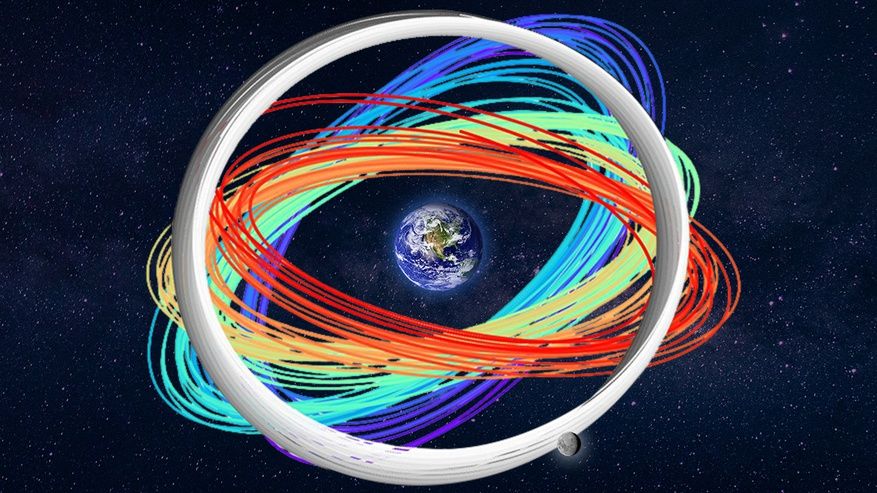
An illustration showing Earth with different colored loops around it.

Space is getting crowded — nowadays, over 45,000 human-made objects orbit Earth. A portion of that figure is indeed represented by the thousands of satellites humans use for internet, GPS and other communications, but it also takes into account space junk from humanity’s previous space escapades.

Thus, figuring how to prevent collisions has become more important as space agencies continue to rocket new technology into low Earth orbit — and there's already a brisk launch schedule planned for 2026. As such, researchers at the Lawrence Livermore National Laboratory (LLNL) in California have developed a new method for modeling orbits in cislunar space, which refers to the space between and around Earth and the moon.

The researchers modeled what a million orbits would look like over six years using an open-access database, or code that's publicly available, and a ton of processing power from the lab's supercomputers.

"When you have a million orbits, you can get a really rich analysis using machine learning applications," LLNL scientist Denvir Higgins said in an announcement. "You can try to predict the lifetime of the orbit, try to predict stability or try to do anomaly detection to see if an orbit is moving in a strange way."

The researchers found that about half of the orbits they modeled remained stable for at least one year, and just under 10% remained stable for the full six years of the simulation.

"If you want to know where a satellite is in a week, there's no equation that can actually tell you where it's going to be," LLNL scientist Travis Yeager said in the release. "You have to step forward a little bit at a time."

The amount of computing power required to track a million obits over a six-year period in a simulated environment is significant. LLNL said they used 1.6 million CPU hours, which would take more than 182 years to process on a single computer. But using the lab’s Quartz and Ruby supercomputers, it only took three days to run the simulations.

This work could be helpful in the future for determining busy intersections for satellites, LLNL says. The lab also noted that, as countries continue to launch satellites without worldwide coordination, this could be a useful tool.

Sign up to read this article
Read news from 100’s of titles, curated specifically for you.
Already a member? Sign in here
Related Stories
Top stories on inkl right now
One subscription that gives you access to news from hundreds of sites
Already a member? Sign in here
Our Picks
Fourteen days free
Download the app
One app. One membership.
100+ trusted global sources.