Get all your news in one place.
100's of premium titles.
One app.
Start reading
Times Life
Times Life
Aishwarya Kapoor

Dragonflies Have Mastered Flight Engineering That No Machine Has Matched, Here Is How

The number that stops engineers cold

95% prey-capture success rate. That is what researchers at Harvard's Concord Field Station recorded when they filmed dragonflies hunting in slow motion. Cheetahs catch roughly 58% of prey they chase. Lions, around 25%. The dragonfly is, by this measure, the most effective predator on the planet, and it achieves this through flight mechanics that aerospace engineers have spent decades trying to decode.

The insect belongs to the order Odonata, a lineage that predates dinosaurs by about 100 million years. Fossils show dragonflies with wingspans approaching 70 centimetres. The modern species is smaller, but the flight architecture has stayed essentially unchanged. When something works this well for this long, the physics behind it are worth examining carefully.

Four wings, zero compromise

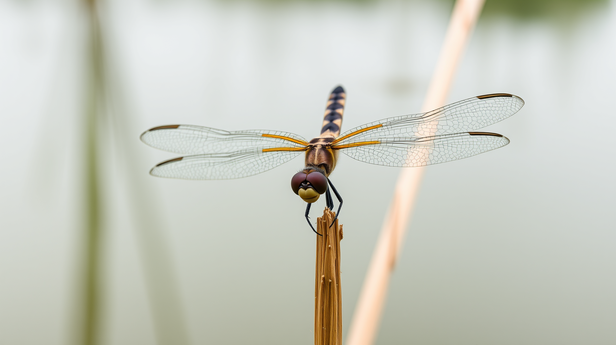
Most flying insects, bees, moths, beetles, have evolved to link their forewings and hindwings into a single functional surface. Dragonflies never did. Each of the four wings is controlled by its own set of muscles and moves on its own timing. This means a dragonfly can flap its hindwings slightly ahead of its forewings, a phase offset that generates a leading-edge vortex: a small, controlled whirlpool of air that dramatically increases lift without increasing the energy cost of each stroke.

The wings themselves are not flat. Under a microscope, the surface is corrugated, a series of ridges and valleys running along the wing's length. For decades this looked like a structural quirk. Wind tunnel experiments published in the Journal of Experimental Biology showed the corrugation actually traps small vortices in the valleys, turning what looks like drag into additional lift. A smooth wing of the same size and weight generates less lift. The dragonfly's wing is, in effect, a passive aerodynamic device that improves its own performance through imperfection.

The wings also tilt. Each can change its angle of attack independently on every single stroke. A dragonfly hovering over a pond in Bengaluru or Kaziranga is making hundreds of micro-adjustments per second, keeping its body stationary while its wings describe complex figure-eight paths through the air.

The brain solves the interception problem differently

Catching a moving target in the air requires solving what mathematicians call a pursuit problem. Most predators solve it reactively, they track the target and follow its path. A cheetah runs where the gazelle is. A dragonfly does not do this. Neuroscience research from the Salk Institute showed that dragonfly neurons fire to predict where the prey will be, not where it is. The insect calculates a future intercept point and flies directly to it, adjusting only when the prey changes course.

This predictive targeting is handled by a small cluster of neurons, roughly 16 identified cells, that can isolate a single moving object against a cluttered background, suppress the visual noise of everything else, and hold the target locked while the wings execute the intercept. The entire system runs on a brain smaller than a sesame seed. No drone guidance system currently matches this combination of target isolation, prediction, and motor execution at this scale and power consumption.

What engineers have borrowed, and what they cannot yet copy

Biomechanics research on dragonfly flight has directly influenced the design of micro air vehicles, or MAVs. The US military's research arm DARPA has funded multiple programmes specifically studying Odonata wing geometry. The corrugated wing structure has been replicated in prototype MAV wings, and the phase-offset flapping principle appears in several experimental designs. Agility at low speed, the ability to hover, reverse, and accelerate in any direction, is the specific engineering target. Helicopters can hover. Fixed-wing aircraft cannot. Dragonflies hover, then sprint at 50 kilometres per hour, then stop and hover again, all within a body length of space.

What remains uncopied is the integration. The wings, the neurology, and the muscle system are not separate components that happen to work together. They are a single co-evolved system where each part assumes the others exist. An engineer trying to replicate dragonfly flight is not copying one mechanism, they are trying to reverse-engineer a conversation between three systems that have been talking to each other for 300 million years.

Why this matters beyond the laboratory

The applications being pursued are not abstract. Agile MAVs modelled on dragonfly aerodynamics have potential uses in search-and-rescue operations, precision agriculture monitoring, and confined-space inspection, environments where current drones, which need open space and stable air, fail. Researchers at IIT Kanpur and IIT Madras have both published work on bio-inspired flight systems, with dragonfly wing geometry among the structures being modelled.

The insect also raises a specific question about how we measure engineering achievement. A dragonfly weighs about 300 milligrams. It carries no battery, no GPS, no external power source. It fuels itself on the insects it catches, which it catches at a 95% success rate, using the same flight system that does the catching. The machine that can do all of this simultaneously does not exist yet. The dragonfly has been doing it since before the first flower bloomed.

The gap between what the dragonfly does and what our best machines do is not closing as fast as the engineering literature suggests. Every time researchers isolate one mechanism and replicate it, the full system reveals another layer of integration they had not accounted for. The wings informed the drones. The neurology is informing the guidance systems. What comes next, the muscle physiology, the sensory feedback loops, the metabolic efficiency, is still mostly a set of open questions. The dragonfly is not a solved problem. It is a 300-million-year head start.

Sign up to read this article
Read news from 100's of titles, curated specifically for you.
Already a member? Sign in here
Related Stories
Top stories on inkl right now
One subscription that gives you access to news from hundreds of sites
Already a member? Sign in here
Our Picks
Fourteen days free
Download the app
One app. One membership.
100+ trusted global sources.