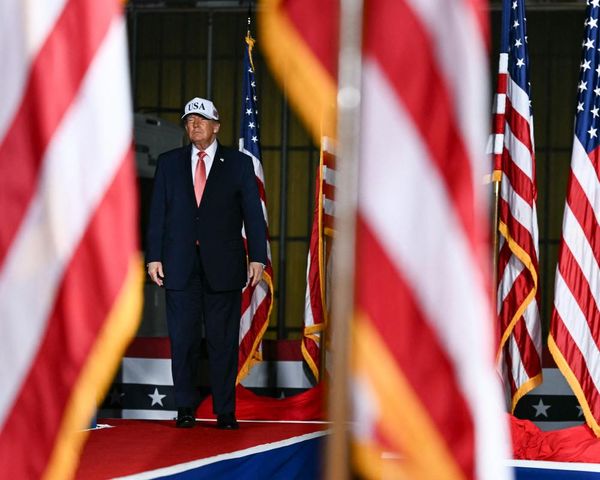
Donald Trump dismissed Barack Obama's claim that governments would run better under female leadership, calling the idea 'ridiculous' during a press conference outside the White House on Saturday, September 26.
The 80 year old president was responding to a reporter's question about comments Obama made days earlier at Salem State University in Massachusetts.

It can be recalled that Obama, speaking with historian Doris Kearns Goodwin on September 21, said he had long entertained the idea of putting women in charge of every government for two years just to see what would happen.
He conceded the result would not be flawless but insisted it would still mark an improvement, telling the audience he felt confident about that.
Donald Trump Hits Back at Obama's Remarks
A reporter put it to Trump directly outside the White House, asking whether he agreed that things would improve if women ran every government for two years. 'Ridiculous. I love women, I think they're great, but what a ridiculous statement that is,' Trump said, according to footage of the exchange shared on social media.
It was a short answer, delivered without much hesitation, and it landed the way these exchanges usually do these days.
Q: Barack Obama just said 'if you put women in charge of every government for two years, things would be better.' Do you buy that?
— Aaron Rupar (@atrupar) September 26, 2026
TRUMP: It's ridiculous. I love women. I think they're great. But what a ridiculous statement that is. pic.twitter.com/Tam56vBc0d
Whether Trump had watched the full Salem State conversation, or was simply reacting to the reporter's paraphrase, isn't clear from the available footage. Obama's own phrasing was more tentative than the blunt hypothetical Trump was asked to weigh in on.
'I have a strong belief that things would, they wouldn't be perfect, but they'd be better,' Obama told Goodwin, who interjected with her own aside before he continued. 'I'm confident about that. I really do.'
For context, the two men have barely been on speaking terms in any political sense for months. Their clashes have stretched well beyond gender and government, taking in everything from artificial intelligence policy to accusations that would sound wild in almost any other administration.
Is any of it really about women in charge, or just the latest excuse for two old rivals to needle each other?
Donald Trump and Obama's Wider Feud Over Policy
Obama had also criticised Trump's approach to artificial intelligence regulation during a September 18 appearance at Colgate University, arguing that government oversight of the technology was overdue.
'The government has to be regulating this,' he said, pointing to comparisons with how airlines, drug companies and food producers are policed. Trump has previously argued that the only AI guardrail the country needs is what he called a smart president, a line widely read as a reference to himself.
The tension between the two predates this latest spat by some time. Back in May, Trump used Truth Social to accuse Obama of treason, calling for him to be arrested over allegations that he helped orchestrate false intelligence during the 2016 election.
'Arrest them all. Prosecute them all. Incarcerate them all at once for treachery, treason, and seditious conspiracy to overthrow the United States Government,' one post read. 'But first, Barack Obama.'
No formal charges have been filed against Obama in connection with those claims, and the allegations remain unproven.
It is worth noting, too, that Obama has floated the women in charge idea before. He made a nearly identical argument at a leadership event in Singapore back in 2019, long before AI regulation or election intelligence disputes had become flashpoints between the two men.
United Nations figures cited elsewhere this week put the number of countries currently led by women at 28, a detail Obama did not raise himself but one that frames just how hypothetical his proposal really is.
Neither Trump's nor Obama's teams issued a formal written statement beyond what was said on camera, so there is little else to attribute here beyond the recorded exchanges themselves. Whether this spat changes anything about how either man is perceived seems doubtful. It rarely does.