
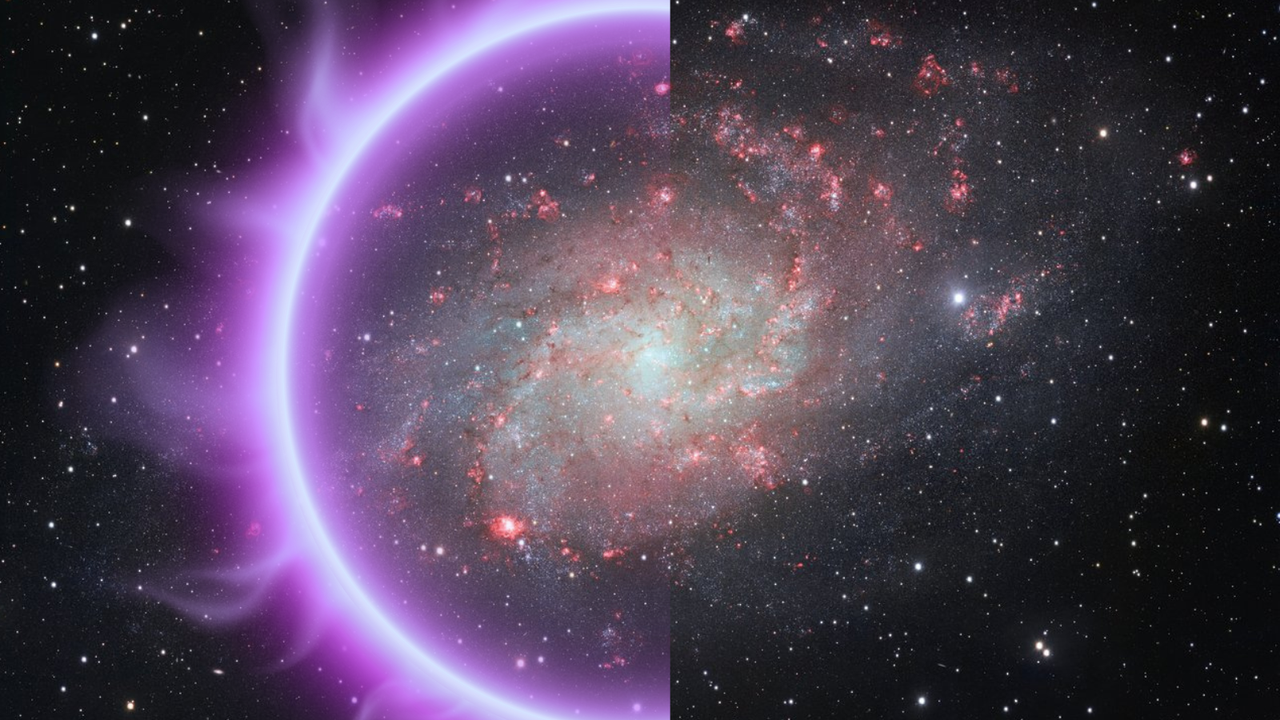
New research suggests that dark matter, the universe's most puzzling and mysterious substance, may not exist. But removing dark matter from our cosmological models could hinge on the possibility that gravity behaves differently on very large scales, one scientist says.
Dark matter has been a thorn in the side of physicists because, despite outweighing ordinary matter by a ratio of 5 to 1, it remains effectively invisible. That's because it doesn't interact with light, or more technically, electromagnetic radiation. Because the particles that comprise the atoms that make up stars, planets, moons, living things, and everything we see around us, do interact with light, scientists have been searching for particles that could make up dark matter. However, this addition to particle physics, which has thus far eluded all attempts to uncover it, isn't needed if we are wrong about how gravity behaves on galactic scales. At least, that is what Naman Kumar of the Indian Institute of Technology suggests.









