Get all your news in one place.
100's of premium titles.
One app.
Start reading
The Conversation
The Conversation
Justin Bradfield, Associate professor, University of Johannesburg

Discovery in South Africa holds oldest evidence of mixing ingredients to make arrow poison

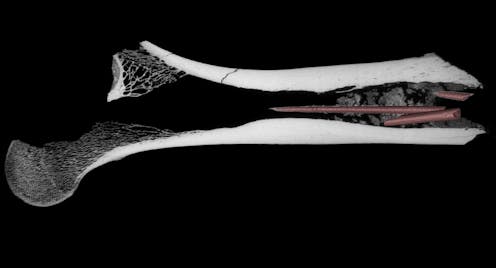
CT-scan thin section through the centre of the bovid femur. The three bone arrowhead fragments and poison substance are visible. CT rendering and image segmentation: Dr Aliénor Duhamel, CC BY-NC-ND

In 1983 archaeologists excavating a cave in South Africa discovered an unusual femur bone. It belonged to an unspecified antelope and was found to be 7,000 years old. X-rays revealed that three modified bone arrowheads had been placed into the marrow cavity.

At the conclusion of the 1983 excavation the bone, together with other artefacts recovered from the cave, was placed in the University of the Witwatersrand’s Archaeology Department storerooms. It lay there until 2022. That’s when new archaeological investigations began at the site where the femur had been discovered: Kruger Cave, in the western Magaliesberg mountains, about 1.5 hours’ drive from Johannesburg. This renewed interest prompted scientists to take a fresh look at Kruger Cave’s treasures.

Sign up to read this article
Read news from 100's of titles, curated specifically for you.
Already a member? Sign in here
Related Stories
Top stories on inkl right now
One subscription that gives you access to news from hundreds of sites
Already a member? Sign in here
Our Picks
Fourteen days free
Download the app
One app. One membership.
100+ trusted global sources.