The widow of a Noongar man who died at a maximum security prison in Western Australia two years ago says “nothing has changed” for Aboriginal people, after a damning report revealed that more Indigenous people died in custody last year than any year since 1980.
The national deaths in custody report by the Australian Institute of Criminology, released on Wednesday, showed there were 113 deaths in custody recorded in 2024-2025, including 33 First Nations people.

It is the largest number of Aboriginal and Torres Strait Islander deaths in custody since the first year of the national monitoring program in 1979-1980 and brings the total number of Indigenous deaths in custody since the 1991 royal commission into Aboriginal deaths in custody to 600, as of 30 June this year. Of that figure, 397 have been in prison custody, six in youth detention, and 197 in police custody.
However, the AIC’s real-time dashboard shows the current number of deaths since the royal commission, as of Wednesday, is 617.
Sign up: AU Breaking News email
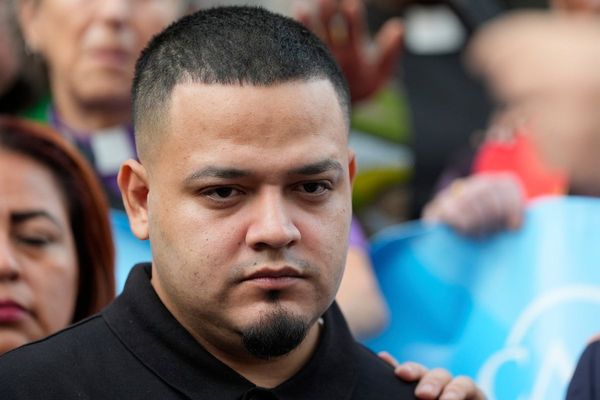
Natasha Ugle, whose husband, Wayne Ugle, died in Perth’s Hakea Prison in November 2023, said the rate of deaths was “terrible” and felt like “a weekly thing now”.
“I’m on the Hakea Prison Facebook page and people are messaging me and they’re saying, ‘another death in custody, another death in custody’, it’s just too much sometimes,” she said.
“The first couple of months after Wayne passed away and there were still more deaths in custody, I just couldn’t handle it any more. I was just too emotional because you know, nothing has changed. We go and we do all these rallies, we do all these marches, we stand up there, we speak for our people, we try and get change and ask for change but nothing happens.”
Natasha and her husband had been married for more than 25 years, and had three biological children and six foster children. The coroner is yet to hold an inquest into his death.
The CEO of the Victorian Aboriginal Legal Service, Nerita Waight, said many of the deaths were preventable, and that “racist policing practices and harmful systems built on oppression” continued to fail First Nations families and communities.
“It is an extremely painful truth that right now we are experiencing the highest rate of Aboriginal deaths in custody in over four decades,” Waight said. “The reality is that police and prison custody is not a safe place for Aboriginal people. This is what the royal commission into Aboriginal Deaths in Custody found in 1991.”
Megan Krakouer, a Menang Noongar woman and social justice advocate, said the high number of deaths were a “predictable outcome of governments failing to provide proper support, oversight, and culturally informed services for First Nations people”.
The 113 deaths in custody recorded in 2024-2025 included 22 deaths in police custody, 90 in prisons – the highest number of deaths recorded in prisons since the first year of the national monitoring program in 1980 – and one death in a youth detention facility. A further seven deaths were classified as “borderline”, meaning they may be added later if a coroner rules that they should be considered a death in custody.
Indigenous people accounted for 29% of all deaths in prison custody last year, the highest proportion since 2002-2023, the report said. It’s the third year in a row that the proportion of Indigenous deaths in prison custody has exceeded the 40-year average of 19%.
Of the 26 Indigenous people who died in prison custody, 58% or 15 people were sentenced and the remaining 11 were on remand. For the deaths were the manner of death was known, 53% were due to self-harm – the highest number of deaths due to self-inflicted injuries among Indigenous prisoners since 1980. Proportions of self-harm were even higher for those on remand, with 75% of deaths with a known cause attributed to hanging.
Removing hanging points from cells was a recommendation of the royal commission. In June, the federal attorney general, Michelle Rowland, said the high number of deaths of people in prison in cells with known hanging points was “unacceptable”.
Natasha Ugle said it felt like the words of Indigenous families were falling on deaf ears.
“No one listens and no one cares,” she said. “Something really needs to be changed because we are still getting deaths, after deaths, after deaths.”
Indigenous Australians can call 13YARN on 13 92 76 for information and crisis support; or call Lifeline on 13 11 14, Mensline on 1300 789 978 or Beyond Blue on 1300 22 4636