Get all your news in one place.
100's of premium titles.
One app.
Start reading
The Independent UK
The Independent UK
Claudia Savage,Pol Allingham and Josh Payne

Orange Order march at Drumcree parade goes ahead after ‘unprecedented’ late-night court hearing

Large crowds gathered for the march - (PA)

A controversial Orange Order march has departed Drumcree following a late-night legal clearance that was greeted with cheers.

The ruling by the Parades Commission authorizing the parade along Garvaghy Road in Portadown was upheld during an "unprecedented" late-night High Court session in Belfast, concluding only a few hours before the march began.
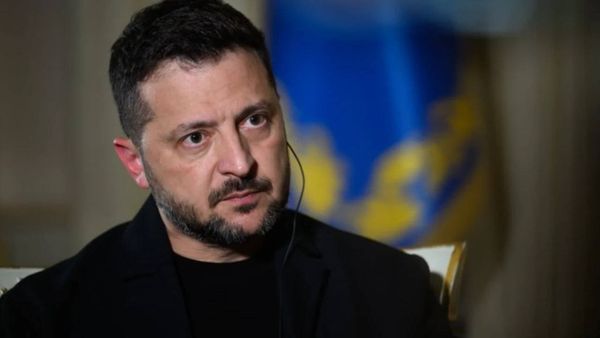
Large groups of protesters, many wearing balaclavas, gathered along the road on Sunday morning—a location renowned as a major Troubles flashpoint in the 1990s.

A substantial display of fireworks was set off nearby roughly five minutes ahead of its scheduled 8am start, while a loudspeaker announcement warned demonstrators that they faced potential arrest for taking part in an unnoticed procession.

Loud cheers broke out after crowd members were informed that the Orange Order had departed Drumcree, followed shortly by chants calling to "Bring Stormont down".

Speaking from the area on Sunday morning, Mary Lou McDonald, the president of Sinn Féin, insisted that the residents of Garvaghy Road would "not be drawn back to the past".

The march was only given the green light in the early hours of Sunday morning (PA)

She said: "We have spent all night here, all night talking to people, listening to people, seeking to reassure people that actually this can be resolved, and it must be.

"So here is what needs to happen now – the Secretary of State needs to intervene. The chief constable of the PSNI needs to intervene and put a stop to this.

"This is madness. This, in fact, is primitive treatment of any community in the year 2026. It is intolerable, and it will not be tolerated.

"The mood here has been peaceful. It has been united and orderly. This is a dignified and united community, and they are absolutely determined that they and we will not be drawn back into the past. That is the message from Garvaghy Road today."

Approval for the procession was finally confirmed during a court hearing that wrapped up at 2.15am on Sunday.

The time-restricted sitting, which commenced at 12.20am on Sunday, was heard before Justice Michael Humphreys.

He noted the "unusual if not unprecedented circumstances as it is now 1.45am, with a parade scheduled to begin in just over six hours’ time".

Delivering his decision, Mr Justice Humphreys cited established case law that as a public body the courts must respect the commission’s judgment and "their decisions will not be lightly interfered with".

He said: "The picture painted here is of a public body which took evidence from the relevant sources, weighed up the key issues which were in play and arrived at a reasoned decision.

"The jurisdiction to impugn (a) public body’s decision on that basis is necessarily limited to cases where no reasonable decision could arrive at that outcome and in my view, in this case that threshold has not been met."

Protesters blocked the Garvaghy Road ahead of the parade (Peter Morrison/PA) (PA Wire)

He added: "This court cannot substitute its own view or anyone else’s view for that of the commission."

Lady Chief Justice Siobhan Keegan, Northern Ireland’s most senior judge, described the situation as "unprecedented".

Justices Keegan and Humphreys joined Lady Justice Denise McBride in the Court of Appeal late on Saturday night to uphold an appeal brought by Portadown Orangeman Alan Hynes, allowing the march to proceed.

The stand-off at Drumcree attracted global attention during the 1990s, when nationalist residents of Garvaghy Road strongly objected to the parade passing through their neighborhood, leading to severe public disorder across multiple summers and requiring major security operations.

For more than twenty-five years, the Orange Order has submitted unsuccessful applications to complete the remaining leg of its traditional 1998 route.

On Friday, the commission reversed its long-standing restriction, drawing praise from unionist parties alongside intense criticism from nationalist and republican representatives.

By Saturday afternoon, Justice Patricia Smyth had placed an injunction on the commission’s ruling, warning that the "long-running dispute has the potential to escalate" across Northern Ireland.

Under Northern Ireland’s parade regulations, if a court simply grants an injunction against a Parades Commission decision concerning Drumcree, it allows the Portadown District to march without any of the restrictions imposed by the commission, because formal notification had been provided.

To counter this, Justice Smyth issued an order pausing the effect of the Orange Order’s parade notification—a move described by legal counsel for Garvaghy residents as "novel" and by John Larkin KC, representing Mr Hynes, as "rewriting history".

The Orange Order subsequently mounted an appeal, which succeeded before the dispute was referred back to the High Court and heard again by a different judge.

Barrister Denise Kiley KC, representing the predominantly nationalist Garvaghy Road residents, argued that significant uncertainty remained regarding the Police Service of Northern Ireland (PSNI) risk assessment submitted to the Parades Commission.

She highlighted that "nowhere" in the PSNI’s submission was there "any assessment of future risk", stating it was "entirely directed to past risk".

Emma McIlveen, junior counsel for Mr Hynes, argued that the Orange Order "has gone to great lengths to engage on the ground in the community".

Ms McIlveen further stated that the issue concerned minority rights, describing the situation as a "hecklers’ veto situation" where "those that scream the loudest get what they want".

Ms Kiley maintained that issuing an injunction "does not mean that this parade cannot proceed, it means it cannot proceed tomorrow".

A protester in an Irish flag balaclava (Getty)

She added: "The only way to preserve the position for this applicant and to preserve the supervisory position of this court was to grant interim relief and it was granted as a last resort."

Tony McGleenan KC, appearing for the Parades Commission, argued that attempting to "deem a notified parade unnotified" was completely without foundation and "entirely unprincipled".

"It’s not who threatens the most, it’s that there’s an assumption in favour of legal assembly," he stated.

"We cannot have every Parade Commission determination brought back into this court every week, that’s not how it is supposed to work."

Justice Keegan had previously observed that "there is a major problem that the decision in this case was given after 2pm on a Friday afternoon.

"This cannot happen again."

Sign up to read this article
Read news from 100's of titles, curated specifically for you.
Already a member? Sign in here
Related Stories
Top stories on inkl right now
Our Picks
Fourteen days free
Download the app
One app. One membership.
100+ trusted global sources.