
In 2026, the Indian economy entered the budget cycle at an unusual crossroads, even if that’s a cliché in economic analysis. Growth remains among the fastest in major economies, yet private investment is still uneven. Global conditions are volatile: wars in Europe and West Asia continue to disrupt energy and shipping routes, supply chains remain fragile, and major economies are recalibrating trade and industrial policy. At home, the economy shows a dual character: headline macro stability alongside persistent stress in employment quality, household consumption, and small enterprise credit.

Within this environment, the Narendra Modi government is coming to terms with a complex political economy challenge. It must preserve fiscal credibility for investors, sustain momentum in infrastructure and manufacturing, manage social expectations amid uneven income recovery, and simultaneously position India as a reliable geopolitical and economic partner in a fragmenting world.
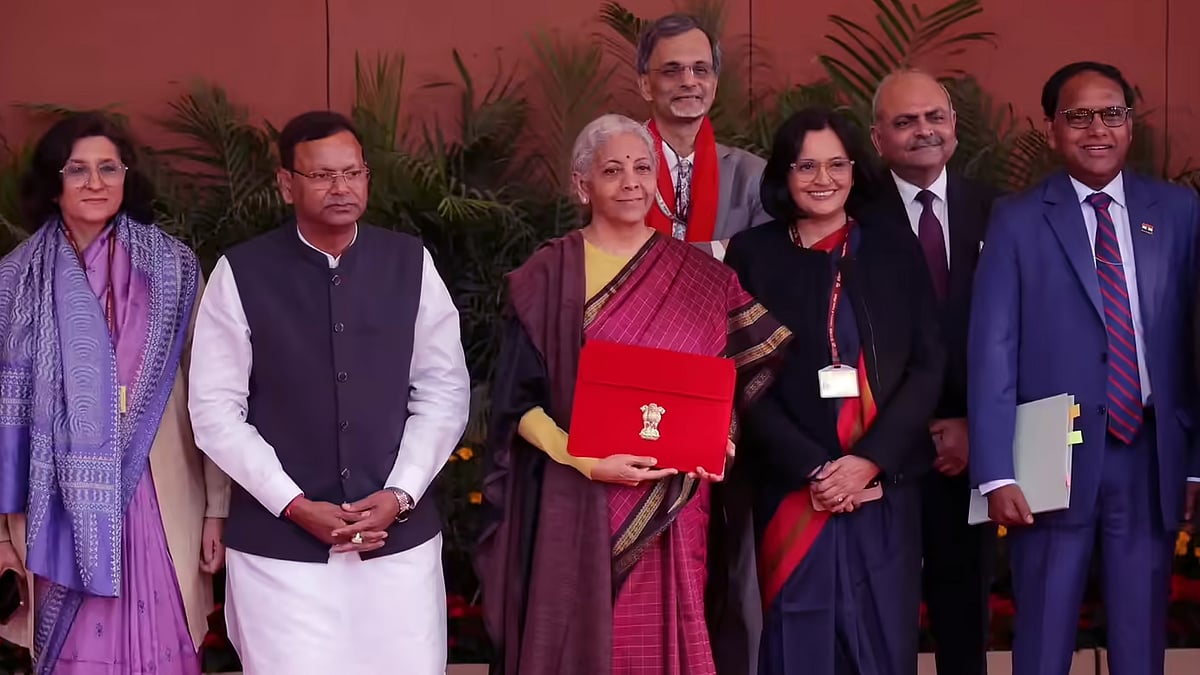
The budget presented by Nirmala Sitharaman reflects this balancing act. In many ways, , it can be understood not as a dramatic pivot, but as an effort to stabilise and deepen a governing strategy already in motion: a strategic, interventionist state partnering with capital, prioritising visible development, and maintaining tight control over macroeconomic narratives – the subtext of the government’s current financial outlook.
This is a budget shaped less by immediate electoral populism and more by medium-term positioning, both domestically and globally. The fact that it comes far from national polls might have suggested space for bolder reforms insulated from electoral pressures. Yet in India there is rarely true political downtime; some assembly election is always looming on the horizon.
At the headline level, the government projects a further reduction in the fiscal deficit to around 4.3 percent of GDP, alongside a stabilising public debt ratio. These figures matter politically as much as economically. They signal continuity in fiscal discipline at a time when many countries are loosening budgets under political pressure. This is not austerity. Rather, it is selective restraint: the government is narrowing the deficit while preserving space for large public investment. The message to markets is clear – India intends to fund growth without abandoning macro control.
The ‘investment state’
In political terms, fiscal consolidation now functions as a credibility device. It reassures foreign investors, supports sovereign ratings, and reinforces the government’s self-image as a competent economic manager. Stability itself becomes part of the political narrative. Yet this discipline is carefully bound.
One highlighted feature of the budget is the continued expansion of central capital expenditure, now exceeding Rs 12 lakh crore. Infrastructure dominates: transport networks, logistics corridors, energy systems, and industrial clusters. This reflects a deliberate development model. Rather than stimulating demand directly through consumption or transfers, the government channels resources into physical and productive assets, hoping to crowd in private investment and raise long-term productivity.
This is the logic of what can be called an “investment state”. Growth is expected to emerge from construction, manufacturing, and supply-chain integration rather than household spending.
Strategic sectors receive special attention: semiconductors, biopharma, defence manufacturing, and critical minerals. These choices are inseparable from geopolitics. As global powers reconfigure trade relationships and prioritise economic security, India is positioning itself as both a manufacturing alternative and a strategically autonomous economy. The budget’s industrial orientation is therefore not merely economic policy; it is statecraft.
A deeper philosophical question
One striking element is continuity. Production-linked incentives and sectoral missions are not expanded indiscriminately; they are refined and extended. The government is signalling predictability – a key demand of long-term investors – while doubling down on selective industrial promotion.
The budget includes references to inclusion: healthcare infrastructure, caregiver training, skilling initiatives, and targeted social support. But these are framed primarily as productivity-enhancing measures. There is no large expansion of universal welfare, no significant change to income tax slabs, and no broad consumption stimulus.
This reflects a deeper philosophical position. Social policy is increasingly treated as a means to build employable citizens rather than guarantee income security. The poor are addressed through skills and access; the middle class through stability; industry through incentives.
Redistribution is indirect, mediated through growth. Politically, this allows the government to maintain a development narrative without creating long-term fiscal liabilities. Welfare becomes conditional and instrumental, not structural. It is a model that assumes growth will translate into opportunity. Its weakness lies in periods when job creation lags behind output expansion – a risk that remains real in India’s current labour market.
Revenue measures avoid controversial changes to personal taxation. Instead, the government relies on targeted instruments: adjustments to transaction taxes, selective tariff rationalisation, and incentives for capital goods and research.
Private consumption expenditure, which accounts for about 61.4 percent of GDP, also requires different forms of stimulus. Urban and rural demand share some drivers, but their dynamics differ. Last year, urban demand lagged behind relatively healthy rural demand. Some economists argued that tax relief and reforms were introduced to spur urban consumption. This year’s budget must be seen in that context, as well as through political imperatives. Altering middle-class tax burdens carries electoral costs; influencing corporate behaviour does not. Tax policy is used less as a redistributive tool and more as a steering mechanism, nudging investment toward preferred sectors while keeping household sentiment stable. The emphasis is on shaping economic direction rather than reshaping income distribution.
What remains absent
At the level of centre–state relations, the budget retains the states’ share of divisible taxes at 41 percent, formally adhering to Finance Commission norms. But substantive power continues to concentrate at the centre through cesses, centrally sponsored schemes, and project approvals. States receive predictable transfers, yet their fiscal autonomy remains constrained. This reflects a broader governing pattern: institutional continuity combined with administrative centralisation. Development priorities increasingly flow from the centre downward, with states acting primarily as implementers.
Taken together, the budget reinforces a distinctive political economy: developmental nationalism anchored in infrastructure, strategic manufacturing, fiscal restraint, and executive control.
This is not a minimalist state. It is an activist one — but activist in service of capital formation and national capability rather than expansive social protection. Electorally, the model offers visible achievements: highways, factories, logistics hubs, semiconductor plants. These projects serve both economic and symbolic purposes, embodying a story of national ascent.
Equally revealing is what remains absent. There is no move toward rights-based welfare expansion or structural redistribution. The government appears comfortable with inequality so long as aggregate growth remains strong and opportunity narratives can be sustained. This is a future-oriented but uneven model.
An exercise in managed continuity
The strategy depends heavily on sustained growth, efficient execution, and private sector response. If global demand weakens or investment stalls, the lack of strong consumption buffers could amplify economic stress. There is also the danger of policy capture: targeted incentives tend to favour large incumbents unless competition frameworks are actively enforced. Persistent centralisation may further strain centre–state relations, particularly where political alignments diverge. These are embedded tensions within the current development framework.
This budget is best read as an exercise in managed continuity. It consolidates a vision of India as an infrastructure-led, manufacturing-oriented economy governed by a strong central state — fiscally disciplined yet interventionist, globally engaged yet strategically inward-looking.
It is a budget designed less to transform social relations than to engineer economic capacity. Whether this approach delivers broad-based prosperity or primarily entrenches capital-led growth will depend on implementation, employment outcomes, and the government’s willingness to recalibrate if infrastructure alone proves insufficient.
For now, the direction is unmistakable: the Indian state is positioning itself as architect, partner, and gatekeeper, building the future while asking citizens to trust its timeline. That balance — between a developmental and entrepreneurial state, and between interventionist ambition and welfare responsibility — will define the test ahead.
If you liked this piece, let our reporters tell you why you should subscribe to Newslaundry.
Newslaundry is a reader-supported, ad-free, independent news outlet based out of New Delhi. Support their journalism, here.