Loan growth at Thailand's large banks picked up in the first half of 2026, driven mainly by corporate lending, while borrowing from small and medium-sized enterprises (SMEs) remained weak.
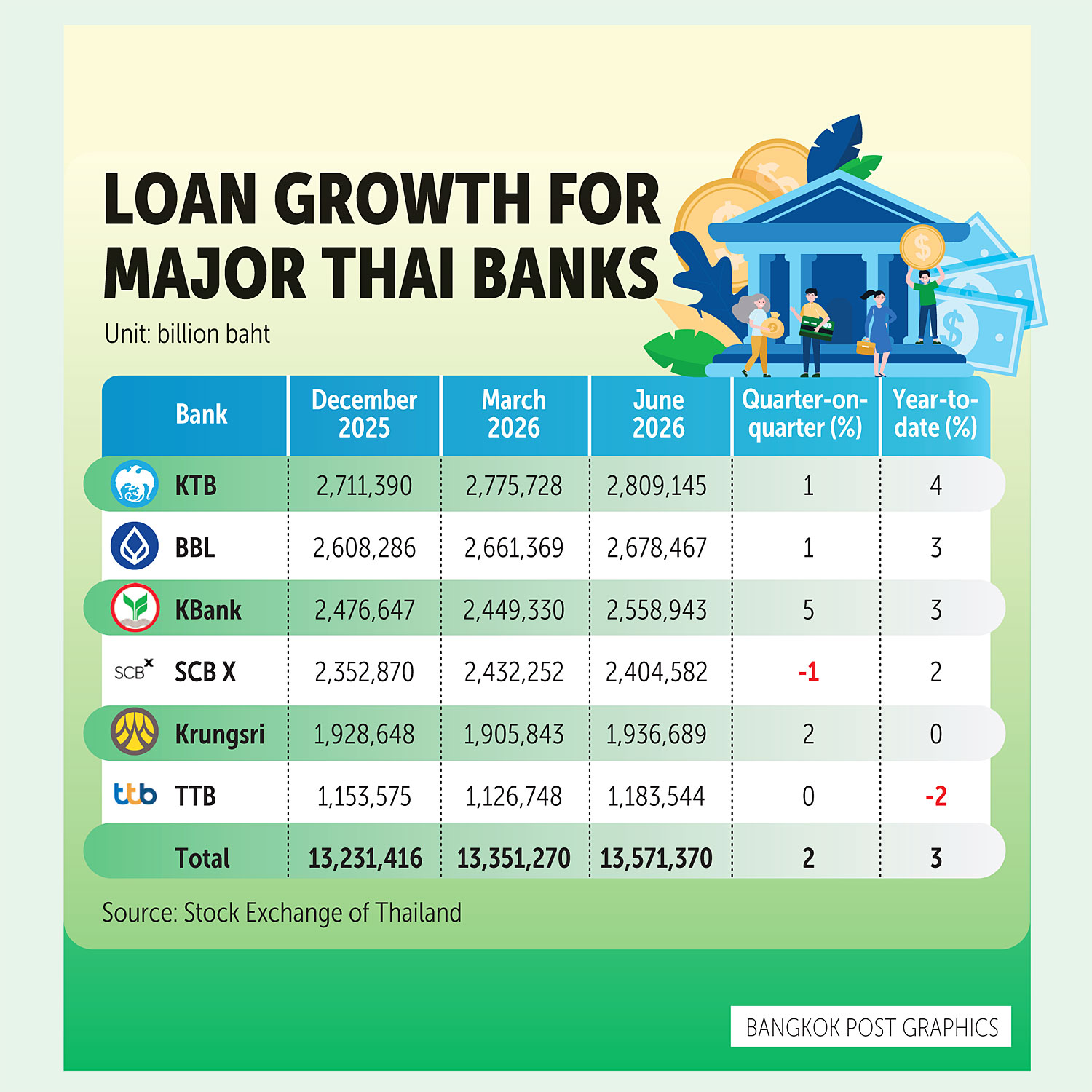
Thailand's six domestic systemically important banks (D-SIBs) reported a combined loan portfolio of 13.6 trillion baht as of June 2026, up 2.6% from the end of 2025 and 1.6% from the end of March.

The six D-SIBs are Krungthai Bank (KTB), Bangkok Bank (BBL), Kasikornbank (KBank), Siam Commercial Bank (SCB), which operates its banking business under holding company SCB X, Bank of Ayudhya (Krungsri), and TMBThanachart Bank (ttb). As of June, KTB became Thailand's largest lender by total assets, overtaking BBL.
KTB reported consolidated loans to customers of 2.81 trillion baht, up 3.6% from the end of 2025, driven mainly by lending growth in the retail, corporate and government segments, according to the bank's financial statement filed with the Stock Exchange of Thailand (SET).
Loans to the government and state enterprises rose sharply to 633 billion baht, up 12.9% in the first half from the end of last year, while SME lending edged up just 0.3% over the period.
"The bank's total loan growth resulted from cautious and flexible portfolio management in line with economic conditions, while maintaining an appropriate risk-return balance," KTB said.
BBL reported outstanding loans of 2.68 trillion baht as of June 2026, broadly unchanged from the previous quarter but up 2.7% from the end of December 2025, mainly due to growth in lending to large corporate clients and loans extended through its international network.
KBank's loans to customers totalled 2.56 trillion baht, up 4.48% in the first half of the year from the end of 2025. The increase was driven by corporate lending, reflecting the bank's strategy of pursuing quality loan growth through prudent credit underwriting and appropriate risk-adjusted returns.
SCB X reported loan growth of 2.2% in the first half, supported mainly by selective expansion of corporate lending at SCB. Corporate loans rose 9.3%, while several retail segments contracted, including SME loans down 9.8%, while auto loans fell 19.6% and unsecured loans declined 83.1%.
"In this operating environment, the group remains focused on maintaining portfolio quality and optimising risk-adjusted returns, prioritising high-quality loan origination to support sustainable growth and long-term asset quality resilience," noted SCB X.
Krungsri reported modest loan growth of 0.4% in the first half under its prudent lending strategy.
Growth was led by the corporate banking portfolio and the Asean customer segment, which expanded 6.0% and 5.1%, respectively. Meanwhile, SME lending declined 4.2%.
Ttb reported a 2.0% contraction in total loans during the first half, with SME lending falling 4.0%.
Amid continued economic uncertainty, the bank said it remained disciplined in pursuing quality loan growth by reshaping its portfolio towards targeted higher-yield retail segments, while strengthening portfolio quality and improving risk-adjusted returns.
Kasikorn Research Center (K-Research) upgraded its 2026 banking sector loan growth forecast to 0.5% from a contraction of 0.7% following robust loan growth in the first half.
Kanjana Chockpisansin, head of banking and financial sector research at the think tank, said the improvement is expected to be driven primarily by corporate lending, which K-Research forecasts will grow 5.0% this year.
However, SME and retail lending are projected to remain under pressure, declining 4.5% and 1.5%, respectively.